Automatic Colour Cubes
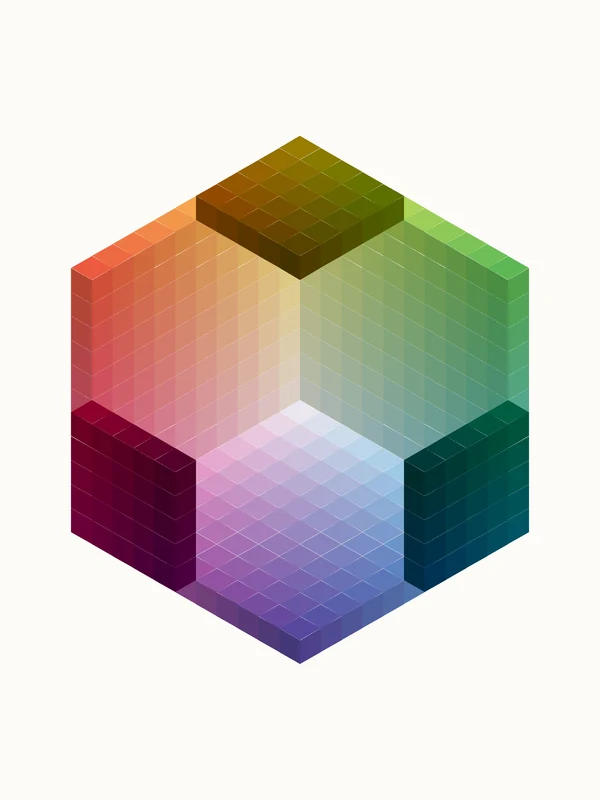
Once a day, a program makes one of 122 colour cubes by applying a rule by Sol LeWitt. The series ends with the 122nd.
About the work
Automatic Colour Cubes is a series of 122 works made automatically on the gallery’s server, one a day. It ends when the last one has been made.
The series brings together two cubes from the 1970s. In Lund, the mathematician Mikael Jern wrote software for the university’s colour plotter that drew a cube of 17 × 17 × 17 small cubes in three inks, cyan, magenta and yellow, each increasing along one edge in 17 steps. The artists Beck & Jung made such cubes into prints. In New York in 1974, Sol LeWitt made Incomplete Open Cubes: every way in which the twelve edges of a cube can be incomplete, as long as the remaining edges are connected and form a three-dimensional structure. He found 122.
Each work takes one of LeWitt’s 122 variants and applies it to the colour cube. The cube is reduced to its outer shell and opened along the edges that the variant leaves out, so that the inside of the colour range becomes visible. The innermost corner, where no ink is used, is the paper itself. The works follow LeWitt’s order, from three edges to eleven: the series begins with the most open cube and ends with the most closed.
Nothing is chosen by hand. The program computes the 122 variants itself and arrives at LeWitt’s number. It turns each cube so that as many of its openings as possible face the viewer, and it chooses three close-ups. Each work exists as a print file in the three inks plus black, for prints up to 100 × 100 cm. The images on this page are translations for the screen.
Read more: The colour cubes and Sol LeWitt, JAEV Editorial.