The colour cubes
Beck & Jung, Mikael Jern and the Lund colour plotter

In the 1970s a programmer at Lund University made an image of a cube in all the colours a new printer could produce. A few years later the same kind of cube hung, according to the programmer, on SAS aircraft and in IKEA, presented as the work of the artist duo Beck & Jung. This text does not try to decide who the colour cubes belong to. It tries to set out, as precisely as the published sources allow, who did what, and why the answer to "who made the work?" is not obvious.
The image alphabet
Beck & Jung were the Lund artist Holger Bäckström (1939–1997) and the engineer Bo Ljungberg (1939–2007). They met in Lund and began to use computers to make art in 1966, a year after computer-generated drawings began to appear in public exhibitions in Germany and the United States, according to Stockholms läns museum; Kulturportal Lund dates their collaboration from 1965.1, 2 Their first method was an "image alphabet" of six basic forms, which was programmed into a computer in collaboration with IBM, so that the forms could be combined into new images without end. Their first joint exhibition was held at Lunds konsthall in 1967.1
The name appears in two forms. Stockholms läns museum writes Beck & Ljung; Kulturportal Lund, Region Blekinge and most other sources write Beck & Jung, and Jern uses both forms in the same interview. This text uses Beck & Jung except in quotations.
A printer that was meant to be a copier
The cubes came from somewhere else. Mikael Jern, who studied mathematics in Lund, worked at the university's computer centre writing software for raster graphics: images built from rows of dots, first on line printers and pen plotters.3 At the Department of Electrical Measurements at the Lund Institute of Technology, professor Hellmuth Hertz was working on ink-jet technology: nozzles that fire a very fast stream of ink droplets, which can be switched on and off electronically to place dots on paper.
According to Jern, Hertz was trying to build a copying machine, not a printer for computers. Jern's idea was that instead of copying an image, the computer could create one. Hertz built the plotter; Jern wrote the software. Jern describes the combination as a matter of chance.3 The plotter printed three colours, cyan, yellow and magenta, on top of each other at 150 dots per inch. To make lighter and darker tones, Jern used a matrix of four by four dots: the more of the sixteen dots are printed, the stronger the colour.3

The dating is uncertain. Jern dates the cube image to 1972. In the same interview he places the building of the colour plotter in 1973–74, and the interview's summary gives his collaboration with Hertz as 1970–1976.3 The surviving accounts do not establish a precise date.
The cubes
With three colours, the natural way to show every combination is a cube, with one colour increasing along each edge. Jern then wrote software that could cut holes in the cube. His point was technical: in the three-dimensional computer graphics of the time, hiding the surfaces that should not be visible was one of the hardest problems, and he wanted to show that raster graphics could solve it more easily than drawings made of lines.3
Of the cube image, Jern says: "This image I created myself, not the artists Beck and Jung, who were later allowed to use my technique. It was my image."3, 4
Following the method
The published accounts describe the method in enough detail to follow it. Anna Orrghen's report for Tekniska museet states that Jern's program could draw a colour cube made of 17 × 17 × 17 smaller cubes.5 Seventeen steps along each edge is exactly what a 4 × 4 dot matrix allows: from no dots to all sixteen. Jern's interview adds the rest: three inks printed on top of each other at 150 dots per inch, the hidden surfaces solved by drawing the far cubes first, and holes and "cake slices" cut out of the cube.3
JAEV wrote a short program that follows these instructions. The image at the top of this page is one result. Where the sources say nothing, such as which corner faces the viewer, which part of the cube is cut away, the colours of the inks and the paper, the thin white lines between the cubes, or the order in which the dots of the matrix are filled, the choices are JAEV's. The result is therefore not a copy of the colour cubes but another realisation of the same method, made about fifty years later by someone who has only read about it.



From computer image to artwork
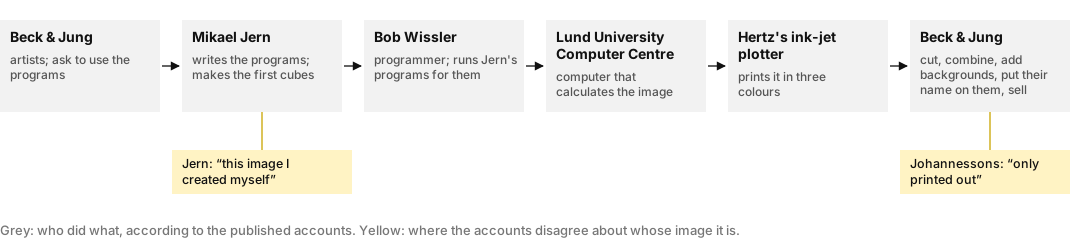
According to Jern, Beck & Jung had read about his cubes and asked whether they could use the programs that made them. He made the first ones for them. After that a programmer in Lund, Bob Wissler, ran Jern's programs for them. Beck & Jung found new ways of cutting the cubes, added backgrounds and combined them with other colours, and the cubes became the works they were best known for.3 Region Blekinge, which holds their work, names the series Chromo Cube.6 Jern's own company, UNIRAS, used the cube as its logo.3
Three accounts
The sources give at least three answers to the question of whose work the cubes are.
Mikael Jern claims the image and, in the same interview, describes the collaboration warmly. "So it was a very good collaboration," he says, and adds that he could not have sold the cubes himself: "since it said Beck & Ljung on them, and it was they who could get this out as art, I could not have done that."3, 4
Sture and Charlotte Johannesson, who also worked with computers in Skåne, remembered it differently in their interview. Sture Johannesson said that Jern was "now very angry at these Beck & Jung, who just printed out", and Charlotte Johannesson added that Jern "did not mean it as art". In Sture Johannesson's words, the artists "just took the printouts of Mikael Jern's UNIRAS logo and made prints from it".7 He contrasted this with his own work with the IBM engineer Sten Kallin, where, he said, they wrote their own program for what they intended to do.7
Beck & Jung themselves worked in a way that made the question less central. Kulturportal Lund describes Beck & Jung as their "artist and company name".2 The art writer Elisabeth Fagerstedt goes further: in her description, the name worked as a brand, modelled on the collective working methods of advertising agencies, architects' offices and graphic design firms, and the duo set out to reduce the individual in favour of what could be shared.8
These accounts do not have to cancel each other out. Jern's statements describe the image and the technique. The Johannessons' describe a judgement of what counts as artistic work. Beck & Jung's working method deliberately shifted attention away from the individual artist. What the sources do show is a chain of people and machines, each contributing something different: the artists who asked, the programmer who wrote the software, the programmer who ran it, the computer centre, the plotter and its builder, and the artists who decided which images became works and put their name on them.
The same question runs through JAEV's texts on Sol LeWitt and Casey Reas: where does the work come from when one person writes the system and another makes the result? In Lund in the 1970s it was not a theory. It was a cube on a wall, and people who remembered it differently.
Sources
- “Beck & Ljung”. Stockholms läns museum
- “Bäckström, Holger (1939–1997), bildkonstnär, skulptör, grafiker, datakonstnär”. Kulturportal Lund
“Från 1965 samarbetade Holger Bäckström med barndomsvännen Bo Ljungberg under artist- och firmanamnet Beck & Jung.” - Mikael Jern, interviewed by Anna Orrghen, 4 October 2007. Från matematikmaskin till IT, Tekniska museet, Stockholm
In Swedish. Quotations are translated by JAEV; the original wording is given in the notes below. - Anna Orrghen, Från matematikmaskin till IT. Fokusgrupp: Media. Slutrapport. Tekniska museet, Stockholm
“Programmet kunde rita upp en färgkub som bestod av 17x17x17 mindre kuber.” - Elisabeth Fagerstedt, “Beck & Jung: datakonstens pionjärer”, Elisabeth Fagerstedt konsttexter, 2012
- Original wording of the quotations from Mikael Jern (source 3)
“Den här bilden, den har jag själv skapat, inte konstnärerna Beck och Jung som senare fick använda min teknik, det var min bild.” — “Så det var ett väldigt fint samarbete.” — “i och med att det stod Beck & Ljung på dem och att det var ju de som kunde få ut det här som konst, det kunde ju inte jag göra.” - “Beck och Jung”. Region Blekinge, Konst i Blekinge
- Sture Johannesson and Ann-Charlotte Johannesson, interviewed by Anna Orrghen, 2 October 2007. Från matematikmaskin till IT, Tekniska museet, Stockholm
In Swedish. Quotations are translated by JAEV. Original wording: “Och han är ju nu väldigt förbannad på de här Beck & Jung som bara printade ut.” — “Han menade ju inte att det var konst.” — “De hämtade ju bara ut utskrifterna från Mikael Jerns Uniras logo och gjorde grafik på det.”