Sol LeWitt
Instructions as a system
Sol LeWitt (1928–2007) was an American artist.1 Many of his works are wall drawings, drawn on the wall by other people who follow his instructions.2 They exist as instructions, sometimes only a sentence long, which other people carry out on a wall. This text takes that practice as an argument: that a work can be defined as a system of instructions, and that its execution can be handed to someone else. The question is what then happens to authorship, to variation and to the drawing itself.
The idea as a machine
LeWitt set out the principle himself. In "Paragraphs on Conceptual Art", published in Artforum in 1967, he wrote that in this kind of art "all of the planning and decisions are made beforehand and the execution is a perfunctory affair. The idea becomes a machine that makes the art."3 Two years later, in "Sentences on Conceptual Art", he went further: "Once the idea of the piece is established in the artist's mind and the final form is decided, the process is carried out blindly."4
He also gave a practical reason. "To work with a plan that is pre-set is one way of avoiding subjectivity. It also obviates the necessity of designing each work in turn."3 A plan, once written, can produce many works.
These statements are strong, and LeWitt's own practice was less absolute than they sound. But they describe the logic that makes the wall drawings possible: the decisions are taken in the instruction, and the instruction is what is kept.
One instruction, many drawings
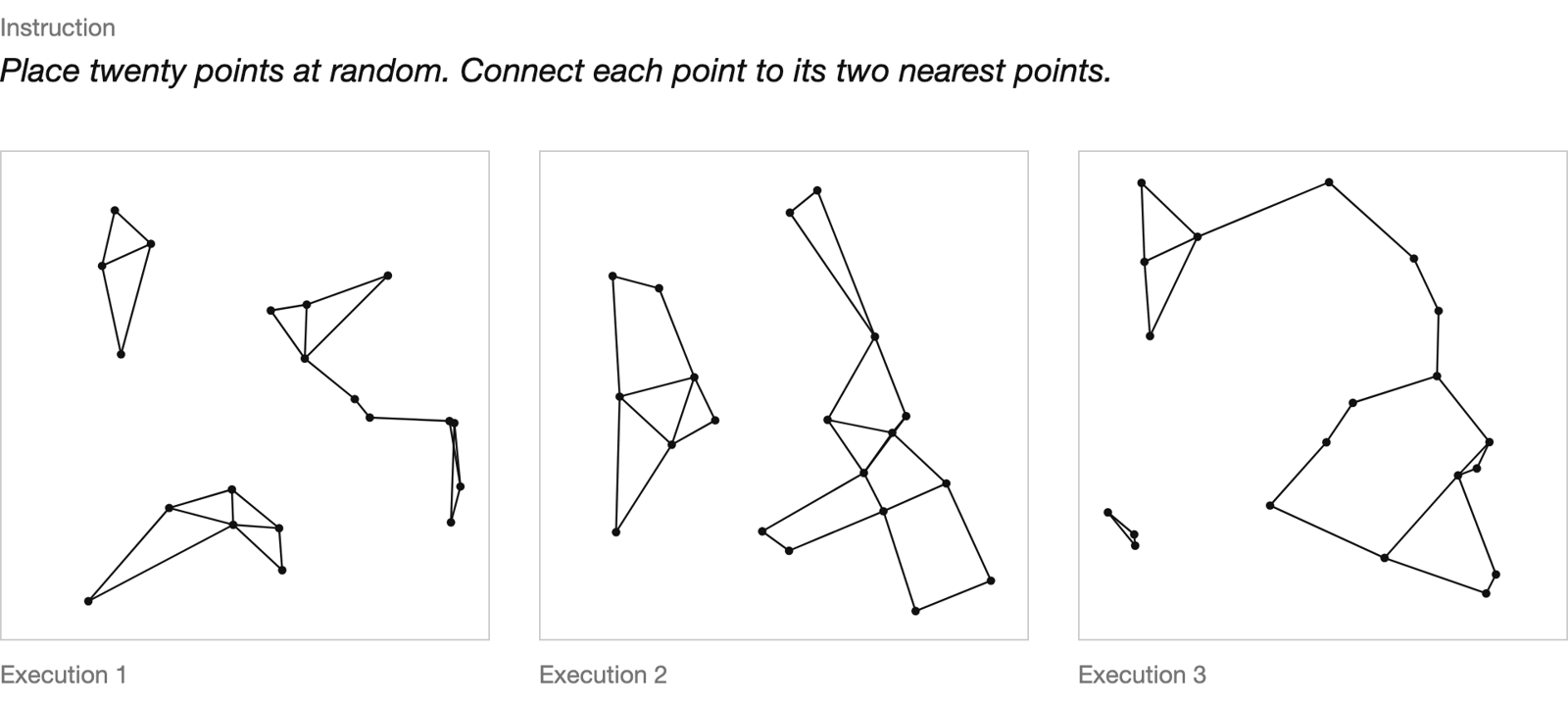
Wall Drawing #118 from 1971 is a clear example. Its title, as the Art Institute of Chicago records it, summarises the instruction: 50 randomly placed points connected by straight lines.1 The instruction fixes what will be on the wall: fifty points and straight lines connecting them. It does not say where the points go. That decision is left to the person who draws it, on that wall, on that day. Every time the work is installed, it is the same work and a different drawing.
LeWitt knew that the instruction would not pass through unchanged. In his text "Doing Wall Drawings" (1971) he wrote that "each person draws a line differently and each person understands words differently", and that "the draftsman perceives the artist's plan, then reorders it to his own experience and understanding."5, 2 The variation was not a flaw in the system. It was part of it.
The diagram at the top of this page makes the same point with an invented instruction. All three panels follow the same words. Only the person following them, here simulated by a different random choice of points, has changed. The drawings were made by a short program on the gallery's server, with a different random seed for each.
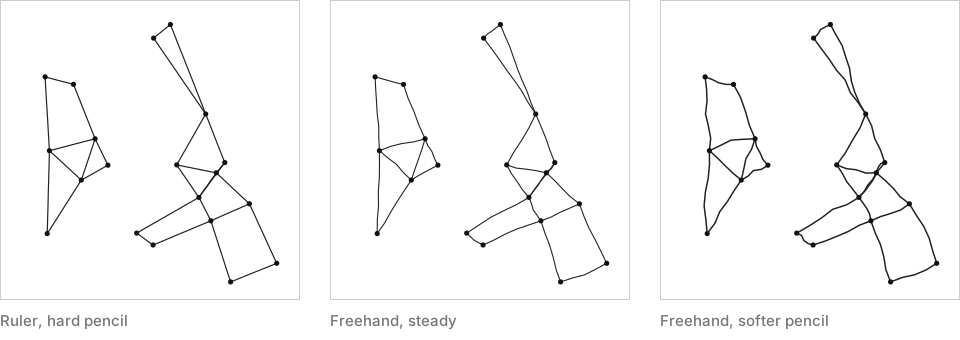
There is a second layer of variation: the hand. Even with exactly the same points, a line drawn with a ruler and a hard pencil is not the line drawn freehand with a softer one.
Who makes the work?
LeWitt installed his first wall drawing himself. From 1969 he began to ask friends, curators and collectors to install the drawings according to his instructions, and later employed a team of specialist technicians.2 The Walker Art Center describes the group of assistants he trusted to carry out his instructions.6
The wall drawings also changed what it means to own a work. The Cleveland Museum of Art explains that LeWitt "developed a system of ownership by which the buyer of the drawing receives a certificate and a rendering with directions for any other drafter to use."7 What the owner holds is not the pencil on the wall but the right, and the instructions, to make it. The drawing on a particular wall is one realisation of the work, made by particular people.
Authorship is divided from execution accordingly. LeWitt is the author of the work: he decided what it is and how it is to be made. The drafters realise it: they make the decisions the instruction leaves open, and their hands are visible in the result. Neither role can be reduced to the other.
LeWitt applied the same distance to himself. He turned down awards, rarely gave interviews and was notoriously camera-shy. In Autobiography (1980) he photographed every part of his loft in Manhattan in more than a thousand pictures, and appears himself, small and out of focus, in only one of them.8 For an artist whose work is the instruction, that is consistent: what matters is the system, not the person or the hand.
Working through every possibility
Instructions can also be used to exhaust a set of possibilities rather than to leave choices open. Variations of Incomplete Open Cubes (1974) "proposes all of the 122 variations in which a cube can be incomplete".9 Here the system does not invite interpretation. It defines a complete series, and each object is identified by its place in it.
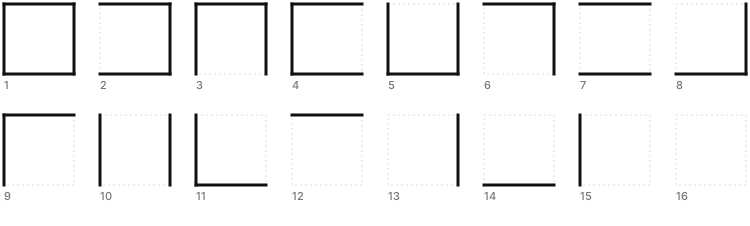
The two approaches belong together. In one, the rule is fixed and the execution varies. In the other, the rule produces every variation itself. Both make the system, rather than a single composition, the centre of the work.
From instruction to code
An instruction that can be followed by anyone is close to a program. The artist Casey Reas made the connection explicit: his project {Software} Structures, presented by the Whitney Museum of American Art, began by implementing three of LeWitt's wall drawings in software, to ask whether the history of conceptual art is relevant to the idea of software as art.10
Place twenty points at random. Connect each point to its two nearest points.
points = random_points(20)
for p in points:
    for q in nearest(p, points, 2):
line(p, q)What changes when the instruction becomes code is the executor. A person reads the words and interprets them; software executes formalised instructions, with variation supplied by whatever choices, inputs or chance operations the program allows. LeWitt's wall drawings show what an instruction can hold before that step: an idea precise enough to be handed over, and open enough to be different every time.
Sources
- “Wall Drawing #118: 50 randomly placed points connected by straight lines”, Sol LeWitt, 1971. Art Institute of Chicago
- Anna Lovatt, “Ideas in Transmission: LeWitt’s Wall Drawings and the Question of Medium”, Tate Papers no. 14, Tate, London, 2010
- Sol LeWitt, “Paragraphs on Conceptual Art”, Artforum, June 1967
- Sol LeWitt, “Sentences on Conceptual Art”, 1969
- Sol LeWitt, “Doing Wall Drawings”, 1971. Reprinted in Gary Garrels (ed.), Sol LeWitt: A Retrospective, San Francisco 2000, p. 376
Quoted from Anna Lovatt’s article in Tate Papers (source 2), notes 44 and 46. - “Peace or misery: The making of a Sol LeWitt wall drawing”. Walker Art Center, Minneapolis
- “Wall Drawing #4”, Sol LeWitt. Cleveland Museum of Art
- “Sol LeWitt, 1928–2007”. Gothamist, New York, 9 April 2007
- “Sol LeWitt: Cubic Forms”. Paula Cooper Gallery, New York
- “Casey Reas: {Software} Structures”. Whitney Museum of American Art, New York