Senster (Edward Ihnatowicz, 1970)
JAEV Notes · October 2026 · 2 min read
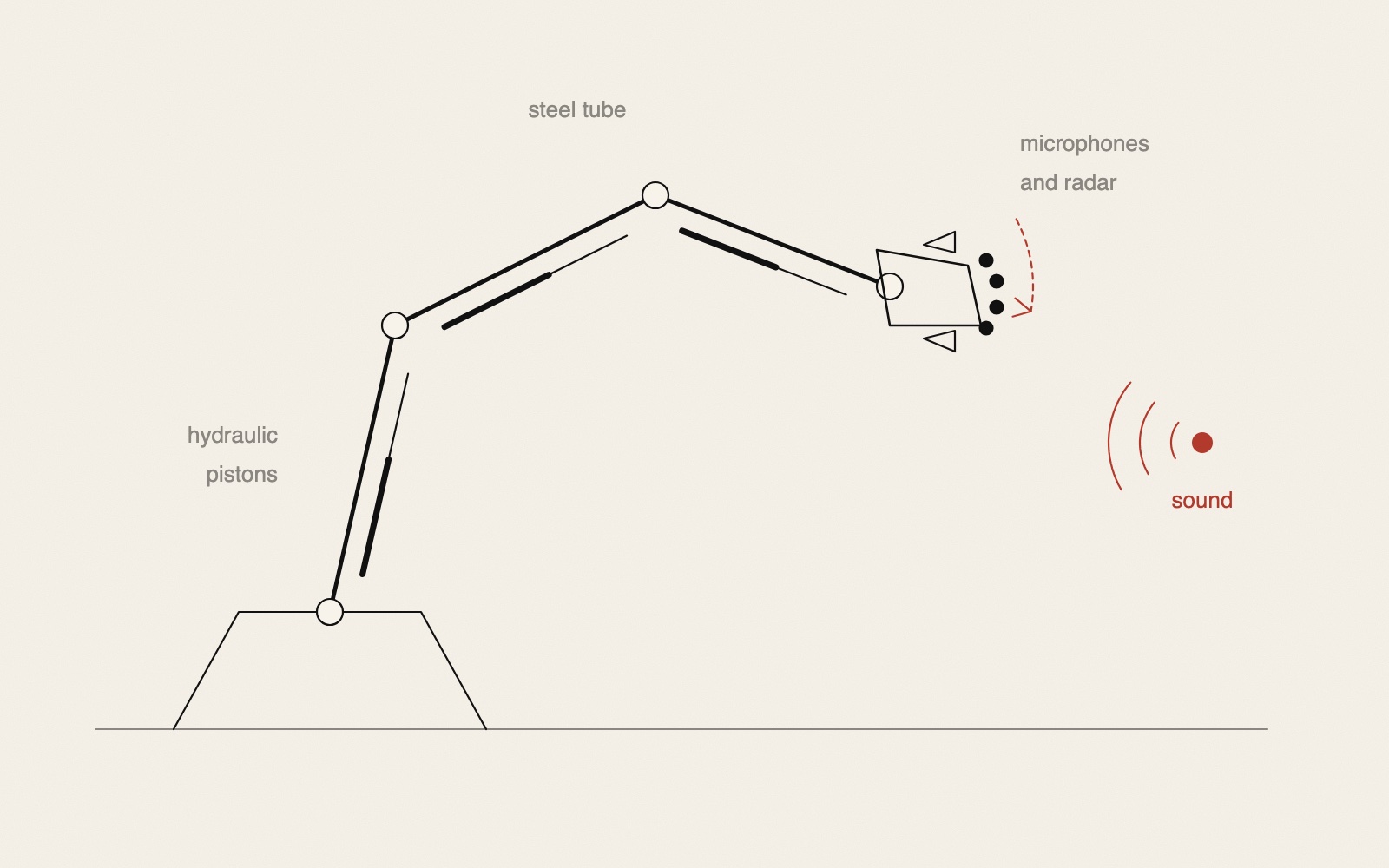
The Senster was a hydraulic sculpture by Edward Ihnatowicz, over four metres long, that stood in the Evoluon in Eindhoven, the permanent showplace of the electronics company Philips, from 1970 to 1974. It turned toward the sounds people made and shied away from sudden movements and loud noises. It was controlled by a computer; the account on senster.com calls it, "as far as I know", the first robotic sculpture that was.1
The artist
Ihnatowicz was born in Poland in 1926, came to Britain in 1943 and studied at the Ruskin School of Art in Oxford. He made furniture and sculpture before he turned to moving machines.2 His first, SAM (Sound Activated Mobile), was shown in Cybernetic Serendipity in London in 1968: a column of cast aluminium vertebrae with four microphones on top, which leaned and twisted toward a quiet, steady sound.3 Philips then commissioned something much larger.1
The machine
The Senster was welded from steel tubing by a technician at University College London, working from Ihnatowicz's rough sketches; there were no proper engineering drawings. It went to Eindhoven in July 1970.1, 4 Hydraulic pistons moved its joints.
It had two kinds of senses, both on its head:1, 5
- Microphones, which picked out the direction of the predominant sound. The head turned toward it first; if the sound went on, the rest of the body followed.
- Two Doppler radar units, which detected people moving toward it or away from it.
A Philips P9201 computer, with 8K of core memory and a punched paper tape unit, read the sensors and drove the pistons. Ihnatowicz wrote its program himself.6
Behaviour, not looks
The rules were fairly simple: go toward a sound, retreat from a shock. The hall's echoes and the unpredictable public made the movements look far more sophisticated than they were, and the account on senster.com concludes that the effect on visitors came from that behaviour, not from the Senster's appearance.1 Art in which simple rules, not a fixed form, produce what is seen is the subject of JAEV's Generative Art.
Afterwards
The Senster was dismantled in 1974. Its electronics were given away; the steel structure went to an engineering company, which set it up outdoors beside its building.7 In April 2017 the AGH University of Krakow bought it, and from 4 October 2018 the restored sculpture could be seen in Kraków. It now responds only to sound.8 Ihnatowicz worked as a research assistant in mechanical engineering at University College London from 1971 and died in 1988.2
Sources
- “Cybernetic sculpture – The Senster”. Alex Zivanovic, senster.com
Commissioned by Philips for the Evoluon in Eindhoven; responded to voices and to movements, detected by radar; “(as far as I know) the first robotic sculpture to be controlled by a computer”; unveiled 1970, dismantled 1974; over 15 feet (4 m) long; welded steel tubing; “Sudden movements or loud noises would make it shy away”; the hall's acoustics and the public made its movements seem more sophisticated than they were. - “Edward Ihnatowicz biography”. senster.com
Born 1926 in Poland; war refugee in Romania and Algiers 1939–43; Britain 1943; Ruskin School of Art, Oxford, 1945–49; SAM 1968; the Senster 1969–71; research assistant at University College London 1971–86; died October 1988. - “SAM – Sound Activated Mobile”. senster.com
Shown at Cybernetic Serendipity, ICA, 1968; four microphones in front of a flower-like reflector; hydraulic pistons in cast aluminium vertebrae; sensitive to quiet but sustained noise rather than shrieks. - “Technical Info about the Senster: The Mechanical Structure”. senster.com
Built by a technician called Stan in the Mechanical Engineering Department of University College London from Ihnatowicz's rough sketches; moved to Eindhoven in July 1970. - “Technical Info about the Senster: The Doppler Radar System”. senster.com
Two Hewlett-Packard Doppler units near the head, 10 GHz; mainly for people moving towards or away from it; range about 8 metres. - “Technical Info about the Senster: The Computer Hardware and Software”. senster.com
A Philips P9201 with 8K of core memory, a punched paper tape unit and a teletype; the program written by Ihnatowicz himself; refinements by Peter Lundahl, the Evoluon's system administrator, after Ihnatowicz left at the end of 1970. - “The final fate of the Senster”. senster.com
Dismantled in 1974; the electronics given away; the steel structure given to an engineering company, which set it up outdoors next to its building. - “Re:SENSTER”. AGH University of Krakow
Bought by AGH in April 2017 from the Delmeco Group in the Netherlands; restored and on view from 4 October 2018; about 5 m long, steel; in Polish, moved by eight synchronised actuators (“ośmiu siłowników”); now responds to sound only, with a modern programmable logic controller instead of the P9201; the third media artwork supported by Philips, after Schöffer's CYSP 1 (1956) and the Poème électronique (1958).
- Published
- JAEV Notes, October 2026.
- Use
- Text CC BY 4.0. Free to use and quote with credit to JAEV and a link to this page. Images and quotations by others keep their own terms.
All texts as one file: archive.json - Cite
- JAEV Notes, “Senster (Edward Ihnatowicz, 1970)”, jaev.gallery/notes/edward-ihnatowicz-senster/, 2026.
- Corrections
- Additions and corrections are welcome: info@jaev.gallery
- Share
A link from your own site, course page or reading list helps others find it.- Follow
- New notes by RSS · Instagram · Bluesky
JAEV is a daemon taking shape: machines, weights, room, brain.