Punched paper tape
JAEV Notes · October 2026 · 2 min read
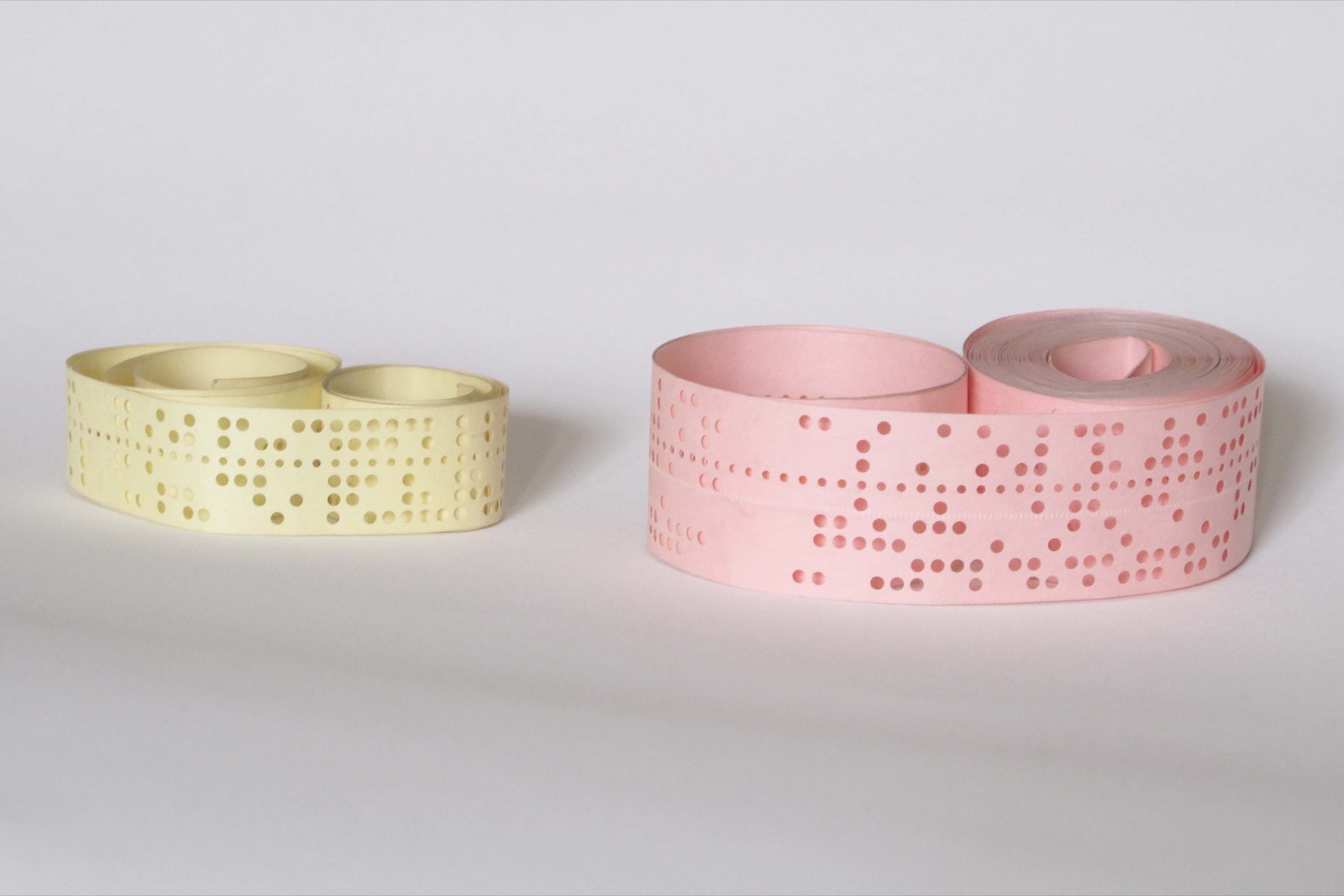
Punched paper tape is a long strip of paper in which a machine punches rows of holes. Each row across the tape holds one character, coded by which positions in the row are punched. Tape carried programs and data between computers, and it carried some of the first plotter drawings shown as art to the plotter: the drawing existed as holes in paper before a pen drew it.1, 2, 3
How the tape is laid out
The European standard ECMA-10 of 1965 describes the tape used to exchange data between computers. It is 25.4 mm wide, one inch, and has eight tracks for data along its length. Between the third and the fourth track runs a line of smaller feed holes, from which the position of each row is measured. The rows are 2.54 mm apart, ten to the inch.1 The standard also allows narrower tape, 17.46 mm, because so much five-track equipment was still in use.1 The photograph above shows both kinds side by side.
The drawing on tape
The Zuse Graphomat Z64 plotter was not controlled directly by a computer. It read punched tape, first five-track and later eight-track: the computer punched the drawing as tape, and the tape was carried to the plotter.2 The Victoria and Albert Museum describes the Graphomat that Siemens bought on the initiative of Georg Nees as "a drawing machine operated by computer-generated punched tape".3
Frieder Nake wrote the software for the Graphomat at the Technische Hochschule Stuttgart before the machine arrived. "So I wrote programs blindly on punched tape," he recalled, and took them to Zuse's headquarters in Bad Hersfeld. The plotter started, then stopped after five minutes, again and again. Nake knew the code well enough to pick up the confetti of punched-out paper from the floor and glue it into chosen holes in his tape. The drawing then ran.4
Programs on tape
Tape also carried the programs themselves. The IBM programmer Sten Kallin (see the note on Astrid Sampe and Computer Art in Sweden) recalled an IBM 1620 he could use for whole nights, on which the FORTRAN compiler "fanns inte i minnet utan den fanns på en hålremsa": it was not in the memory but on a paper tape. He punched his program on tape. The computer read the first part of the compiler from tape and punched a new tape, then read the second part and his own tape, and punched out the finished program.5 In 1972 Tektronix sold the source code of its graphics software PLOT-10, for the Tektronix 4010 terminal, either on paper tape or on punched cards.6
Not every plotter artist used it. At the Météorologie Nationale in Paris, Manfred Mohr fed in his programs on punched cards, and his drawings went to the Benson plotter on magnetic tape.7 See the note on the Benson plotter and JAEV's text on plotter art.
Sources
- ECMA-10, Data Interchange on Punched Tape, November 1965. Ecma International (OCR transcription by Joseph Myers)
Tape width “Nominal 25,40 mm”; “The data tracks on punched tape shall be numbered consecutively from one to eight”; feed hole track between tracks 3 and 4; “The distance between two adjacent rows shall be 2,540 mm”; code holes 1.83 mm, feed holes 1.17 mm; for 7-bit codes the parity bit on track 8, “Parity shall be even, overall”; 17.46 mm tape allowed because of existing 5-track equipment. - “Project Zuse”. Computer Museum, Department of Computer Science, University of Stuttgart
“The Gaphomat is not controlled directly online by the computer, but via punched strips, initially via 5-channel strips, later also via 8-channel strips”; “The increment is 1/16mm, the maximum speed is 22.5 mm/sec”; “original punched strips have been preserved”. - Georg Nees, Schotter, 1968–1970. Victoria and Albert Museum, London (catalogue text)
Nees, a software engineer at Siemens, “was instrumental in their purchasing a ‘Zuse Graphomat’, a drawing machine operated by computer-generated punched tape”. - Frieder Nake and Wolf Lieser, “60 Years of Algorithmic Art”. Digital Art Museum (DAM), Berlin
“So I wrote programs blindly on punched tape and travelled with them to the Zuse headquarters in Bad Hersfeld”; “The machine started drawing, but after 5 minutes it stopped. Again and again”; “Wherever tape is punched, confetti-like paper scraps lie on the floor”; “I collected a few of these scraps and glued them into selected holes in my punched tape”; “And lo and behold, it worked.” - Sten Kallin, interview by Anna Orrghen, 2007. Tekniska museet, Stockholm (PDF)
On the IBM 1620: “FORTRAN-kompilatorn fanns inte i minnet utan den fanns på en hålremsa”; the program was first punched on tape “med en hålremsstans”; the machine read the compiler tape, punched a tape, and then read that with his own tape to punch “ett resultatprogram”; “den kunde jag disponera hela natten”. - PLOT-10 Terminal Control System User's Manual (062-1474-00), April 1972. Tektronix, via Bitsavers and the Internet Archive
“User's Manual and Paper Source Tape: 062-1474-01”; “User's Manual and Source Card Deck: 062-1474-02”. - Manfred Mohr, “Météorologie Nationale”
Photo captions: “punching hollerith computer cards”, “feeding in the program with punched cards”, “mounting magnetic tape on tape drive”, “setting up magnetic tape for data transfer to plotter”; drawings on “a Benson 1284 flatbed plotter”.
- Published
- JAEV Notes, October 2026.
- Use
- Text CC BY 4.0. Free to use and quote with credit to JAEV and a link to this page. Images and quotations by others keep their own terms.
All texts as one file: archive.json - Cite
- JAEV Notes, “Punched paper tape”, jaev.gallery/notes/punched-paper-tape/, 2026.
- Corrections
- Additions and corrections are welcome: info@jaev.gallery
- Share
A link from your own site, course page or reading list helps others find it.- Follow
- New notes by RSS · Instagram · Bluesky
JAEV is a daemon taking shape: machines, weights, room, brain.