Desmond Paul Henry's drawing machines (1961–1967)
JAEV Notes · October 2026 · 2 min read
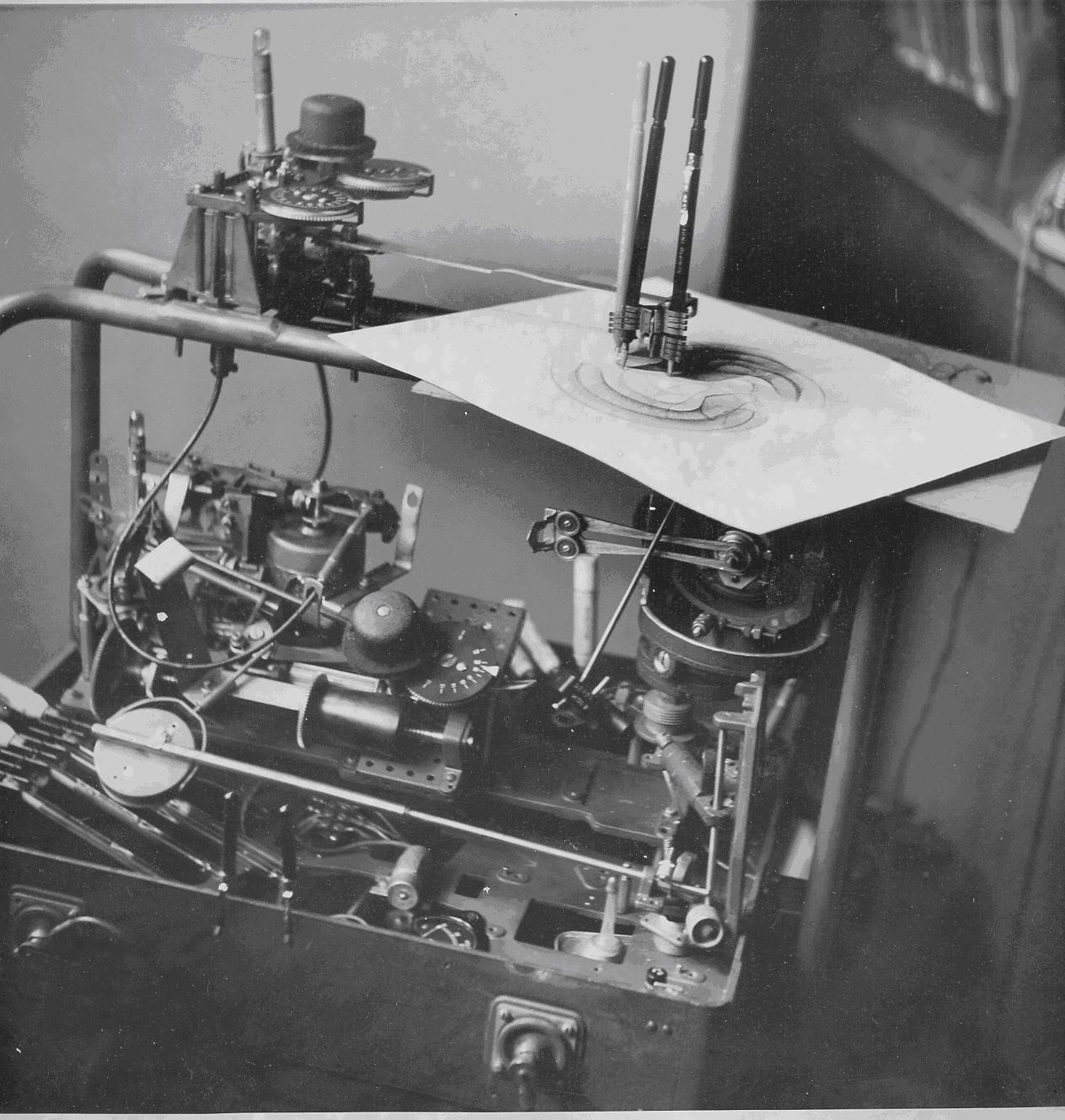
Desmond Paul Henry (1921–2004) was a philosopher at Manchester University who, in the 1960s, built three drawing machines out of analogue bombsight computers from the Second World War. They made curving line drawings with real pens, and he showed them in London from 1962.1, 2
The bombsight
A bombsight computer was a calculator carried in Second World War bombers to work out when to release the bombs so that they hit the target.1 It was analogue, calculating with moving mechanical parts rather than stored numbers. According to Wikipedia, Henry bought his first one, a Sperry model, in 1952 from an army surplus warehouse in Manchester.3
How the machines drew
Henry kept the bombsight's mechanism and attached pens to it. Electric servo motors drove the gears, and the pens hung over a drawing table that stood still or moved. The first machine drew with ballpoint pens, the later ones with Indian ink in technical pens.3 As the parts turned against each other, the pen traced long loops and overlapping curves.
The machines could not be programmed, and they stored nothing. What they drew depended on chance in how they were built and run, and Henry said he let each machine "do its own thing".3 JAEV's Plotter art therefore lists Henry among the early computer artists who did not use a pen plotter. A plotter like the Zuse Graphomat Z64 follows coordinates sent by a digital computer; Henry's machines only ever drew what their own mechanism did.
Three machines
The Science Museum Group dates the three machines to 1961, 1962 and 1967.2 Henry's first show of machine drawings was at the Reid Gallery in London in 1962.1 Wikipedia gives its title as Ideographs.3
In 1968 the second machine and its drawings were in Cybernetic Serendipity at the Institute of Contemporary Arts in London, and Henry wrote "The Henry drawing computer" for its catalogue.1, 2, 4
What remains
The remains of the second machine are with the Science Museum in London, and Manchester's Museum of Science and Industry showed a retrospective of his machine drawings in 2011.5 His daughter, Elaine O'Hanrahan, looks after the D. P. Henry Archive.5 Between 2012 and 2019 the artist-engineer Jack Tait built a machine in Wales by working backwards from Henry's; the Science Museum Group now holds it, with the note that it makes similar drawings but "does not aim to replicate them".6
Sources
- “Desmond Paul Henry”. Computer Arts Society
Desmond Paul Henry (1921–2004), Lecturer in Philosophy at Manchester University 1949–1982 and part-time artist; in the 1960s “a series of three electromechanical drawing machines” from analogue bombsight computers “originally used in WW2 Bombers to calculate the accurate release of bombs onto their targets”; first show of machine-generated art 1962, Reid Gallery, London; his second machine in Cybernetic Serendipity, ICA, 1968. - “Desmond Paul Henry”. Science Museum Group Collection, people record
Three mechanical drawing machines, 1961, 1962 and 1967, built around the components of analogue bombsight computers; Reader in philosophy at Manchester, retired 1982; the second machine and its drawings shown at Cybernetic Serendipity. - “Desmond Paul Henry”. Wikipedia (English)
Born 5 July 1921, Huddersfield; died 28 October 2004, Manchester. First Sperry bombsight bought in 1952 from an army surplus warehouse in Shude Hill, Manchester; one or two servo motors; drawing implements suspended over a stationary or moving table; biros, later Indian ink in technical pens; could not be pre-programmed or store information; L. S. Lowry saw Drawing Machine 1; Reid Gallery show “Ideographs” from 30 August 1962. - “Cybernetic Serendipity: The Computer and the Arts”, Studio International special issue, ed. Jasia Reichardt, 1968. Contents
Contents include “The Henry drawing computer by D. P. Henry”. - Lecture by Elaine O'Hanrahan on Desmond Paul Henry, 24 September 2024. Computer Conservation Society, announcement
Abstract, curved images made with three electromechanical drawing machines adapted from WWII bombsight computers; the remains of the second machine are with the Science Museum, London; a retrospective at Manchester's Museum of Science and Industry in 2011; Elaine O'Hanrahan, his daughter, curator of the D. P. Henry Archive. - “'Homage to Henry' Analogue Drawing Machine developed and built by Dr. Jack Tait” (2024-426). Science Museum Group Collection
Made 2012–2019 in Wales by reverse engineering Henry's drawing machines; produces similar drawings but “does not aim to replicate them”; Tait's aim, the “best Lissajous based machine”; the museum holds a surviving example of the bombsight computers Henry used.
- Published
- JAEV Notes, October 2026.
- Use
- Text CC BY 4.0. Free to use and quote with credit to JAEV and a link to this page. Images and quotations by others keep their own terms.
All texts as one file: archive.json - Cite
- JAEV Notes, “Desmond Paul Henry's drawing machines (1961–1967)”, jaev.gallery/notes/desmond-paul-henry-drawing-machines/, 2026.
- Corrections
- Additions and corrections are welcome: info@jaev.gallery
- Share
A link from your own site, course page or reading list helps others find it.- Follow
- New notes by RSS · Instagram · Bluesky
JAEV is a daemon taking shape: machines, weights, room, brain.