Flow fields
JAEV Notes · October 2026 · 2 min read
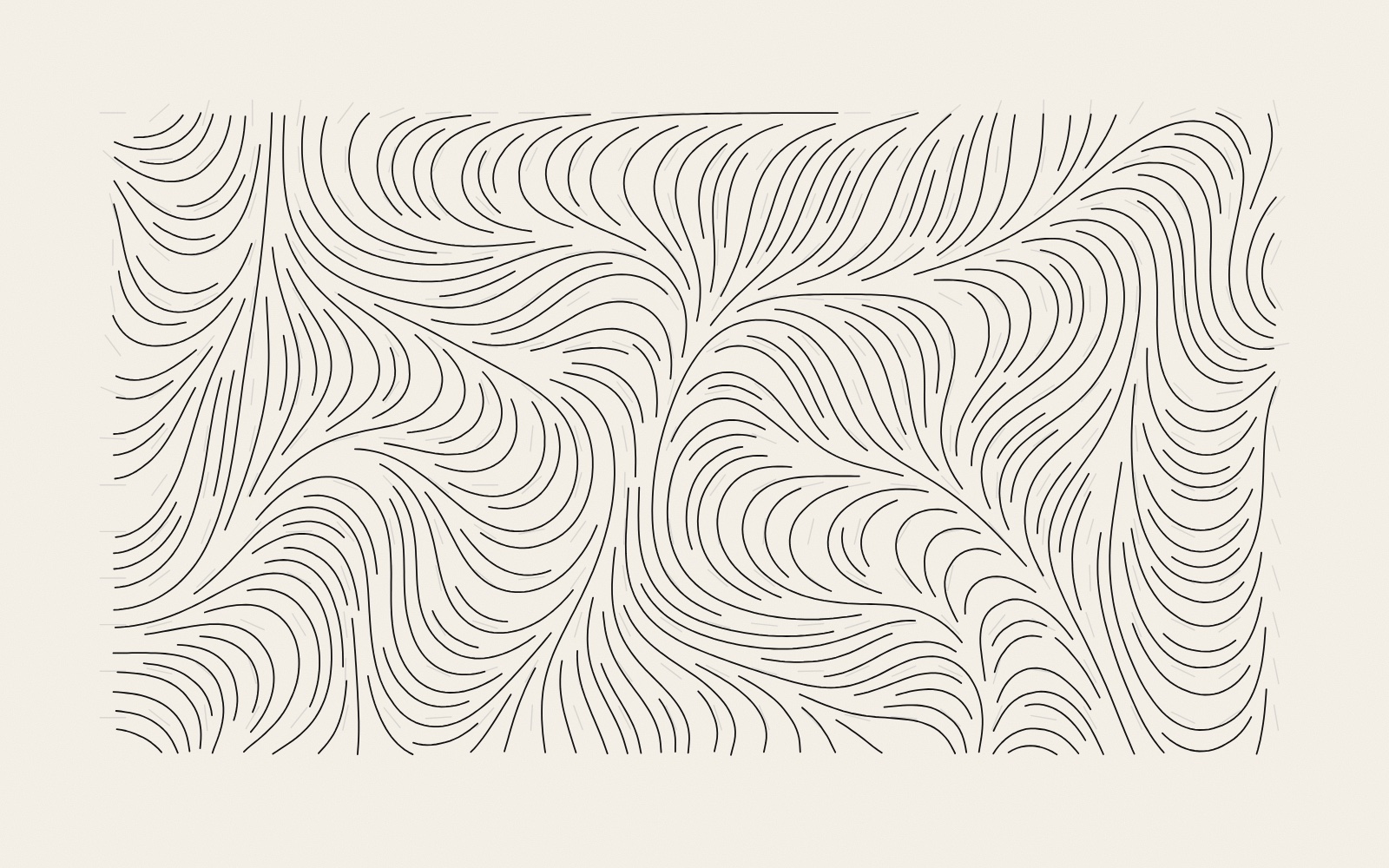
A flow field is a grid in which every point holds a direction. A curve is drawn by starting somewhere, looking up the direction nearest to it, taking a short step that way and repeating. The method is common in generative art, and the artist Tyler Hobbs describes it step by step in his essay Flow Fields (2020).1
The grid
"Flow fields are based around a grid," Hobbs writes, and at each point of the grid sits an angle.1 The artist chooses how fine the grid is and how the angles vary across it. If they vary smoothly, curves that follow them bend smoothly too.
The angles have to come from somewhere. "About 90% of the time, people use Perlin noise to initialize the vectors," Hobbs writes: each noise value is turned into an angle.1 Perlin noise gives values that change smoothly from point to point, so neighbouring angles stay close. Hobbs also calls it "so overdone" and suggests inventing other ways to distort the field.1
Drawing the curves
Three choices shape the result.1
- Step length. Small enough that "you don't see any sharp points on the curve".
- Number of steps. "Short curves may look more like "fur". Long curves are more fluid."
- Starting points. On a regular grid, chosen at random, or placed by circle packing.
Keeping curves apart
Without a rule against it, curves can run into each other and along each other. Hobbs's rule: "At each step of a curve, check if any other existing curves are too close, and if so, stop."1 For evenly spaced lines he points to a paper from scientific visualisation, where such curves are called streamlines: Bruno Jobard and Wilfrid Lefer's "Creating Evenly-Spaced Streamlines of Arbitrary Density" (1997).1, 2 The sketch below uses the simple stopping rule.
In works
Hobbs's Fidenza (2021), on Art Blocks, is built on a flow field that he uses to "produce unpredictable, organic curves".3 Hobbs also makes many works with a pen plotter.4 A flow-field curve is already a chain of short straight steps, which is exactly what a plotter draws (see Plotter Art). A drawing of thousands of curves also gives the pen a long way to travel between them, which is the subject of the note on plotter path optimisation. For the wider field, see the editorial Generative Art.
Sources
- Tyler Hobbs, “Flow Fields”, 3 February 2020
“Flow fields are based around a grid”; “Flow fields are incredibly powerful and flexible tools for producing interesting curves”; step length “small enough that you don't see any sharp points”; “Short curves may look more like “fur”. Long curves are more fluid.”; starting points on a grid, random, or by circle packing; “About 90% of the time, people use Perlin noise to initialize the vectors”, “so overdone”; “At each step of a curve, check if any other existing curves are too close, and if so, stop.”; Ben Kovach and the Jobard paper. - Bruno Jobard and Wilfrid Lefer, “Creating Evenly-Spaced Streamlines of Arbitrary Density”. 8th Eurographics Workshop on Visualization in Scientific Computing, 1997 (bibliographic record)
- Tyler Hobbs, “Fidenza”, 11 June 2021
“my most versatile generative algorithm to date (as of 2021)”; built on a flow field to “produce unpredictable, organic curves”; shown on Art Blocks. - “Tyler Hobbs”. Avant Arte
“I also create a large number of works utilising a plotter.”
- Published
- JAEV Notes, October 2026.
- Use
- Text CC BY 4.0. Free to use and quote with credit to JAEV and a link to this page. Images and quotations by others keep their own terms.
All texts as one file: archive.json - Cite
- JAEV Notes, “Flow fields”, jaev.gallery/notes/flow-fields/, 2026.
- Corrections
- Additions and corrections are welcome: info@jaev.gallery
- Share
A link from your own site, course page or reading list helps others find it.- Follow
- New notes by RSS · Instagram · Bluesky
JAEV is a daemon taking shape: machines, weights, room, brain.