Plotter Art
How a pen plotter works, who has drawn with one since 1965, and how a plot is made today
JAEV Editorial · 19 October 2026 · 14 min read
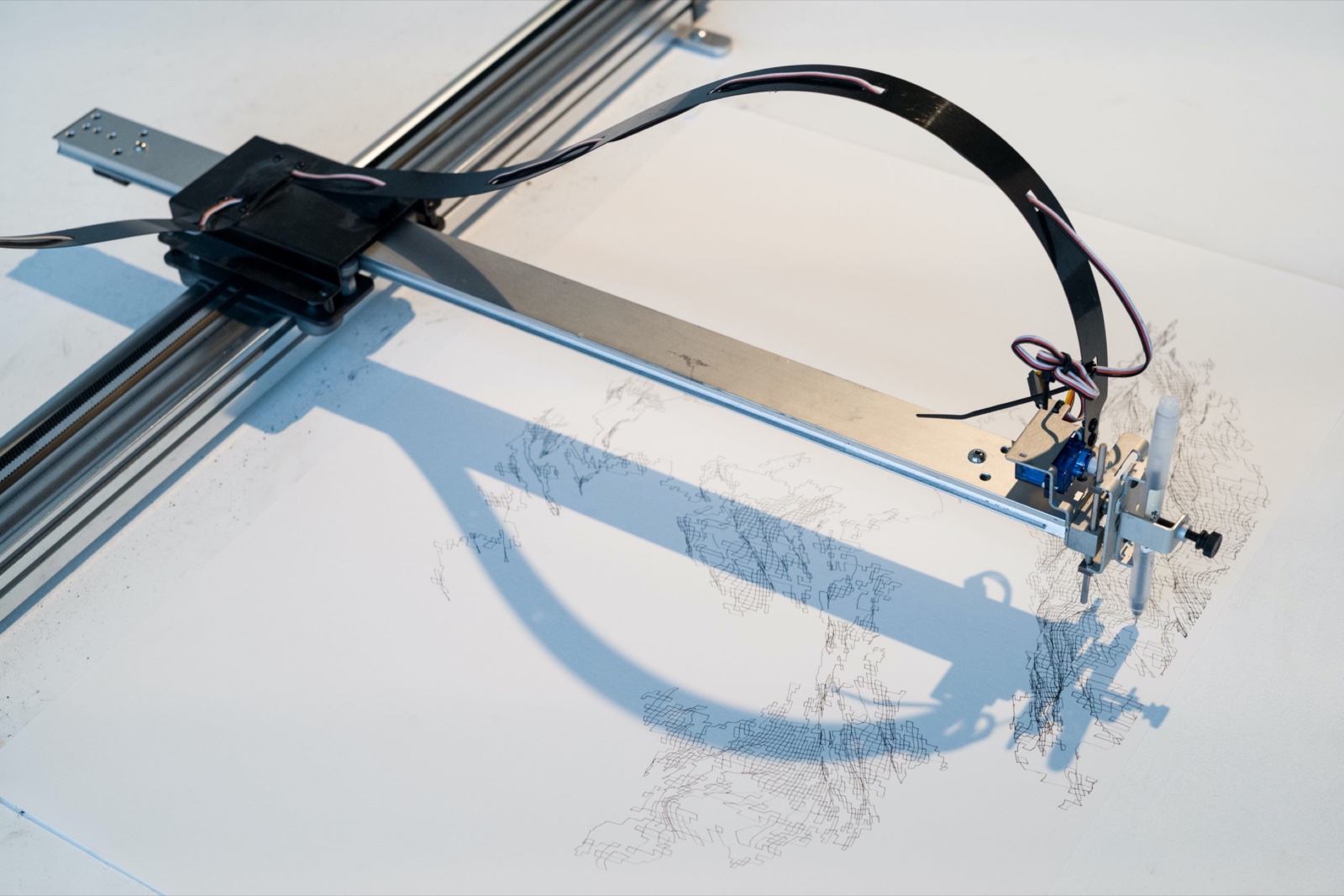
A pen plotter is a machine that moves a real pen across real paper under a computer's control. It does not print dots. It draws lines, one after another, in the order it is told, and lifts the pen between them. Everything that makes a plotter drawing look the way it does follows from that: the ink that pools where the pen pauses, the slight wobble of a pen in its holder, the hours a dense drawing takes.
Plotter art is as old as computer art. What Frieder Nake has called the first exhibition of computer-generated images opened in Stuttgart on 5 February 1965, with drawings by Georg Nees made on a flatbed plotter.1, 2, 3 Sixty years later the same kind of machine sits on the desks of a large community of artists who plot their own code, sell signed sheets and argue about pens. This page is JAEV's guide to the whole field: how the machine works, which machines mattered, who drew with them, how a plot is made today, and what collectors and museums do with the results.
What a plotter is told
A printer receives an image. A plotter receives instructions: lower the pen, go to this point, go to that point, lift the pen, go somewhere else. The pen travels in a straight line between two points, so a curve is drawn as many short straight lines.4
The best-known language for such instructions is HP-GL, which Hewlett-Packard introduced with its 9872A plotter in 1977.5 Its commands are two letters long. IN starts the plotter, SP1 selects pen 1, PU means pen up and PD pen down, each followed by coordinates.6 On HP's desktop plotters one unit is 0.025 millimetres, so 4,000 units make ten centimetres.7
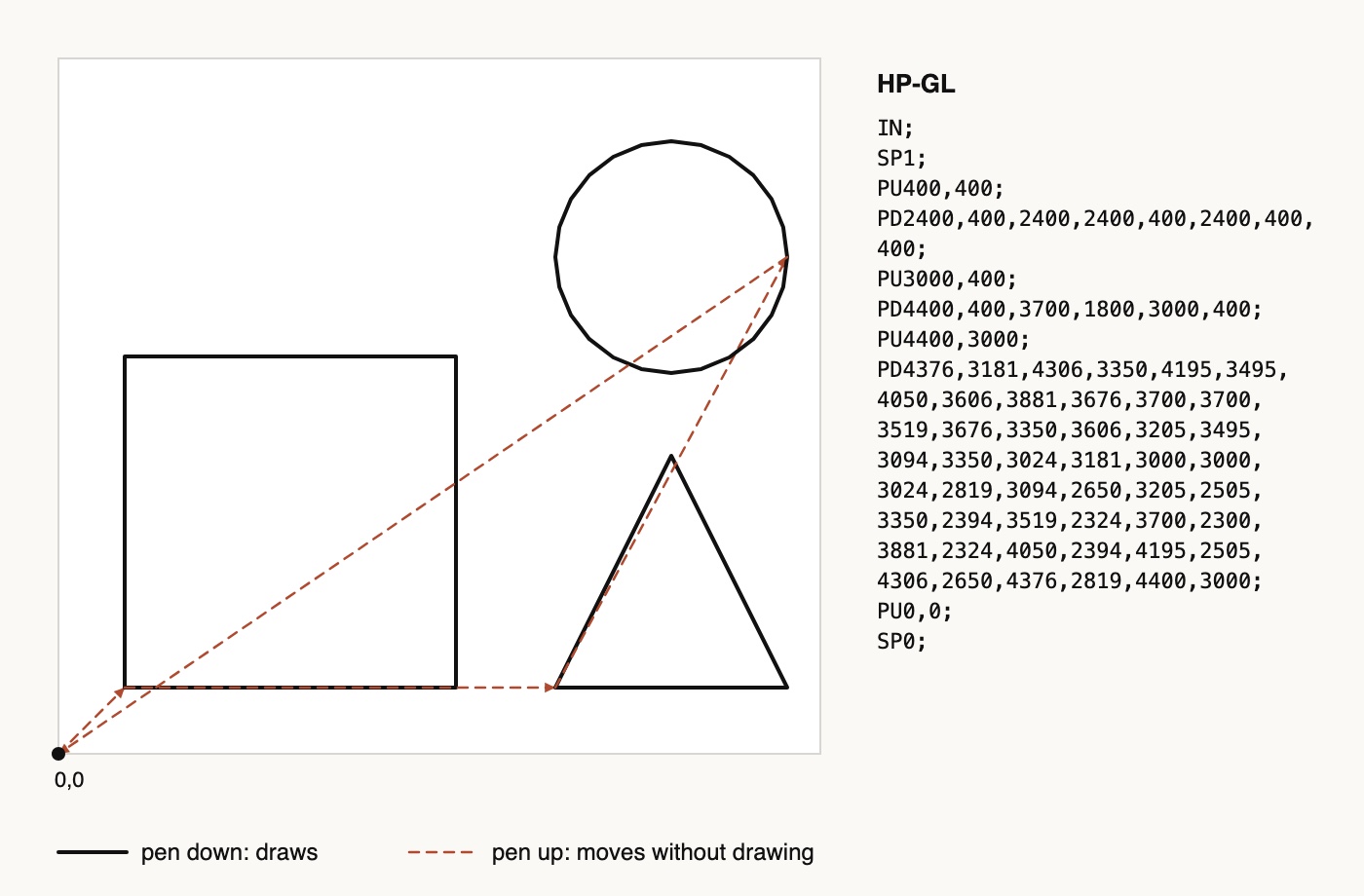
Two things follow, and every plotter artist meets them. The order of the lines is part of the work, because the machine draws them in exactly that order, with every pen-up journey between them. And a filled area does not exist. To make a surface dark, the program has to fill it with lines, which is why so many plotter drawings are made of hatching.
Four ways to move a pen
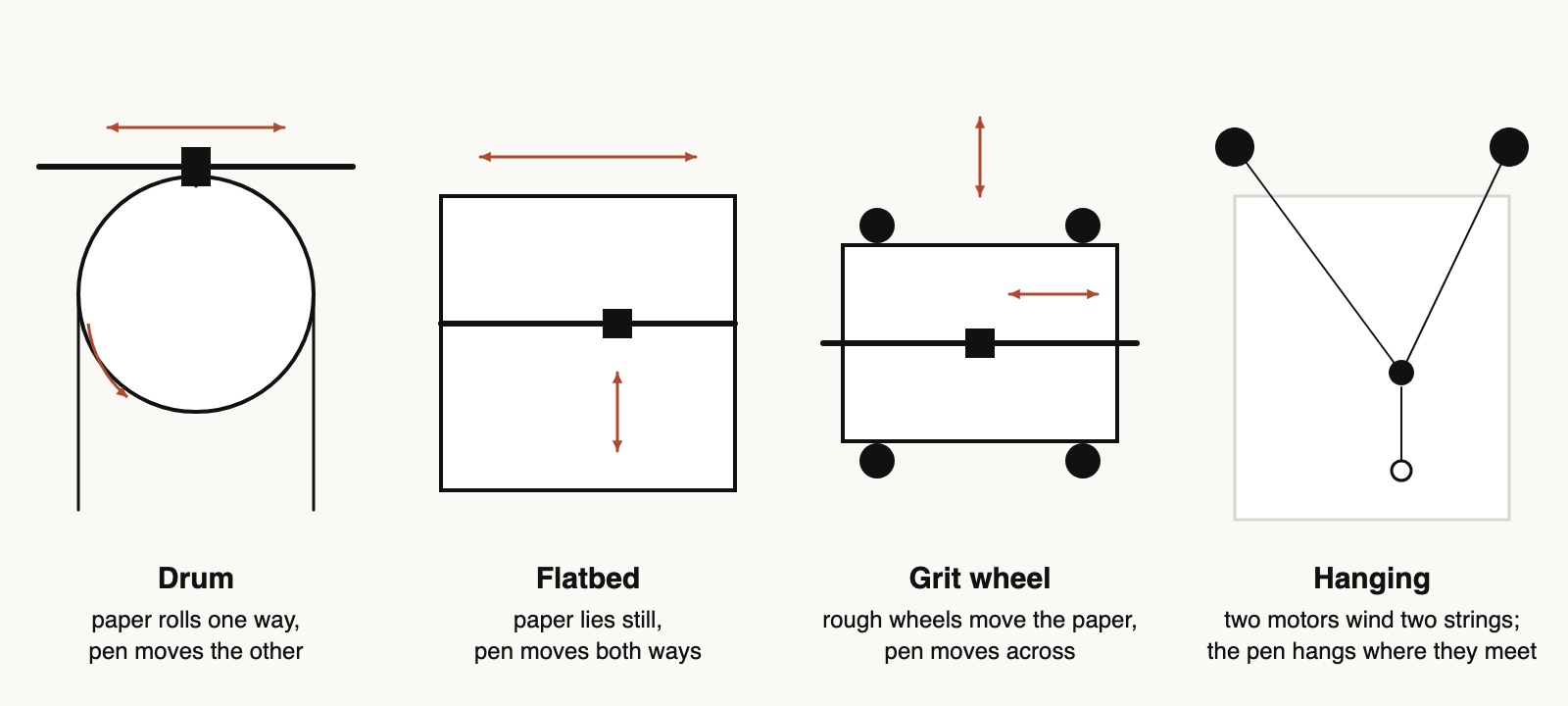
Plotters differ in how they move the pen relative to the paper.
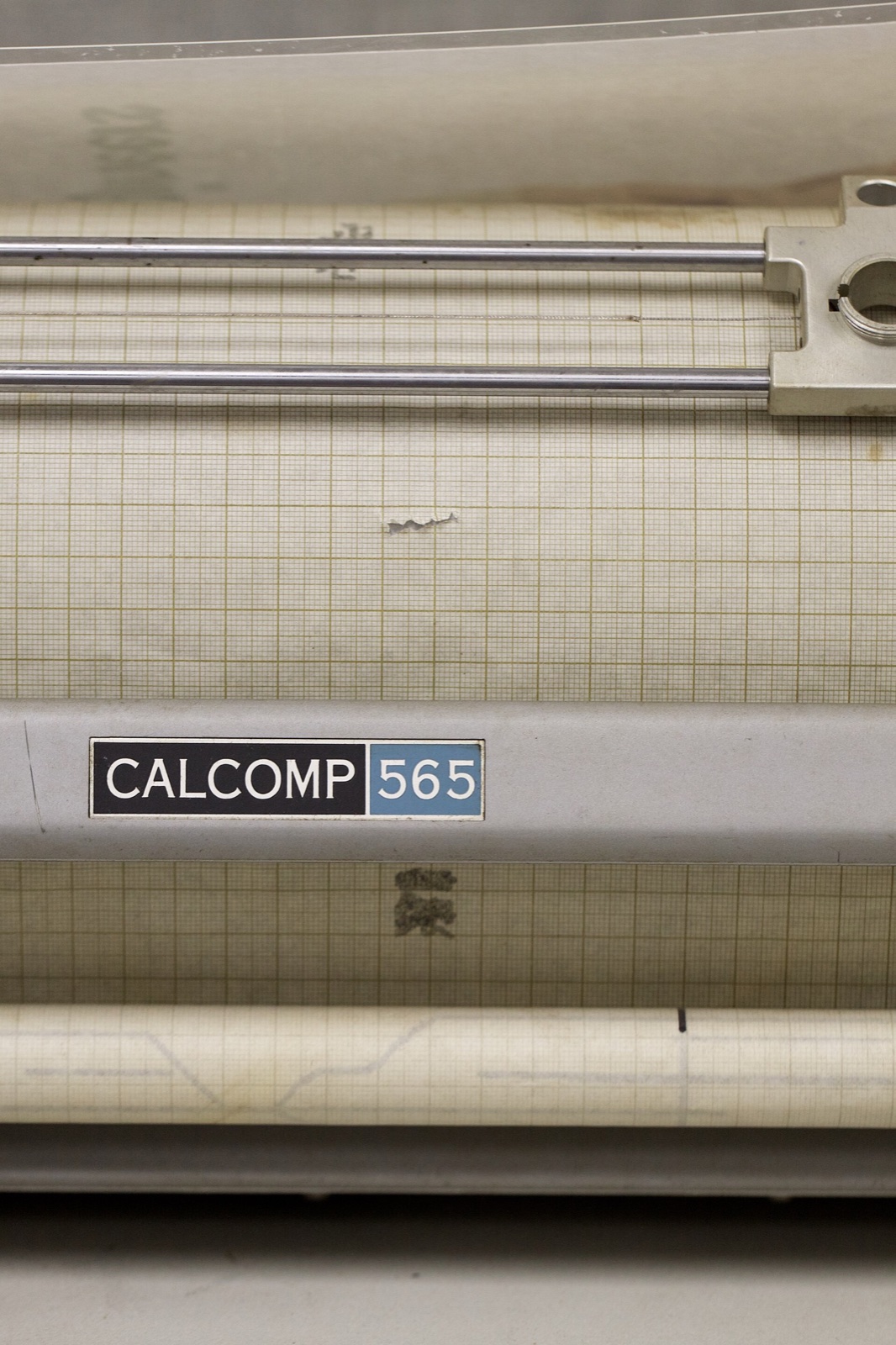
- Drum. The paper is wrapped over a drum that turns back and forth, which gives one direction; the pen moves along a rail across it, which gives the other. The CalComp 565 of 1959, the first drum plotter according to the company's history, worked this way. Its pen moved in steps of a hundredth of an inch, on paper 11 inches wide and up to 120 feet long.8, 9, 10
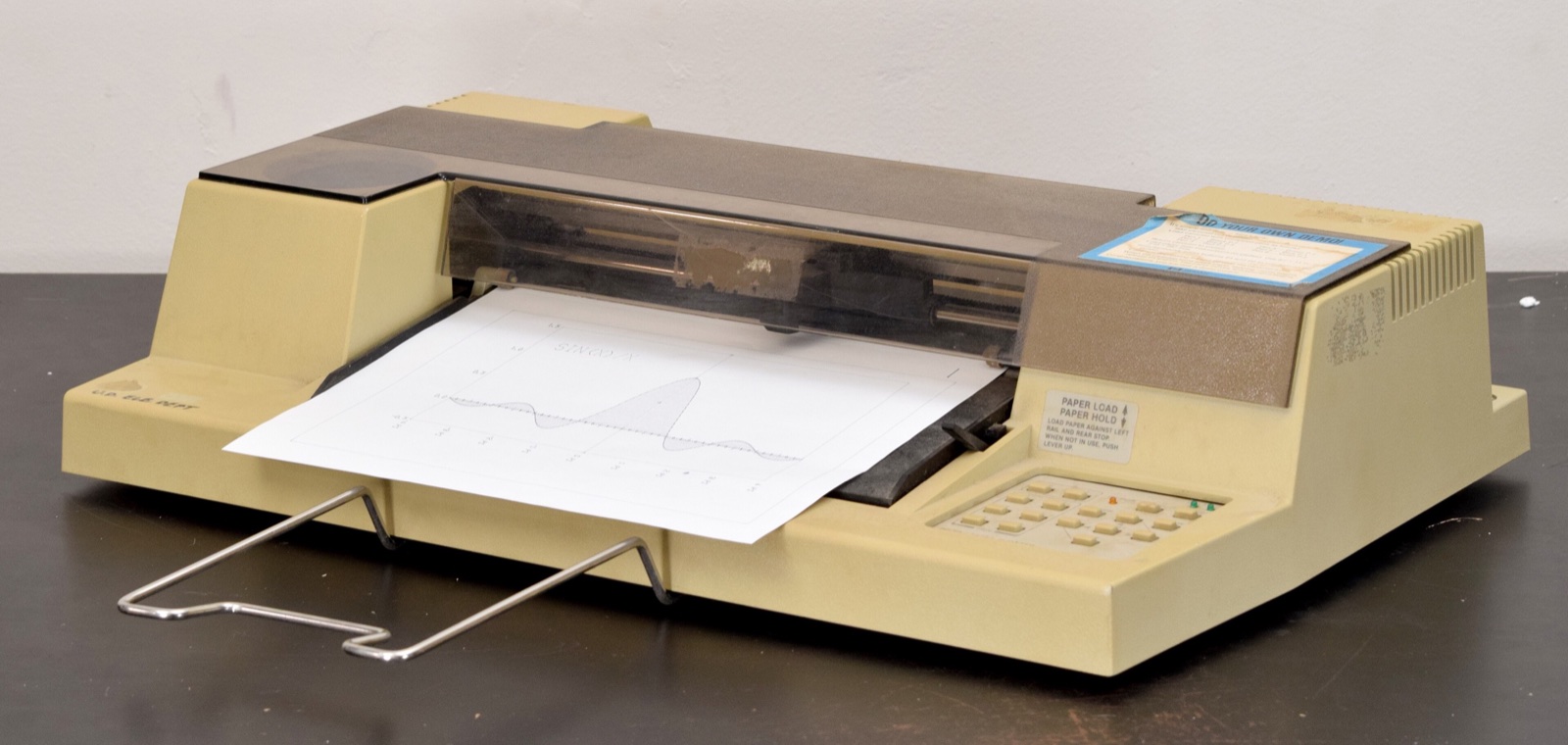
- Flatbed. The paper lies still on a table and the pen moves in both directions over it, carried by a bridge. The Zuse Graphomat Z64, built from 1961 to 1964, was a flatbed plotter, and so are most plotters made for artists today.11
- Grit wheel. The paper itself is moved back and forth by wheels coated with something like sandpaper, while the pen moves across it. Hewlett-Packard built a model of the idea in 1976 and sold its first grit-wheel plotter, the 7580A, in 1981.12, 13
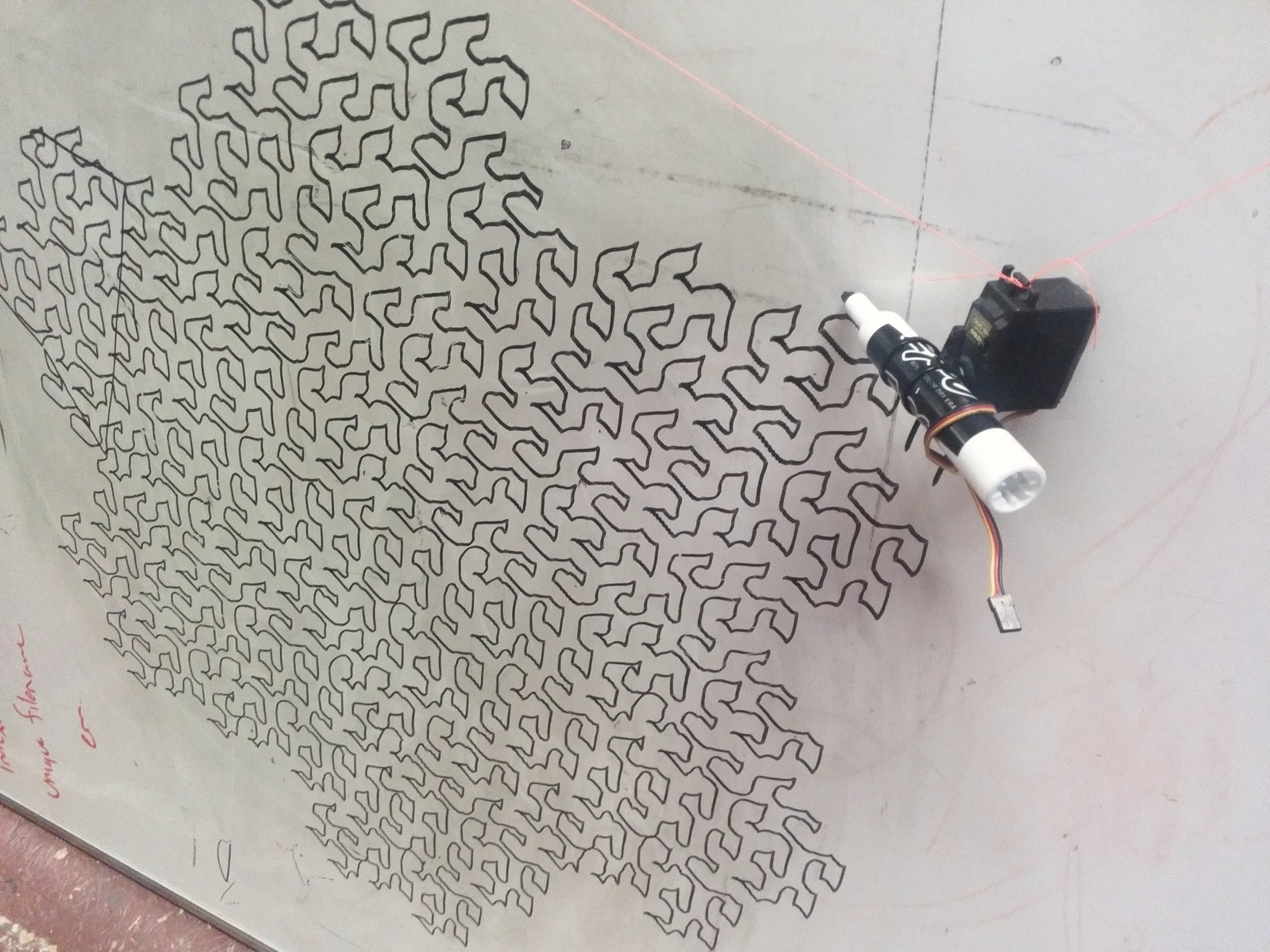
- Hanging. A pen hangs from two strings, each wound by a motor at the top corners of a board, and goes wherever the two lengths put it. The Polargraph, made by Sandy Noble in Edinburgh in 2011, is one such machine.14

The machines, 1959 to today
| Year | Machine | Maker | Why it matters |
|---|---|---|---|
| 1959 | CalComp 565 | California Computer Products, USA | The first drum plotter, in the company's account; also sold by IBM as the 1627.8, 10 |
| 1961–64 | Graphomat Z64 | Zuse KG, Germany | Flatbed; 98 built. Drew Nees's and Nake's first works.11, 15 |
| 1960s–80s | Benson plotters | Benson, France | Dominated Europe; Manfred Mohr drew on a Benson 1284 from 1970 to 1983.13, 16 |
| 1977 | HP 9872A | Hewlett-Packard, USA | Four pens; introduced HP-GL.5 |
| 1981 | HP 7580A | Hewlett-Packard | The first grit-wheel pen plotter.13 |
| 1982 | HP 7470A | Hewlett-Packard | Small, two pens, A4; the first small paper-moving plotter.17 |
| 1982 | Roland DXY-100 | Roland DG, Japan | First of the DXY desktop plotters.18 |
| 1983 | HP 7475A | Hewlett-Packard | Six-pen carousel, A4 and A3; in HP's words "the most popular pen plotter ever made", sold until 1994.19 |
| 2010 | EggBot | Evil Mad Scientist, USA | Open-source drawing robot for eggs and balls.20 |
| 2011 | Polargraph | Sandy Noble, UK | Hanging plotter built with an Arduino.14 |
| 2016 | AxiDraw | Evil Mad Scientist | The standard plotter of the present scene.21 |
| 2024 | NextDraw | Bantam Tools, USA | Successor to the AxiDraw, after Bantam Tools bought Evil Mad Scientist.22, 23 |

The pioneers, 1965–1980
The first plotter artists were people who already had access to a plotter, at a company, a university or a weather service, rather than artists who had bought one. They often used it in the evenings and at night.
Georg Nees worked as a software engineer at Siemens, where, according to the Victoria and Albert Museum, he was instrumental in the company buying a Zuse Graphomat.24 He showed his drawings at the Technische Hochschule in Stuttgart from 5 February 1965, at the invitation of the philosopher Max Bense.2, 25
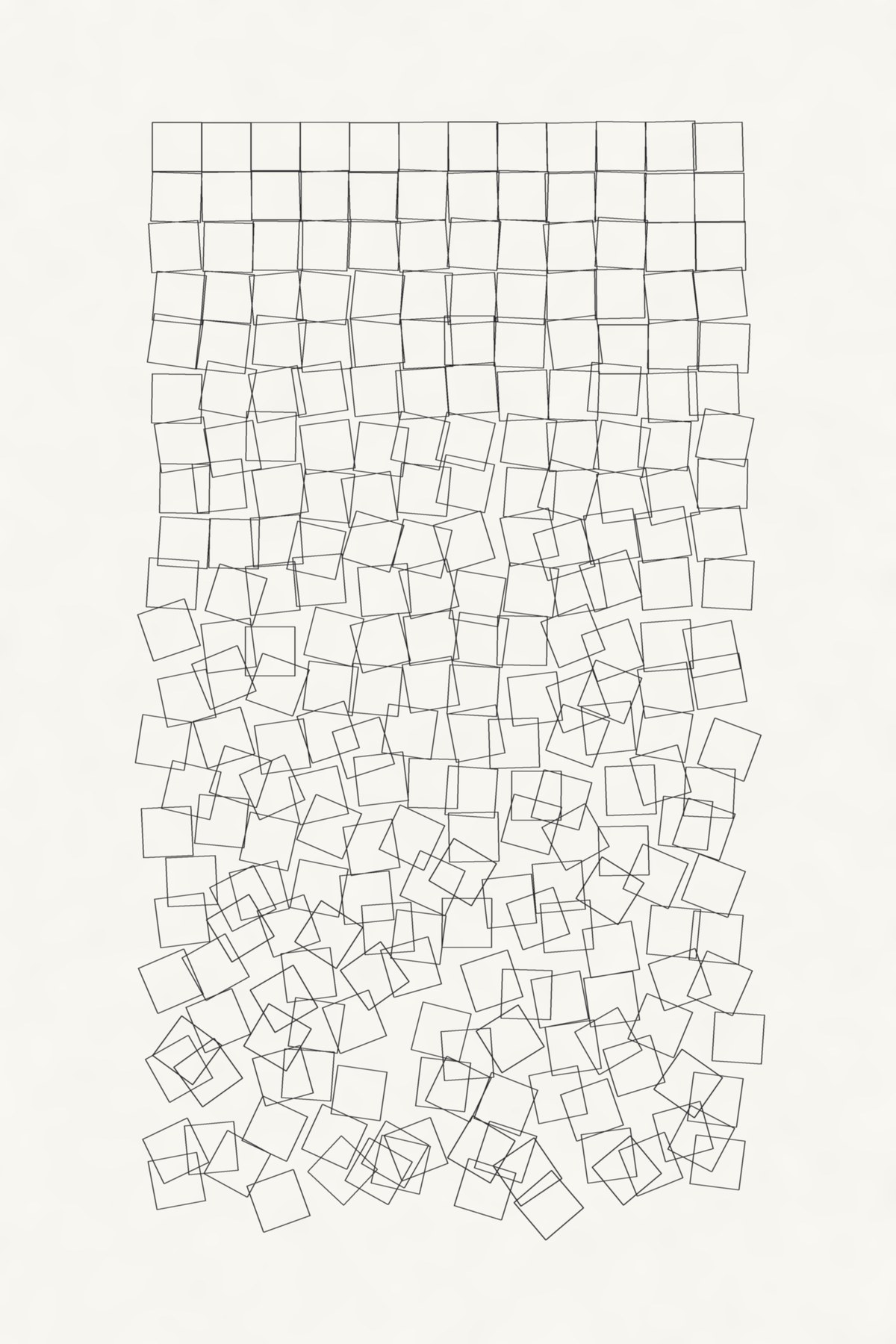
Frieder Nake used the mainframe at the computing centre of the same university from 1963. He wrote his programs for its Standard Elektrik Lorenz ER56 and had them drawn on a Zuse Graphomat Z64.15 His Hommage à Paul Klee 13/9/65 Nr. 2, named after the day it was plotted, is based on Paul Klee's 1929 painting Hauptweg und Nebenwege (Highway and Byways).27 He estimates that the machine drew "about 30 or 40 copies" of it between 1965 and 1967.28 In November 1965 Nake and Nees showed together at Galerie Wendelin Niedlich in Stuttgart, a bookshop and gallery; "it changed my life", Nake wrote later.25, 1
Charles Csuri at Ohio State University drew on a CalComp 565 drum plotter driven by an IBM 7094. For Sine Curve Man (1967) he digitised a drawing of a man and passed it through a sine function, many times over; for Sinescape the same year he got colour "by simply changing the plotter pen from black to red".29, 30
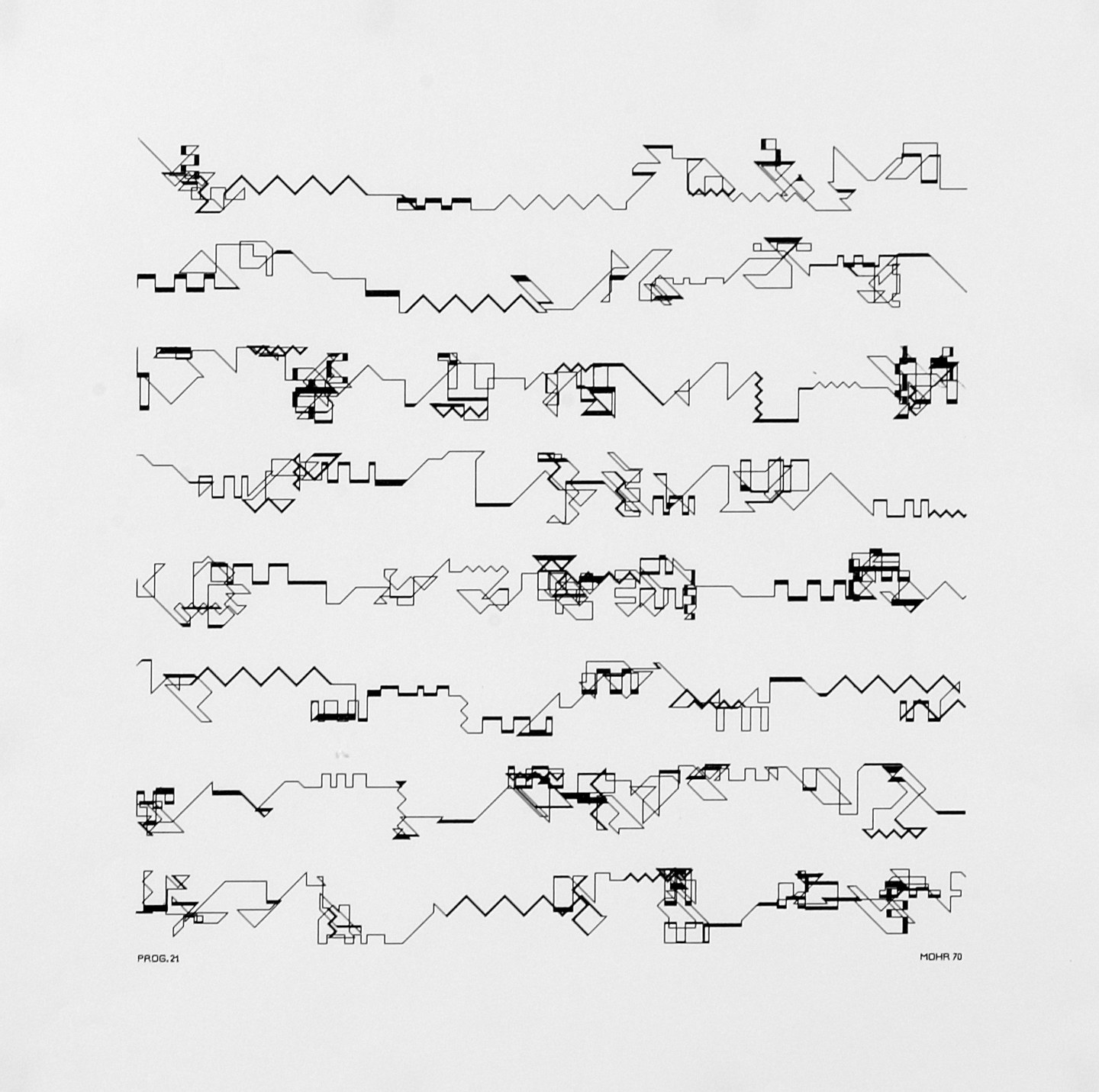
Manfred Mohr, a jazz musician and painter living in Paris, wrote his first program in October 1969. From June 1970 he used the Benson plotter and CDC 6400 computer of the French weather service, where he was allowed to work nights and weekends.31 He drew there "almost nightly" until 1983.16

Vera Molnár had worked from 1959 with what she called an imaginary machine. In 1968 she gained access to a real computer at the computing centre in Orsay, outside Paris, and remembered falling asleep in the evenings "to the noise of the plotter".32
Harold Cohen went further and built his own drawing machines. From 1973 his program AARON drew with a "turtle", a small robot with a marker that moved on the floor, and later with pens on robotic arms.33
From the late 1970s some artists had machines of their own: Jean-Pierre Hébert acquired his first pen plotter in 1978, according to the V&A,34 and Roman Verostko fitted a plotter with a Chinese brush.35 In 1995 Hébert suggested the name algorists for artists who write their own algorithms, and Verostko took it up. "It is the inclusion of one's own algorithms that makes the difference," Verostko wrote.36
In Sweden
In Stockholm the IBM systems engineer Sten Kallin spent his evenings with an IBM 1130 and its drum plotter at IBM in Solna. He liked that the pen sat loosely in its holder: "lite karaktär eller lite slump i strecket", a bit of character or a bit of chance in the line.37 The Art Institute of Chicago holds Computer Colonne (1975), a textile credited to the designer Astrid Sampe "with computer programmer Sten Kallin and IBM Plotter 1627".38 The story is told in full in JAEV's text on computer art in Sweden.
What was not a pen plotter
Some well-known early computer works were not made with a pen plotter at all.
- A. Michael Noll and Béla Julesz at Bell Labs, who showed at the Howard Wise Gallery in New York in April 1965, used a Stromberg-Carlson SC-4020 microfilm plotter: a screen photographed onto 35 mm film.39, 40 Not a single work was sold.40
- Hiroshi Kawano printed his designs on a line printer and painted them by hand.41
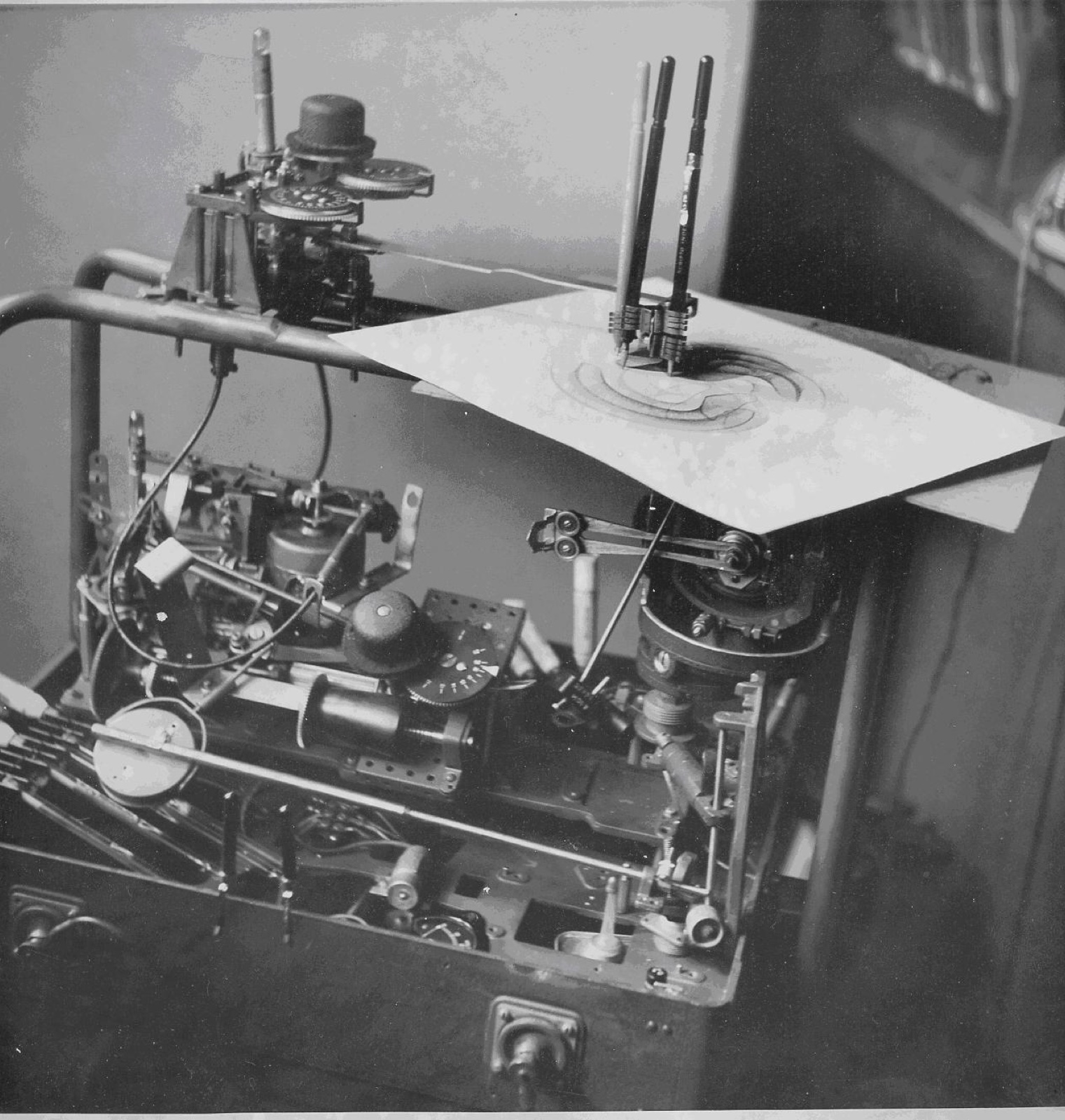
- Desmond Paul Henry built drawing machines from analogue bombsight computers taken from Second World War bombers. They drew with real pens but could not be programmed.42
- The colour plotter in Lund, on which Mikael Jern's software made colour cubes in the 1970s, sprayed dots of ink. It was an ink-jet machine, not a pen plotter.43

Exhibitions that defined the field
| Date | Exhibition | Place |
|---|---|---|
| 5–19 Feb 1965 | Georg Nees, computer graphics | Studiengalerie, Technische Hochschule Stuttgart25, 2 |
| Apr 1965 | Computer-Generated Pictures, Julesz and Noll (microfilm, not pen) | Howard Wise Gallery, New York40 |
| 5–26 Nov 1965 | Computer-Grafik, Nake and Nees | Galerie Wendelin Niedlich, Stuttgart25 |
| 2 Aug – 20 Oct 1968 | Cybernetic Serendipity | Institute of Contemporary Arts, London44 |
| 1968–69 | Tendencies 4: Computers and Visual Research | Zagreb25 |
| 1971 | Manfred Mohr, Computer Graphics – Une Esthétique Programmée, with a Benson plotter in the room | ARC, Musée d'Art Moderne de la Ville de Paris45 |
| 3–28 Aug 1981 | Computer Culture Art Show '81, the first SIGGRAPH art show | Dallas City Hall46 |
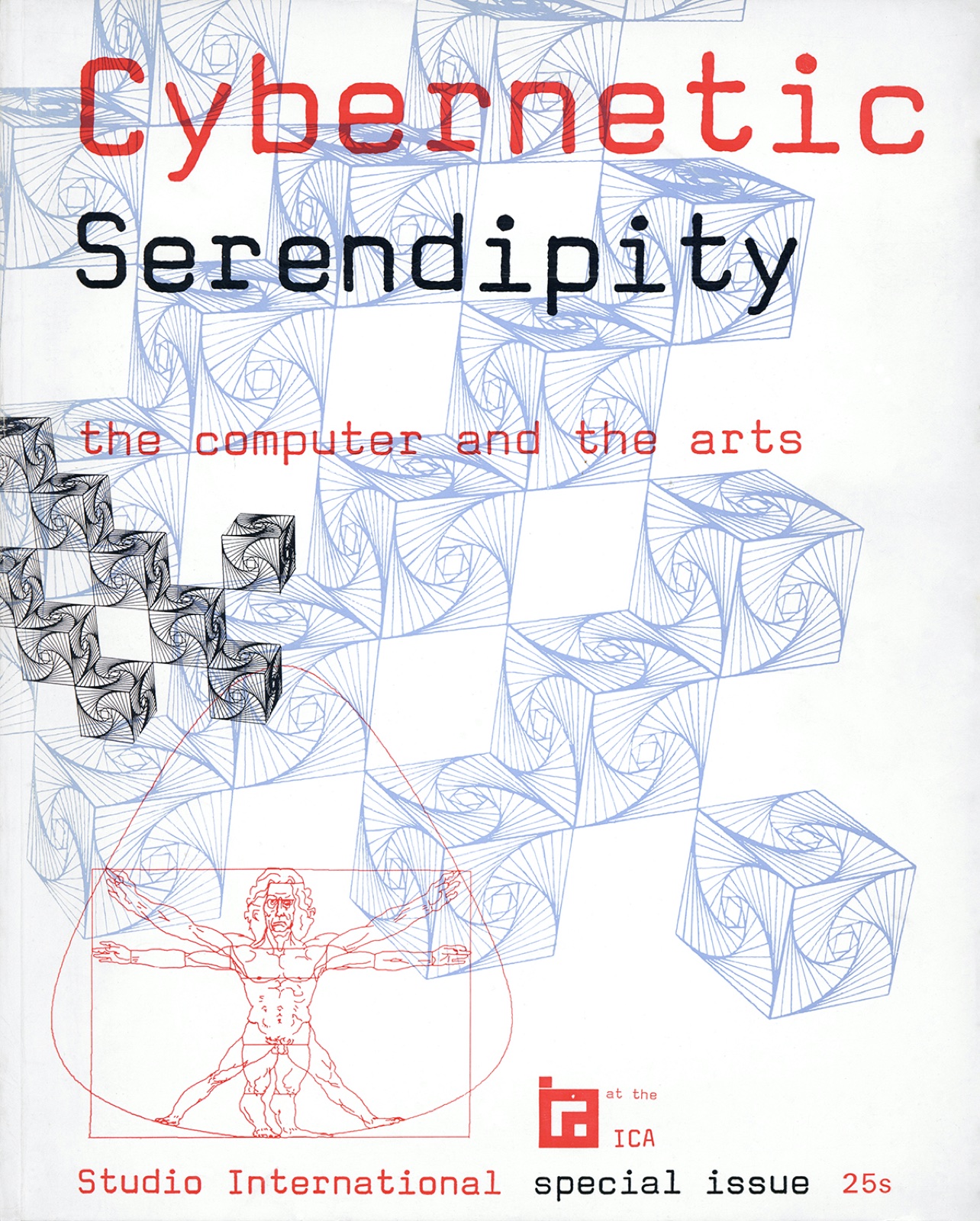
Cybernetic Serendipity at the Institute of Contemporary Arts in London was seen by some 60,000 people.44 Its catalogue, a special issue of Studio International, printed texts by Nake, Nees and Noll, an interview with Csuri and a section on the CalComp plotting system.47
The revival
The pen plotter came back in the 2010s, on old HP and Roland machines bought second-hand and on new machines made for artists and hobbyists.48
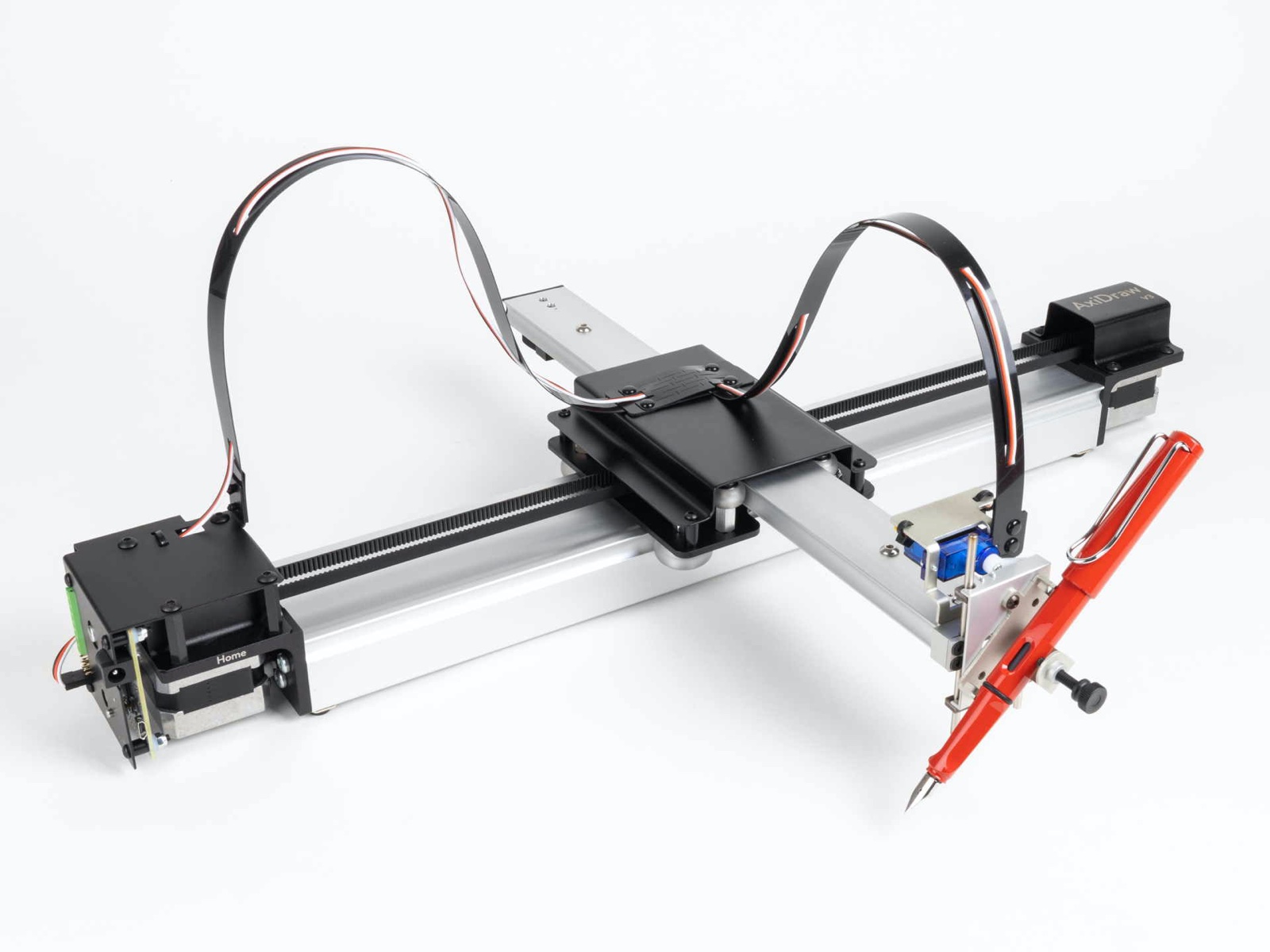
Many of the artists below use the AxiDraw, which the company Evil Mad Scientist launched in 2016 as "a simple, modern, precise, and versatile pen plotter" that can hold "fountain pens, permanent markers, and other writing implements".21 In 2024 Bantam Tools bought the company; the NextDraw succeeded the AxiDraw.22, 23
Around these machines grew a community on social media under the tag #plottertwitter, which researchers studied in a paper in 2021.49

Plotter artists today
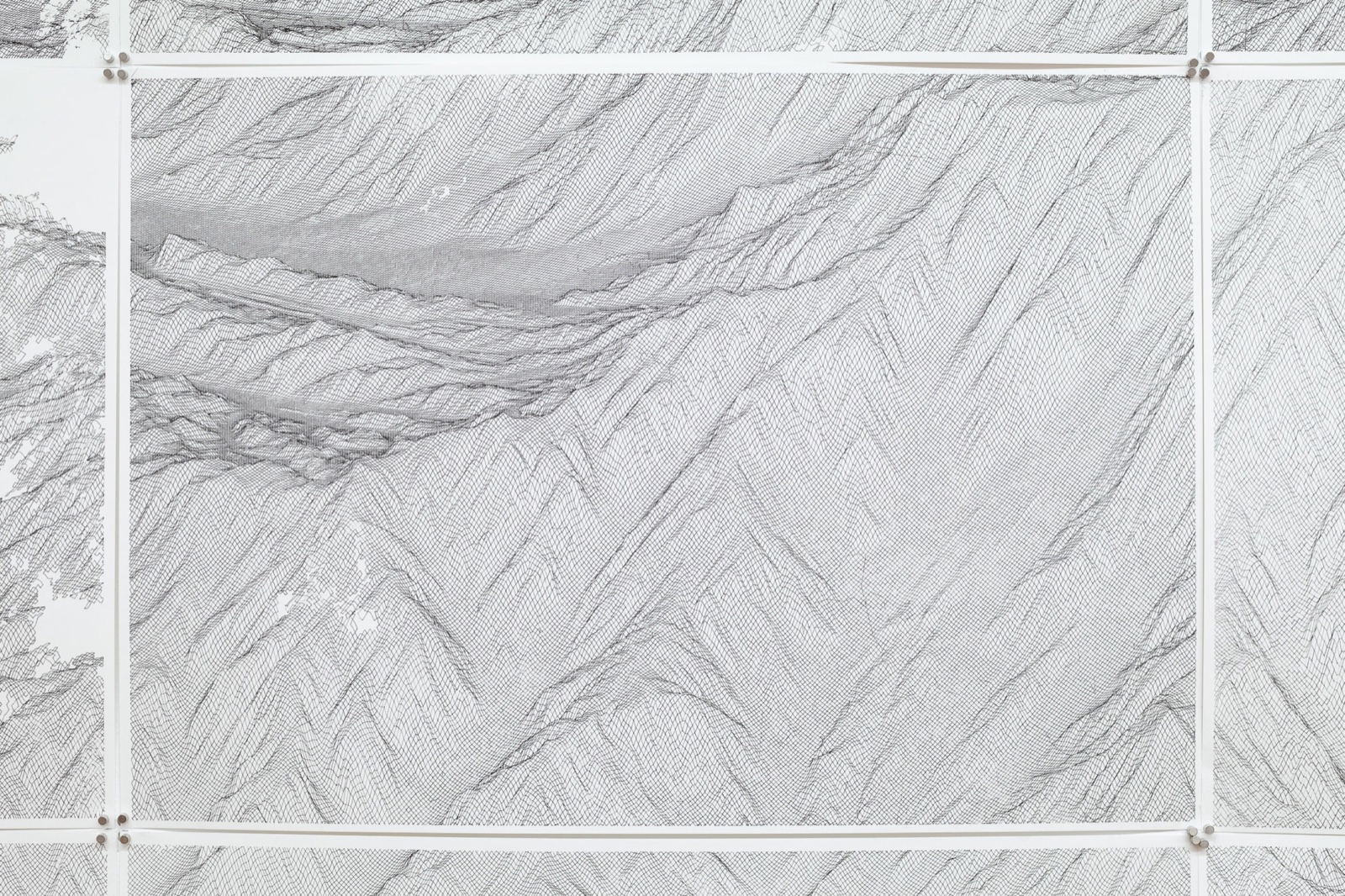
- Joanie Lemercier (France) has drawn Paysages Possibles, landscapes made of lines, on a plotter since 2018. He has written that the machine reveals "mechanical glitches coming from the machine, wear and ink glitches coming from the pen".50, 51
- Tyler Hobbs (USA): with F(l)ight (2021) the first collector of each NFT received the matching plotter drawing.52
- Licia He (USA) paints with watercolour and an AxiDraw holding a brush: "plotter-rendered generative painting made with Python".53, 54
- LIA (Austria) paints with brushes, Indian ink and watercolour on an AxiDraw, with her own software for the height of the brush.55
- Julien Gachadoat (France) makes dense line drawings; in 2024 he showed in Paris together with Pierre Braun, an artist of the generation forty years before him.56, 57
- Paul Rickards (USA) plots on vintage machines, among them an HP 7585B and a Roland DXY 1150.48
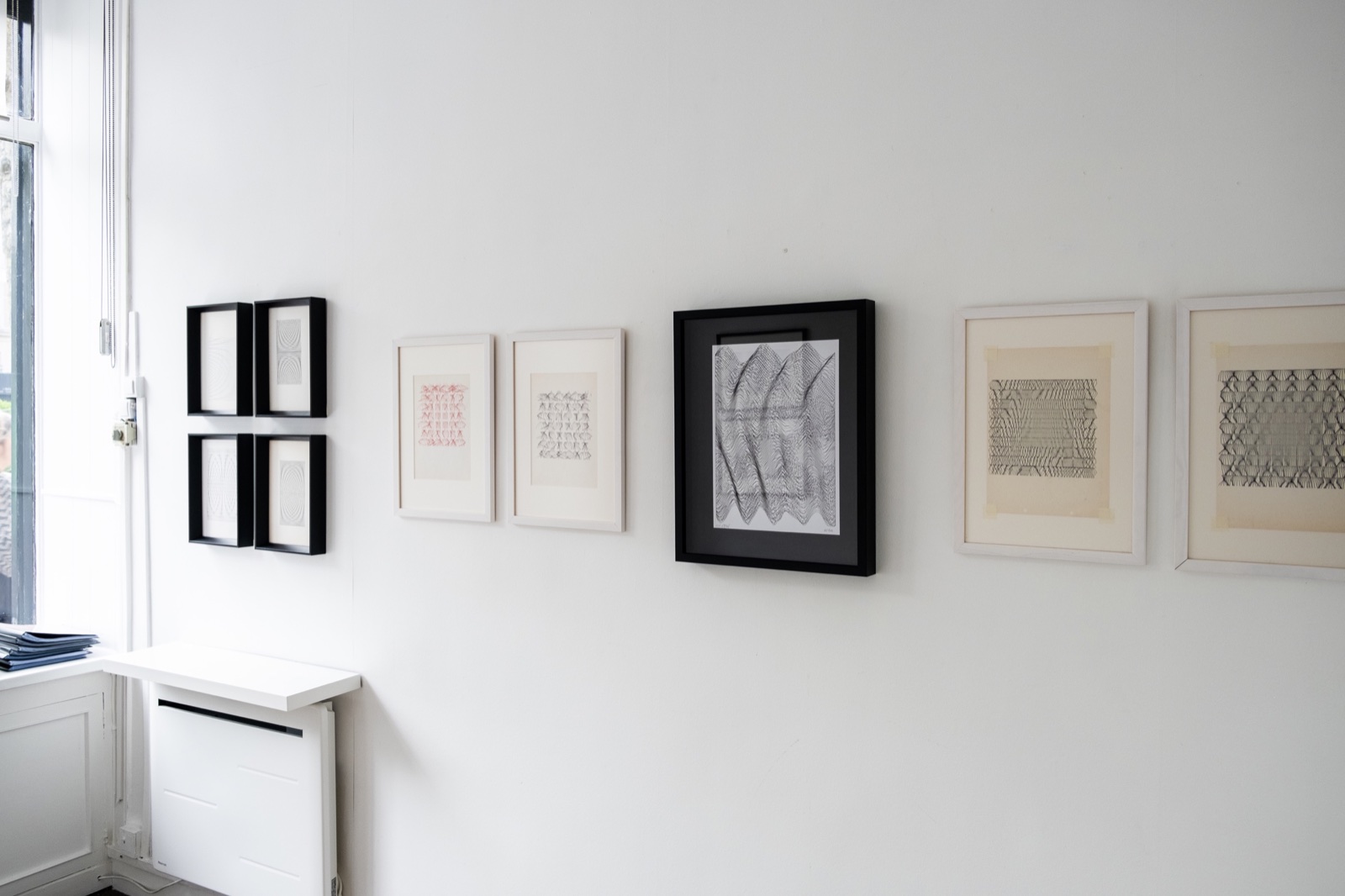
- Lars Wander: "the pen plotter imbues physicality on the piece that you really don't get on the computer screen."58
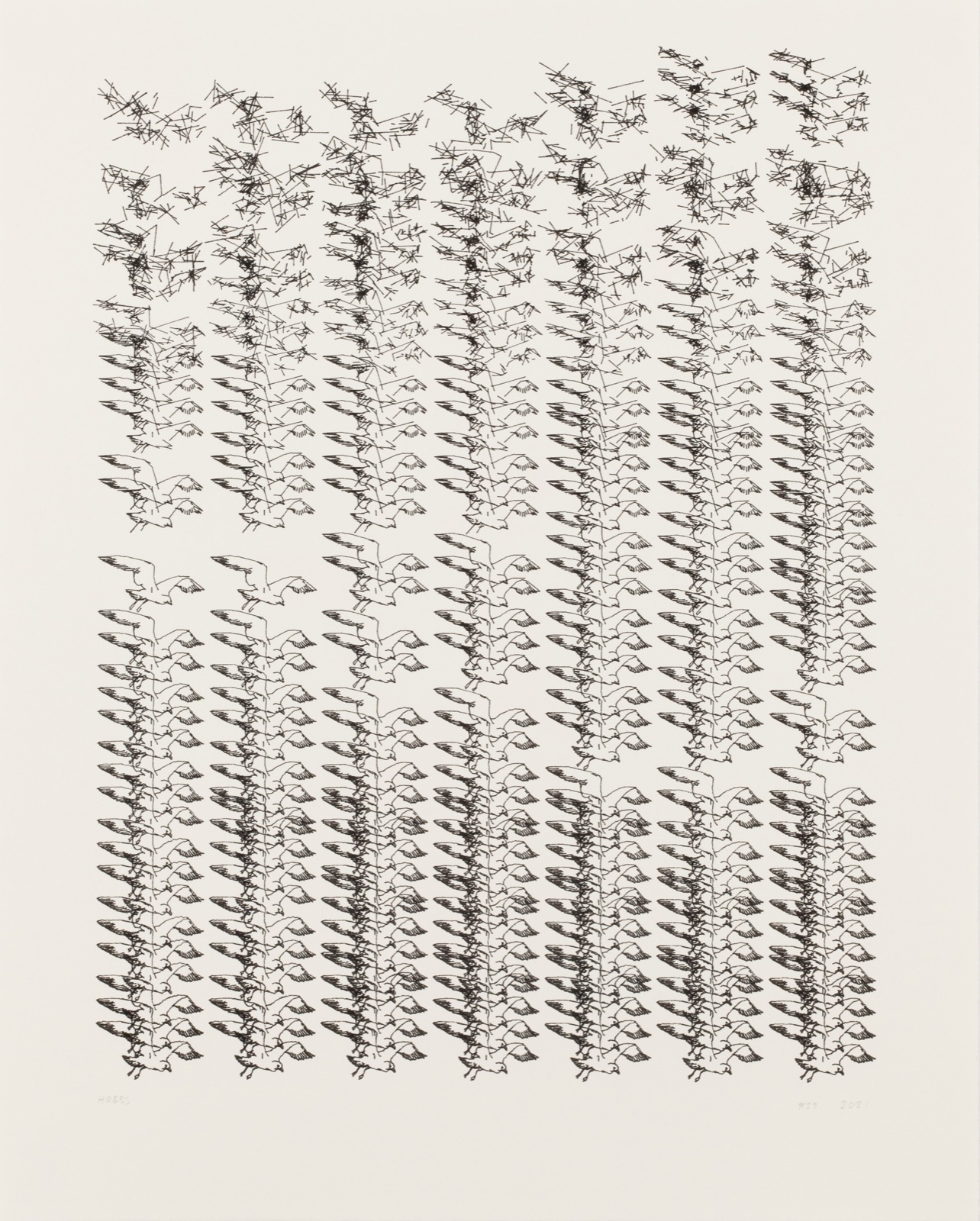
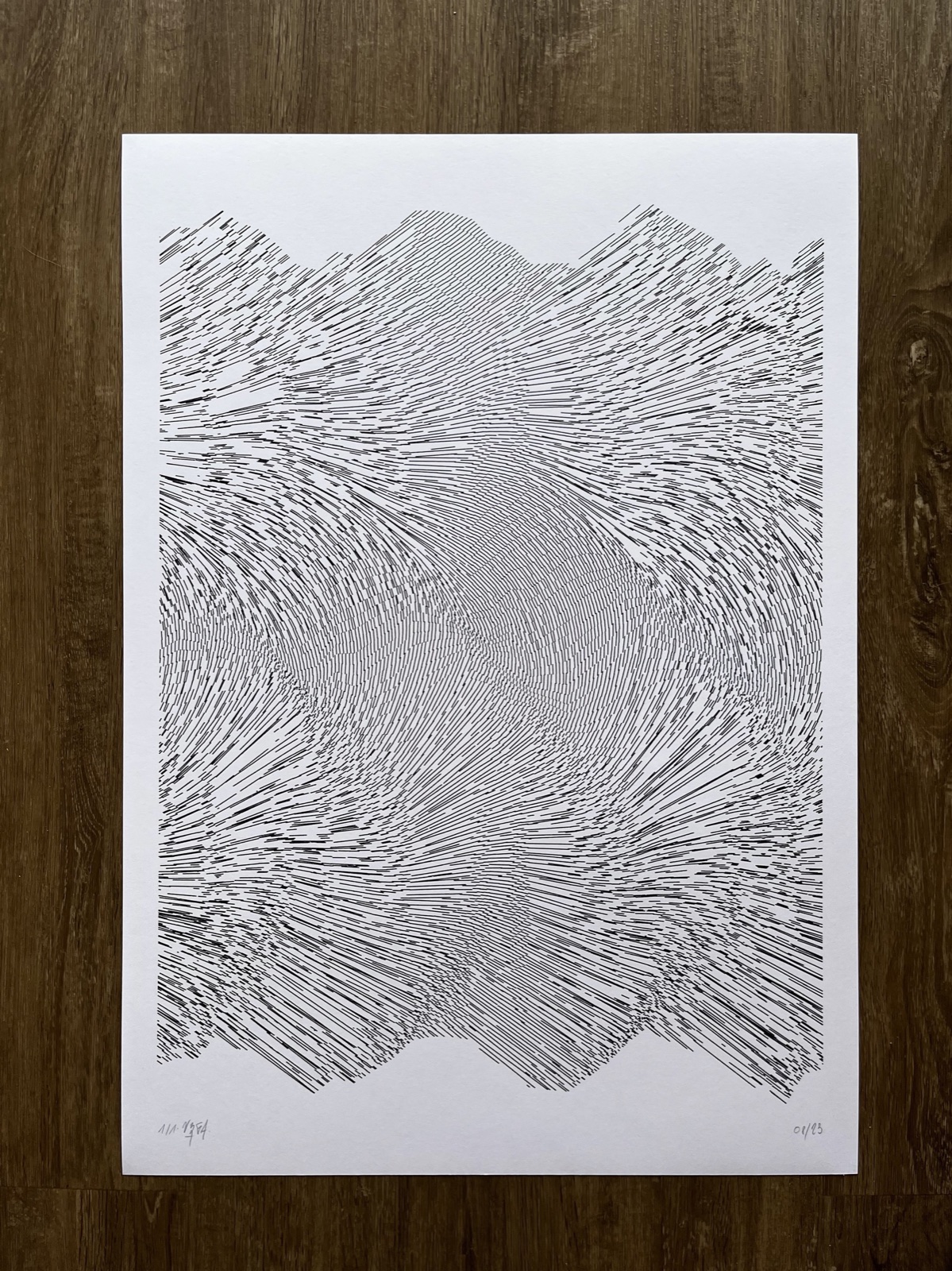
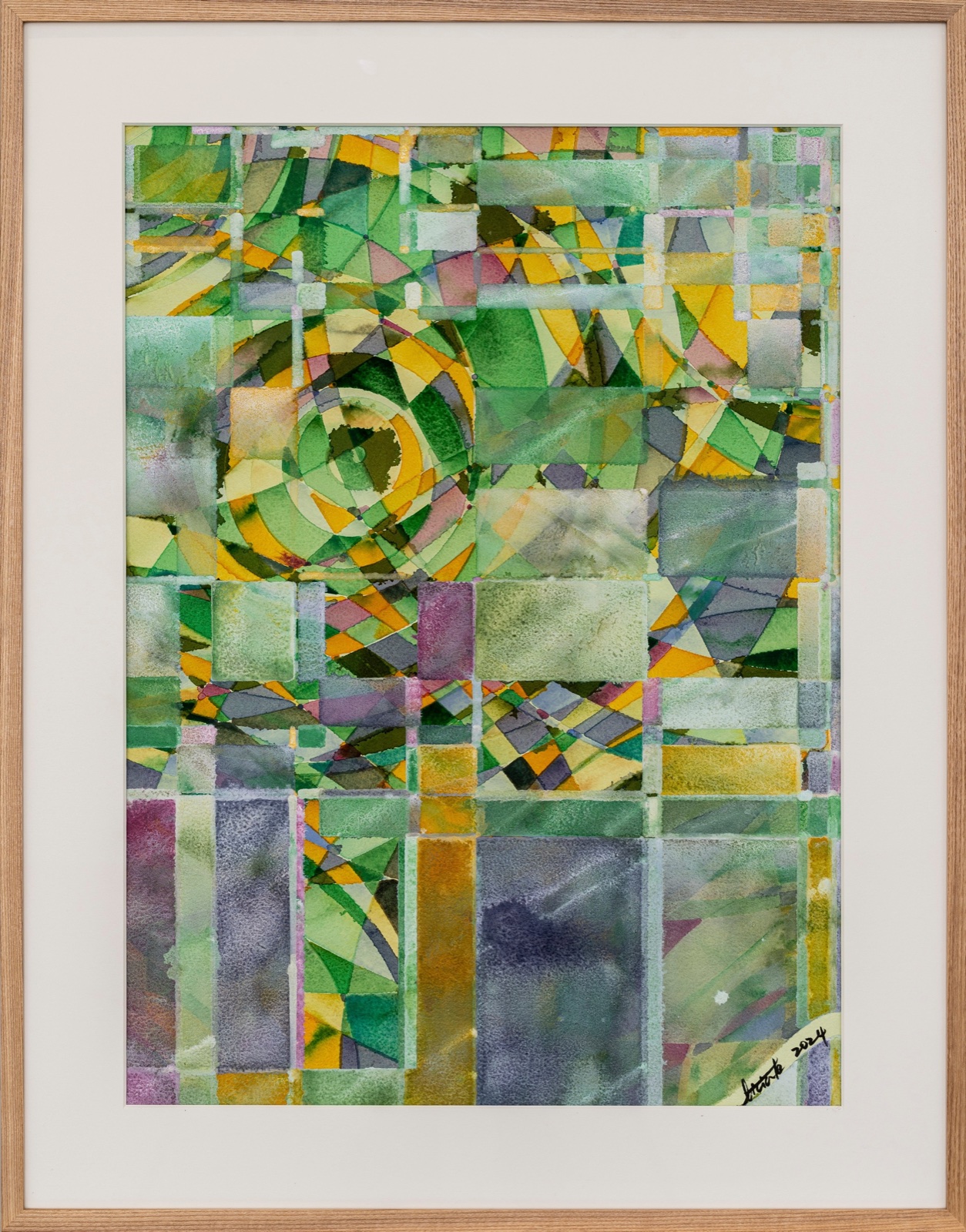
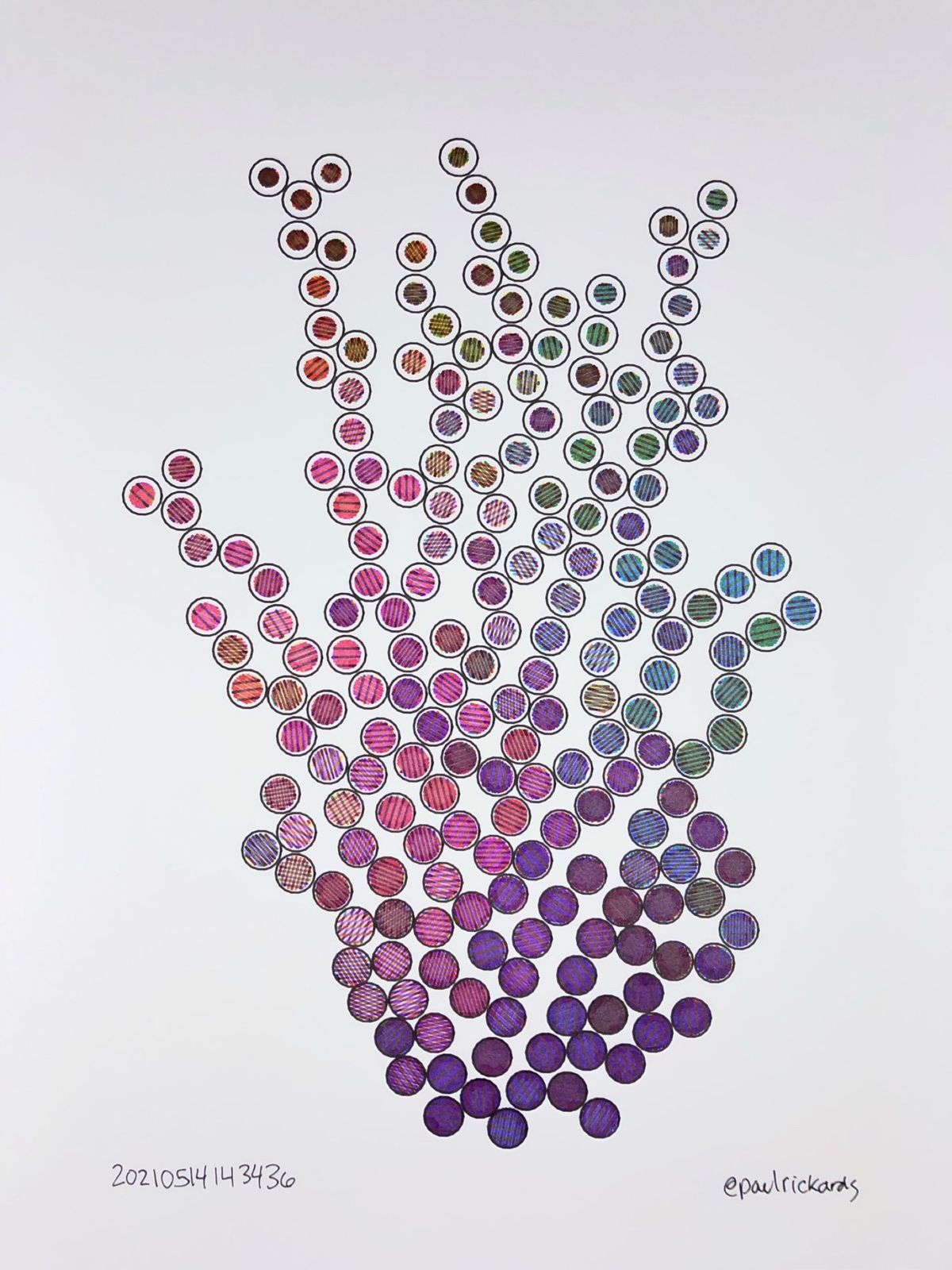
How a plot is made today
A plot today is usually made in six steps, which the tools below are built for.
1. Write a program that outputs lines. The common format is SVG, a vector file that a browser can also show. Processing has a library for it, and since 2024 p5.plotSvg by Golan Levin makes SVG files "tailored for pen plotting" from p5.js.61, 62
2. Clean up and sort the lines. vpype by Antoine Beyeler, "the Swiss-Army-knife command-line tool for plotter vector graphics", joins lines that touch, removes duplicates and sorts the lines so that the pen travels as little as possible in the air.63, 64 The tool saxi does the same while it drives the plotter.65 The difference can be large:
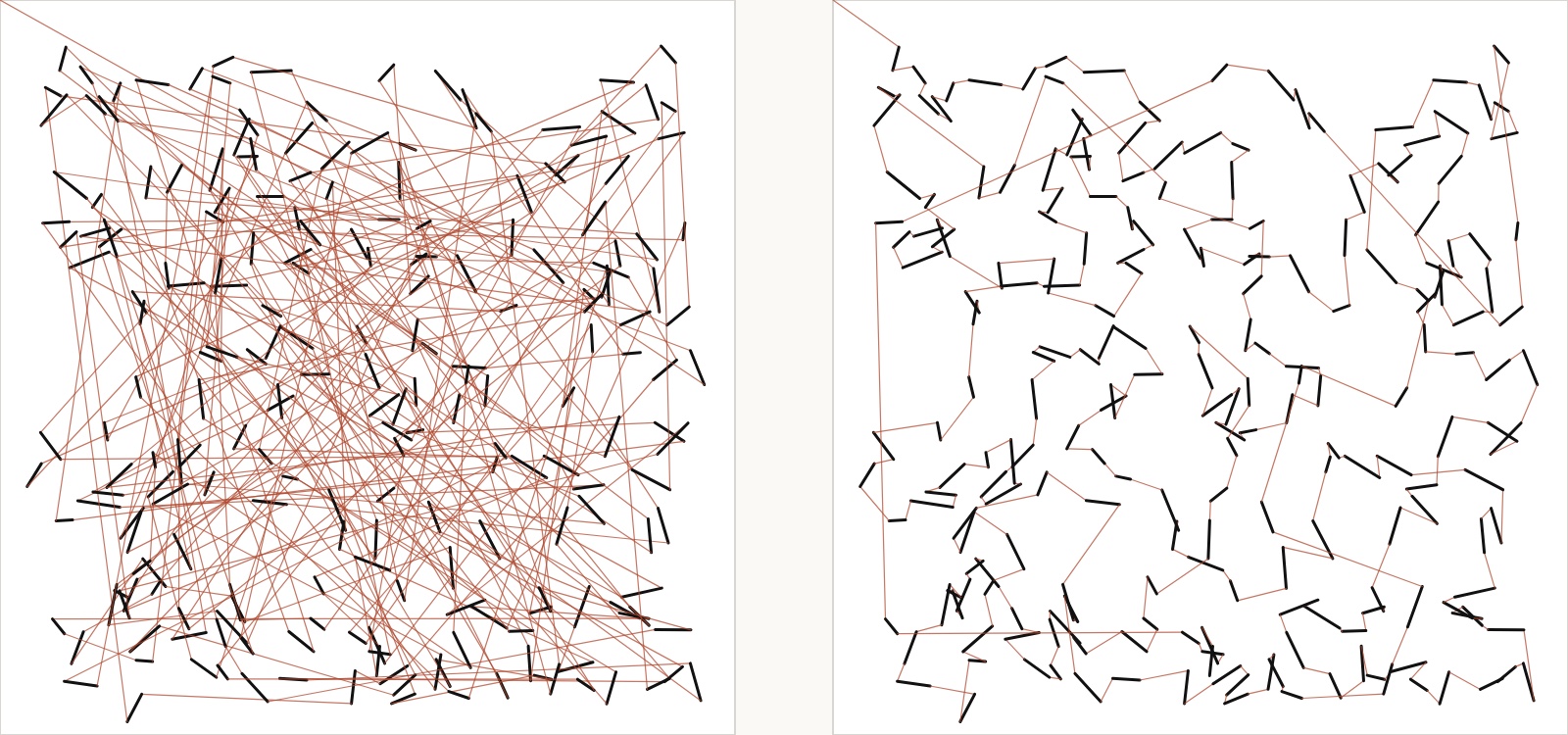
Sorting is not always wanted. The Art Blocks project Time Between the Lines is Thread Through the Mind by Matto (2024) asks collectors who plot it to "maintain the drawing order for canonical outputs", because the order is the work.66
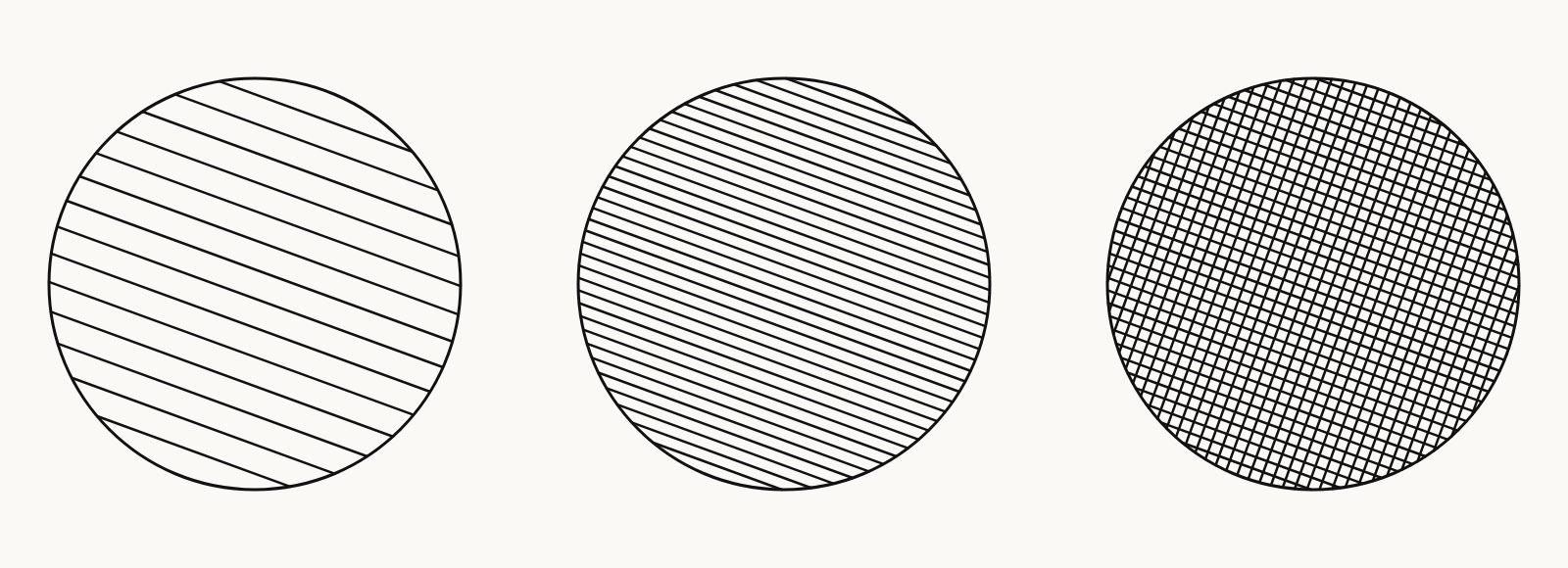
3. Fill areas with hatching. A plotter cannot paint a surface, so it fills areas with parallel lines: the spacing gives the tone, and crossed lines give a darker one. Evil Mad Scientist's Hatch Fill for Inkscape does this "with adjustable spacing and angle".67
4. One layer per pen. Each colour is a separate layer, plotted with its own pen. The pens must sit at the same height, and the paper must not move between layers; otherwise the colours will not meet where they should.68
5. Choose pen and paper. Evil Mad Scientist lists Sakura Pigma Micron pens as recommended by many customers, Staedtler technical pens as common, and notes that "most fountain pens work very well"; gel pens with opaque ink work on dark paper.69 The papers named in artists' records include cotton paper, Stonehenge and Fedrigoni Sirio, and Evil Mad Scientist notes that smoother paper makes pens last longer.53, 59, 56, 69
6. Drive the machine. The AxiDraw is driven from Inkscape, from the command line or from Python.70 Old HP plotters are sent HP-GL.5
An example: Unverified Air
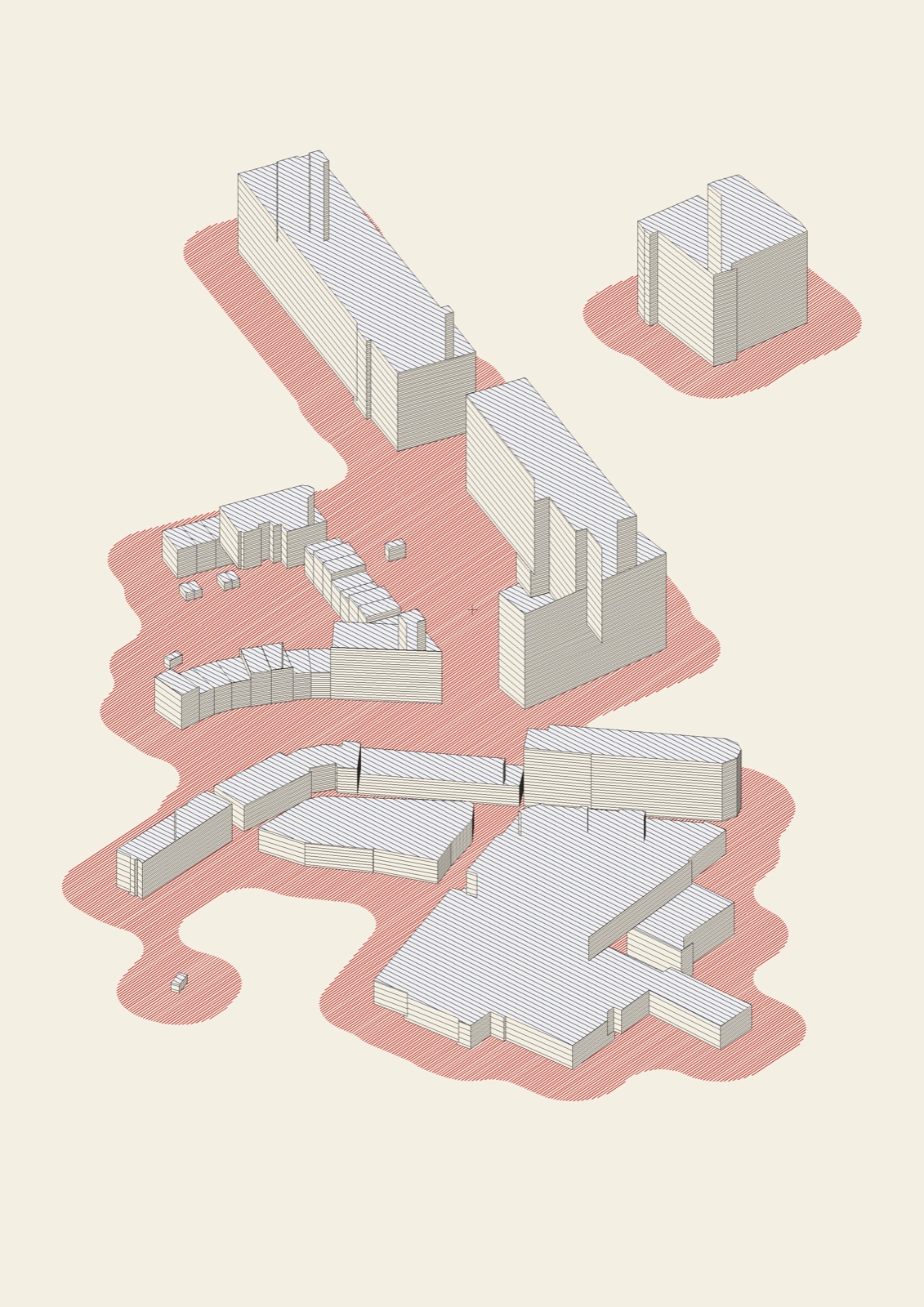
JAEV's exhibition Unverified Air by Olof Broström is a year-long series of drawings for the pen plotter. Every day a program draws the buildings around a European air-quality station, with the day's highest nitrogen dioxide as red lines and ozone as blue lines, and stores the drawing as a plotter file in black, red and blue ink; plotted sheets are made in two copies and signed by hand.71 Each work page gives what a plotter cares about. No. 11, Schiedam in the Netherlands, has 2,231 black, 1,302 red and 685 blue lines, 66 metres of line in total, on an A3 sheet.72
Collecting plotter drawings
A plotter drawing is a physical object, but the program can draw it again. Artists have answered that in different ways. Nake's Hommage à Paul Klee exists as some 30 or 40 drawings from 1965–67 and as a screenprint edition of 40.28 Mohr's work numbers can cover several sheets.73 Hobbs paired each plot with one token.52 Others sell the code and let collectors plot it themselves.66
Some recent prices for early plotter drawings:
| Work | Sale | Price |
|---|---|---|
| Vera Molnár, (Des)ordres, 1974, nine drawings on one roll of Benson plotter paper, unique | Phillips, London, July 2022 | £100,80074 |
| Charles Csuri, Bspline Men, 1966, drum plotter | Christie's, online, March 2025 | $50,40075 |
| Harold Cohen (AARON), Untitled (i23-3758), 1987 | Christie's, online, March 2025 | $11,34075 |
| Frieder Nake, Hommage à Paul Klee, 1966 | Quittenbaum, Munich, October 2025 | €6,500 hammer76 |
Museums buy them as drawings. Csuri's Sine Curve Man and Mohr's Band Structures P-021-U both appear in the Whitney's records as "Plotter pen and ink on paper".77, 78 The V&A in London holds the National Collection of Computer Art, which includes the collection of the American curator Patric Prince.79 The ZKM in Karlsruhe and the Kunsthalle Bremen also hold early plotter drawings.3, 80
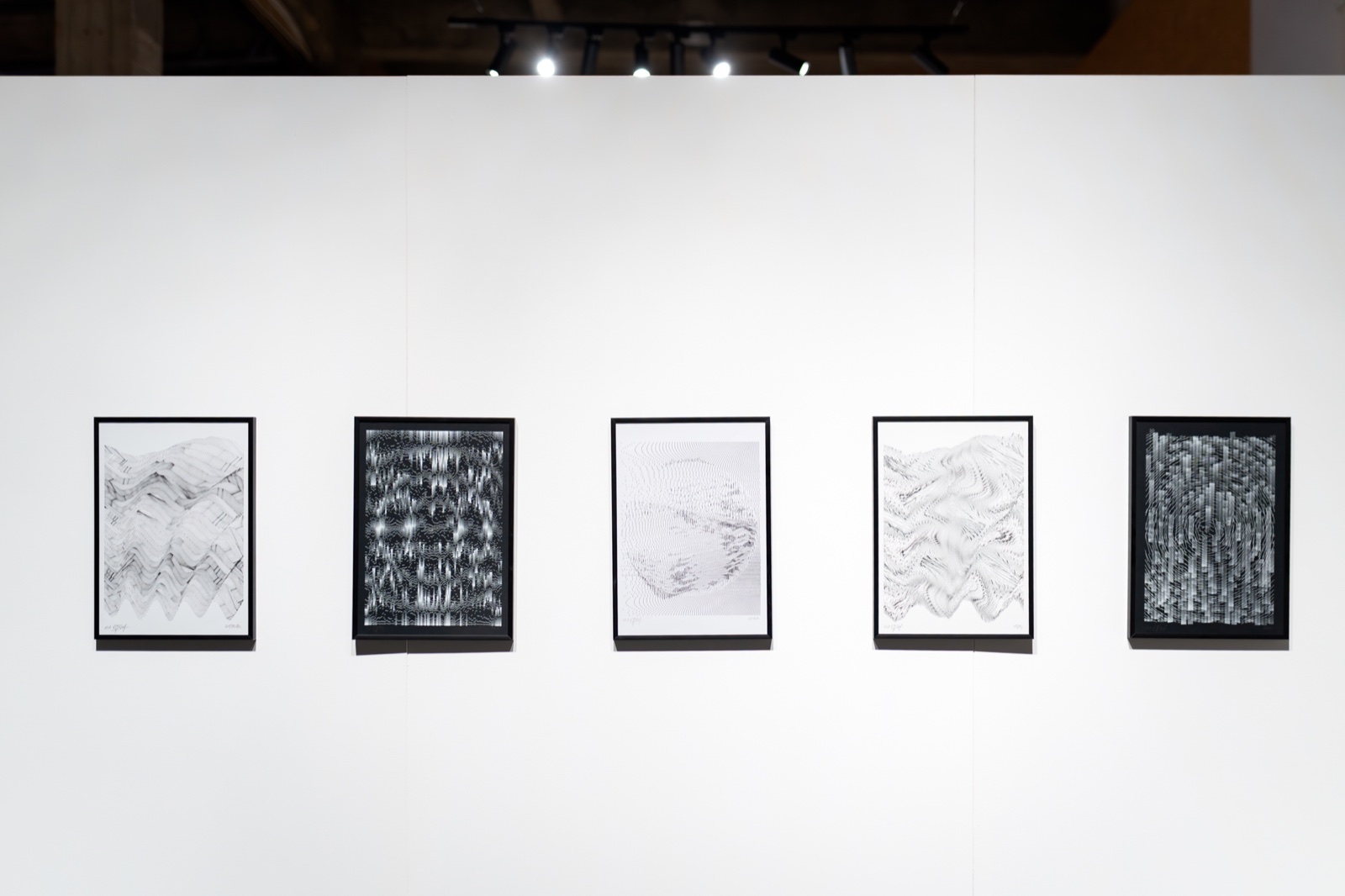
Is the work the code or the drawing?
The question is as old as the field. "Think the image, don't make it," Nake has said of algorithmic art, and he described the paper outputs as belonging to "a more conventional tradition". He also said, of his own selection: "I threw a lot away."1 For Verostko, what defines the work is the artist's own algorithm, yet his works are catalogued as plotter drawings.36, 35 Lemercier and Wander point the other way, to what only the physical pen adds: the glitches, the wear, the ink.51, 58
The plotter does not settle the question; it makes it visible. The program decides every line, and the machine still draws each of them a little differently. That gap, between the rule and the line on the paper, is where plotter art has always lived, from the Zuse Graphomat in 1965 to the AxiDraw on a desk today. JAEV's text on generative art makes the same case for the rule.
Further reading
- JAEV Editorial on the pioneers: Georg Nees, Manfred Mohr, Vera Molnár, Harold Cohen, Computer art in Sweden.
- Frieder Nake, "The Semiotic Engine", Art Journal, 2009: an eyewitness history of the first years.
- DrawingBots: tools, files and artists of today's plotter scene.
- Victoria and Albert Museum, computer art: search the collection for "plotter".
Sources
- Frieder Nake and Wolf Lieser, “60 Years of Algorithmic Art”. Digital Art Museum (DAM)
“Think the image, don't make it.” “I threw a lot away.” On Galerie Niedlich: “it changed my life.” - Frieder Nake, “The Semiotic Engine: Notes on the History of Algorithmic Images in Europe”. Art Journal 68:1, 2009
Eyewitness account of the Nees opening in Stuttgart, 5 February 1965. - Georg Nees, Achsenparalleler Irrweg, 1964. ZKM | Center for Art and Media Karlsruhe
A plotter drawing from a Siemens computer programmed in ALGOL, drawn with the “ZUSE Graphomat Z 64”. - Brian Schmalz, “EiBotBoard” (the controller of the EggBot and AxiDraw)
“This command … will cause the motors to move in a straight line between two points”; “The EBB does not understand G-code.” - HP 9872A Graphics Plotter. HP Computer Museum
“Introduced: 1977”; with the 9872A HP “began marketing its 2-letter mnemonic graphics language as HP-GL”; four pens; $4,200. - “HPGL commands”. Reference, PIC microcontroller archive (Hallikainen)
IN, SP, PU, PD, PA, PR. A community reference; the HP manuals online are image scans. - HP 7475A Interfacing and Programming Manual, p. 2-5, quoted in Inkscape bug report 548918
“one plotter unit equals 0.025 mm (0.00098 in)”. - “CalComp Inc.”. Encyclopedia.com (company history)
Founded 1958; in 1959 it “developed the world's first drum plotter”; the Model 565. - “Bresenham line drawing and the IBM 1627”. IBM 1401 restoration project
IBM 1627 Model 1 = CalComp 565: “Plotting area: 11 inches by 120 feet”, “1/100 inch incremental-step size, up to 18,000 steps/minute”. - “CalComp 565 plotter”. Computer museum, University of Amsterdam
A “drum-type XY plotter” driven by step motors; sold by IBM as model 1627. - Zuse Z64 Graphomat. ZCOM Zuse-Computer-Museum, Hoyerswerda, via museum-digital
Built 1961–1964, 98 units, four colours. Read as a search summary; the Zuse brochure in the RPTU computer museum is dated 1962. - “Model for the grit wheel plotter, 1976”. HP Virtual Museum
Sandpaper on the paper drive roller; invented by Larry Labarre of HP Labs. - HP 7580A Drafting Plotter. HP Computer Museum
Introduced 1981; the first “grit wheel” pen plotter; in the late 1970s Calcomp and Xynetics led the US market while “a French company, Benson, held sway in Europe”. - “Computerized Sketching With The Polargraph”. The Creators Project / Vice, 27 June 2011
Sandy Noble's hanging plotter, “a pen and string”, driven by an Arduino. - Frieder Nake, Hommage à Paul Klee 13/9/65 Nr. 2, 1965. ZKM | Center for Art and Media Karlsruhe
“computer: Standard Elektrik Lorenz ER56”, “output device: Zuse Graphomat Z64”. - Manfred Mohr, “Météorologie Nationale”
“a Benson 1284 flatbed plotter”, “a CDC 6400 computer”; he worked there “almost nightly” from 1970 to 1983. - HP 7470A Graphics Plotter. HP Computer Museum
“Introduced: 1982”, $1,550, “the world's first small format paper-moving plotter”, two pens, A4. - “History”. Roland DGA
1982: DXY-100 pen plotter; 1983: DXY-800 A3 pen plotter. Roland DG's 2015 annual report gives 1981 for the DXY-100. - HP 7475A Graphics Plotter. HP Computer Museum
“Introduced: 1983”, $1,895, six-pen carousel, A4 and A3; “the most popular pen plotter ever made”; sold until 1994. - “Egg-Bot, An Art Robot That Can Draw on Spherical Surfaces”. Laughing Squid, 8 September 2010
- Windell Oskay, “The AxiDraw Drawing Machine”. Evil Mad Scientist, 9 March 2016
“a simple, modern, precise, and versatile pen plotter”; writes with “fountain pens, permanent markers, and other writing implements”. - “Evil Mad Scientist joins Bantam Tools”. Evil Mad Scientist, 16 January 2024
- “Introducing Bantam Tools NextDraw”. Evil Mad Scientist, 29 April 2024
Three models, from A4 to A1. The AxiDraw is listed as “No longer in production” in the shop. - Georg Nees, Schotter, 1968–1970 (E.217-2008). Victoria and Albert Museum, London
Nees “was instrumental in their purchasing a ‘Zuse Graphomat’, a drawing machine operated by computer-generated punched tape”; first shown at the Technische Hochschule Stuttgart in February 1965. - “Timeline: Events”. Digital Art Museum (DAM), Berlin
Stuttgart, 5–19 February 1965; Galerie Niedlich, 5–26 November 1965; Zagreb, 1968 and 1969. - Zellyn Hunter, “Schotter – Georg Nees – Part 1”, 2024
A reading of Nees's ALGOL program for Schotter. - Frieder Nake, Hommage à Paul Klee, 1965 (screenprint after a plotter drawing). Victoria and Albert Museum, London
Based on Klee's 1929 painting Hauptweg und Nebenwege; screenprint edition of 40. - “Hommage à Paul Klee”. Digital Art Museum (DAM), Berlin
Nake “generated about 30 or 40 copies” of the drawing from 1965 to 1967, and a silkscreen edition of 40 in 1966. - Charles Csuri, Sine Curve Man Three, 1967. The Charles A. Csuri Project, Ohio State University
“Hardware Calcomp Drum Plotter Model 565, IBM 7094, Punch Cards”. - Charles Csuri, Sinescape, 1967. The Charles A. Csuri Project, Ohio State University
Colour obtained “by simply changing the plotter pen from black to red”. - Manfred Mohr, “50 Year Celebration: Time Line”
Artist's own account: first program mid-October 1969; at Vincennes “I had to plot the lines by hand”; Brookhaven light-beam plotter; Zuse flatbed plotter in Darmstadt, spring 1970; Benson plotter and CDC 6400 at the Météorologie Nationale. - “Vera Molnar aux sources du code”. Centre Pompidou, Magazine
In 1968 she gained access to the computing centre at Orsay; “On s'endormait le soir avec le bruit de la table traçante.” - “Harold Cohen and AARON: A 40-Year Collaboration”. Computer History Museum
AARON from 1973; the turtle, “a small robot equipped with a marker”; “The turtles gave way to sturdier pens on robotic arms”. - Jean-Pierre Hébert, Untitled, 1990. Victoria and Albert Museum, London
“acquired his first pen plotter in 1978”. The Digital Art Museum gives 1977. - Roman Verostko, Pathway Series, Bird 2, 1990. Victoria and Albert Museum, London
“adapting a pen plotter to hold a Chinese brush”. - Roman Verostko, “The Algorists”
“In 1995, Jean-Pierre suggested that we adapt the term algorist for our identity.” “It is the inclusion of one's own algorithms that makes the difference.” - Sten Kallin, interview by Anna Orrghen, 2007. Tekniska museet, Stockholm (PDF)
Evenings on an IBM 1130 and its drum plotter at IBM in Solna; on the loose pen: “lite karaktär eller lite slump i strecket”. - Astrid Sampe, Computer Colonne, 1975 (reproduced 1985). Art Institute of Chicago
“Designed by Astrid Sampe (Swedish, 1909–2002) with computer programmer Sten Kallin and IBM Plotter 1627”. - A. Michael Noll, “First-Hand: Early Digital Art at Bell Telephone Laboratories, Inc.”. Engineering and Technology History Wiki
“The data were plotted on 35-mm film by a Stromberg Carlson SC-4020 microfilm plotter.” - A. Michael Noll, “Howard Wise Gallery Show of Digital Art and Patterns (1965): A 50th Anniversary Memoir”. Engineering and Technology History Wiki
The press release names the IBM 7094 and the “SC-4020 Microfilm Plotter”; “In the end, not a single work was sold.” - Hiroshi Kawano, Design 1, 1964. ZKM | Center for Art and Media Karlsruhe
“Painting after a computer-generated design … output: line printer.” - “Desmond Paul Henry”. Computer Arts Society
Drawing machines built from “analogue Bombsight Computers”; first show 1962, Reid Gallery, London; the second machine at Cybernetic Serendipity. - “The Aesthetics of the Color Plotter”. Cooper Hewitt, Smithsonian Design Museum, 8 May 2018
Mikael Jern's software in Lund drove a colour jet plotter that “rendered images with a fine array of dots”. - “Cybernetic Serendipity: The Computer and the Arts”. ICA archive
2 August – 20 October 1968; “some 60,000 visitors”; “over 130 participants”. - Manfred Mohr, “Computer Graphics – Une Esthétique Programmée”, ARC, Musée d'Art Moderne de la Ville de Paris, 1971
“BENSON-France SA, generously installed a plotter (drawing machine)” in the exhibition. - “Computer Culture Art Show '81”. ACM SIGGRAPH History Archive
The first formal SIGGRAPH art show, Dallas City Hall, 3–28 August 1981. - “Cybernetic Serendipity: The Computer and the Arts”, Studio International special issue, ed. Jasia Reichardt, 1968. Contents
Texts by Nake, Nees, Noll and Harmon and Knowlton, an interview with Csuri, and a section on the “Calcomp plotting system”. - Paul Rickards, “Pen Plotter Designs”. biosrhythm.com
His Commodore 1520, an HP 7585B and a Roland DXY 1150. - Hannah Twigg-Smith, Jasper Tran O'Leary and Nadya Peek, “Tools, Tricks, and Hacks: Exploring Novel Digital Fabrication Workflows on #PlotterTwitter”. CHI '21, ACM, 2021
- Joanie Lemercier, “Paysages Possibles”
“Plotter, pen on paper (2018 – ongoing)”. - “Joanie Lemercier, Plotter drawings series, n° 112”. Artjaws
“mechanical glitches coming from the machine, wear and ink glitches coming from the pen”. - Tyler Hobbs, F(l)ight, 2021. Feral File
“the first collector of each edition will receive the corresponding plotter drawing.” - Licia He, Even when I want to., 2022. Gazelli Art House
“Plotter-rendered generative painting made with Python, mixed watermedium on cotton paper”; AxiDraw A3. - “Licia He: I Have To Talk To A Plotter”. GAZELL.iO, London, 2024
- LIA, “Mechanical Interventions: An Investigation into Generative Plotter Painting”, 2018
AxiDraw with brushes, Indian ink and watercolour; custom software for the Z axis. - “Julien Gachadoat”. Kate Vass Galerie
“By printing these unique pieces with a plotter, he creates a link between text and code, between computer and pencil.” - “Sinusoïdes”, Julien Gachadoat and Pierre Braun, Galerie Data, Paris, 4–27 April 2024. v3ga.net
- “Verse meets Lars Wander”. Verse
“the pen plotter imbues physicality on the piece that you really don't get on the computer screen”. - Tyler Hobbs, F(l)ight. tylerxhobbs.com
“Black Archival Ink on Stonehenge Paper & Matching Non-Fungible Tokens”. - Paul Rickards, CMY Circle Growth Series
- “SVG Export”. Processing reference
- Golan Levin, p5.plotSvg (README)
“a p5.js library for exporting SVG files tailored for pen plotting”, begun in November 2024 for the course Drawing with Machines at Carnegie Mellon. - Antoine Beyeler, vpype
“The Swiss-Army-knife command-line tool for plotter vector graphics”; line merging, line sorting, layers. - “Plug-ins”. vpype documentation
hatched, occult, deduplicate, vpype-gcode and others. - saxi
“minimizes pen-up travel time by reordering & reversing paths”. - Matto, Time Between the Lines is Thread Through the Mind. Art Blocks, 2024
“Please maintain the drawing order for canonical outputs - avoid reordering or optimizing the paths during plotting.” - “Hatch fill”. Evil Mad Scientist wiki
“Hatch Fill will fill any selected objects with a series of back and forth lines, with adjustable spacing and angle.” - “Multicolor plot tips”. Evil Mad Scientist wiki
- “Pens for AxiDraw”. Evil Mad Scientist wiki
Micron, Staedtler, fountain pens, Rotring, gel pens; pens up to 16 mm across and 45 g. - “AxiDraw CLI & Python API”
- Olof Broström, Unverified Air, 2026–2027. JAEV
- Olof Broström, Unverified Air, no. 11 (Schiedam-Alphons Arienstraat), 14 October 2026. JAEV
“Lines: 2,231 black, 1,302 red, 685 blue”; “Line length: 66 m in total”; “A3, 297 × 420 mm (plotted)”. - Manfred Mohr, P-103, “visual pythagoras”, 1972
“series of four plotter drawings, ink on paper”. - Vera Molnár, (Des)ordres, 1974. Phillips, Ex-Machina: A History of Generative Art, London, July 2022, lot 22
“9 DESSINS SUR 1 ROULEAU”, Benson plotter paper, unique; sold for £100,800. - “Christie's All-A.I. Sale Surpasses Expectations”. Artnet News, March 2025
Csuri's Bspline Men (1966) at $50,400; Cohen's 1987 AARON drawing at $11,340. - Frieder Nake, Hommage à Paul Klee, 1966, no. 28/100. Quittenbaum, Munich, sale 179C, 15 October 2025, lot 718
€6,500 hammer. The catalogue speaks of an edition of 100 machine drawings. - Charles Csuri, Sine Curve Man, 1967 (2018.33). Whitney Museum of American Art, New York
“Plotter pen and ink on paper”. - Manfred Mohr, Band Structures P-021-U, 1970–1983 (2019.418). Whitney Museum of American Art, New York
“Plotter pen and ink on paper”. - “Patric D. Prince: digital art visionary”. Victoria and Albert Museum
“The V&A holds the National Collection of Computer Art”; Prince gave over 260 artworks and an archive in 2008. - Wulf Herzogenrath and Barbara Nierhoff-Wielk (eds.), Ex machina: frühe Computergrafik bis 1979. Die Sammlungen Franke und weitere Stiftungen in der Kunsthalle Bremen, 2007
- “DRAW()”, Overflow, Liège, 13–30 January 2026
With Arno Beck, Daniela Kröhnert, Frédérik Vanhoutte, Jessica In, Joanie Lemercier, Julien Gachadoat and Matt DesLauriers.
- Published
- JAEV Editorial, 19 October 2026.
- Use
- Text CC BY 4.0. Free to use and quote with credit to JAEV and a link to this page. Images and quotations by others keep their own terms.
All texts as one file: archive.json - Cite
- JAEV Editorial, “Plotter Art”, jaev.gallery/editorial/plotter-art/, 2026.
- Corrections
- Additions and corrections are welcome: info@jaev.gallery
- Share
A link from your own site, course page or reading list helps others find it.- Follow
- New texts by RSS · Instagram · Bluesky
JAEV is a daemon taking shape: machines, weights, room, brain.