Conway's Game of Life (1970)
JAEV Notes · October 2026 · 2 min read
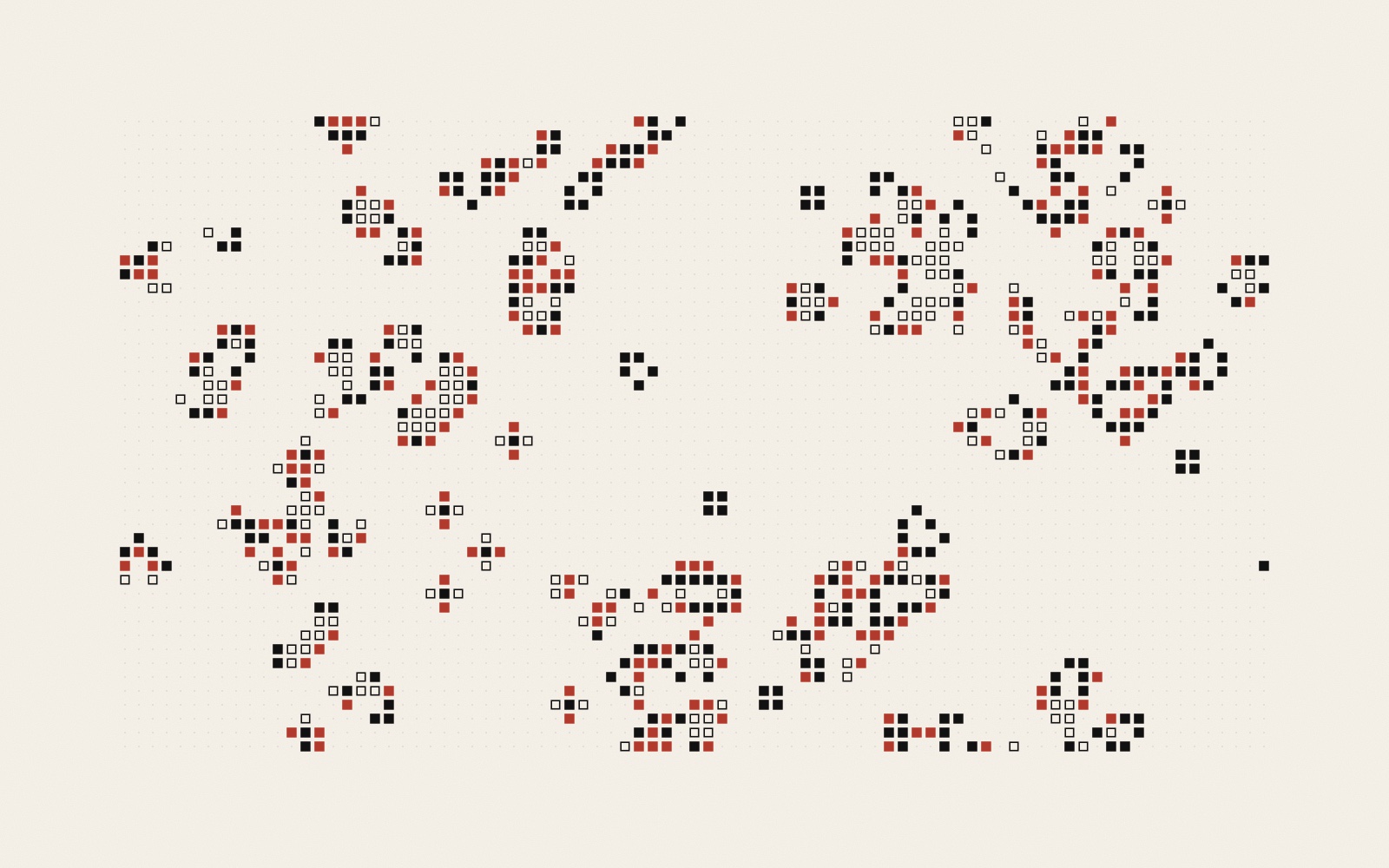
The Game of Life is a grid of cells, each either alive or empty, that changes in steps by three rules about neighbours. The British mathematician John Horton Conway devised it in 1970, and Martin Gardner made it known in his "Mathematical Games" column in Scientific American in October that year.1, 2
The rules
Gardner presented it as a game for one person with a large checkerboard and flat counters of two colours. Each cell has eight neighbours, four beside it and four on the diagonals. Conway's "genetic laws", as the column calls them:1
- Survivals. "Every counter with two or three neighboring counters survives for the next generation."
- Deaths. A counter with four or more neighbours dies from overpopulation; one with one neighbour or none dies from isolation.
- Births. "Each empty cell adjacent to exactly three neighbors – no more, no fewer – is a birth cell."
"It is important to understand that all births and deaths occur simultaneously." To keep them apart on the board, Conway put a black counter on every cell about to die and a white one on every birth cell, checked the board, and only then cleared the dead and turned the white counters black.1 The picture at the top of this page marks one generation the same way.
Conway chose the rules after long experiment, aiming for a result that would be hard to predict: there should be no simple proof that a pattern can grow without limit, some patterns should seem to grow without limit, and simple patterns should change for a long time before they die out, settle, or start repeating.1
What the rules make
Most random starts end in "still lifes", shapes that no longer change, or in oscillators that repeat for ever, such as the "blinker", a row of three cells that turns from horizontal to vertical and back. Some take very long: Conway followed the five-cell R pentomino for 460 generations without learning its fate.1
The best-known shape is the glider: five cells that after four generations have rebuilt themselves one cell further along the diagonal.1
Conway guessed that no pattern could grow without limit and offered $50 to the first person to prove or disprove it before the end of 1970.1 In November a team at MIT led by Bill Gosper won the prize with a glider gun.2 Life has since been shown to be Turing-complete: in principle, a large enough pattern can carry out any computation a computer can.2
A rule, not a picture
Life is a cellular automaton: nothing in it is drawn, only the rule is written, and every shape on the grid follows from the starting cells. That makes it a close relative of other rule systems in these notes, such as Boids, where flocks appear from three rules per bird, and diffusion-limited aggregation. See also Generative Art.
Sources
- Martin Gardner, “Mathematical Games: The fantastic combinations of John Conway's new solitaire game “life””. Scientific American 223, October 1970
Conway at Gonville and Caius College, Cambridge; a checkerboard and counters of two colours; the three desiderata; Survivals (two or three neighbours), Deaths (four or more, or one or none), Births (exactly three); “all births and deaths occur simultaneously”; $50 prize; R pentomino tracked for 460 moves; PDP-7 program by M. J. T. Guy and S. R. Bourne; the glider, one cell diagonally in four moves, “a fourth the speed of light”. - “Conway's Game of Life”. Wikipedia
The prize “won in November by a team from the Massachusetts Institute of Technology, led by Bill Gosper”; the Game of Life is Turing-complete.
- Published
- JAEV Notes, October 2026.
- Use
- Text CC BY 4.0. Free to use and quote with credit to JAEV and a link to this page. Images and quotations by others keep their own terms.
All texts as one file: archive.json - Cite
- JAEV Notes, “Conway's Game of Life (1970)”, jaev.gallery/notes/game-of-life/, 2026.
- Corrections
- Additions and corrections are welcome: info@jaev.gallery
- Share
A link from your own site, course page or reading list helps others find it.- Follow
- New notes by RSS · Instagram · Bluesky
JAEV is a daemon taking shape: machines, weights, room, brain.