Diffusion-limited aggregation (Witten and Sander, 1981)
JAEV Notes · October 2026 · 2 min read
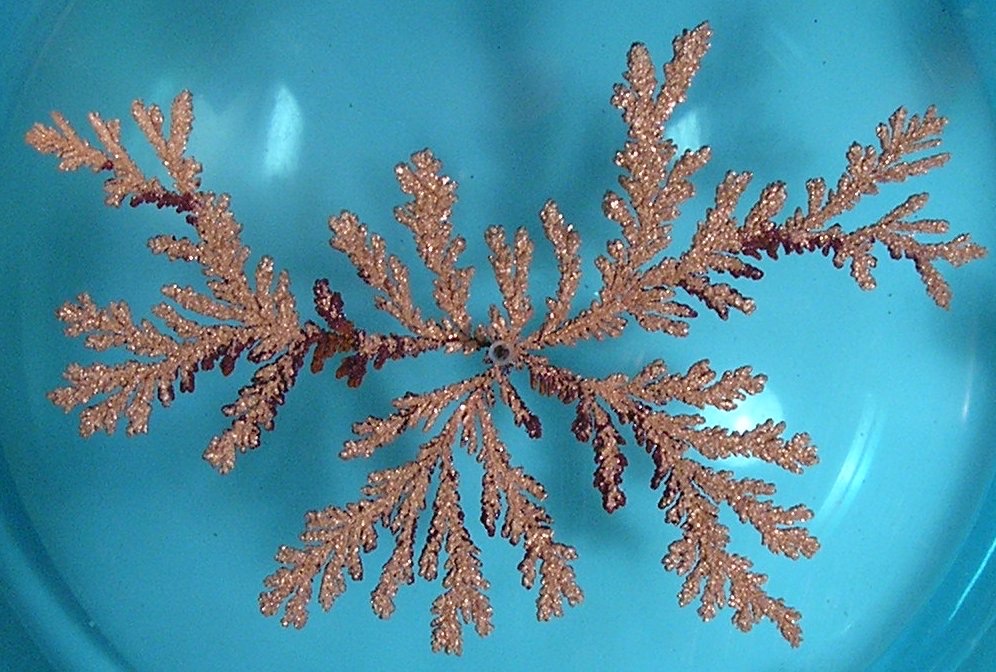
Diffusion-limited aggregation (DLA) is a way for a cluster to grow: particles wander at random, and each one stops for good where it first touches the cluster. The physicists Tom Witten and Len Sander introduced it in 1981 in Physical Review Letters, as a model of "irreversible colloidal aggregation", in a paper that begins "A model for random aggregates is studied by computer simulation."1, 2
How it works
The rule is short. Paul Bourke gives it for a picture made of pixels:3
- Start with an empty image. One particle is fixed: "a single black pixel in the center".
- Let a new particle loose at the edge and move it one step at a time, in a random direction each time, so that its path is a random walk.
- When it comes next to a fixed particle, it sticks. It belongs to the cluster now, and the next particle starts.
Nothing tells the cluster to branch. It branches because of where wandering particles arrive. In the physicist Thomas C. Halsey's words, "an arriving random walker is far more likely to attach to one of the tips of the cluster" than to get deep into one of its "fjords" without touching something first. The tips grow, and in doing so they shield the gaps behind them, at every scale.2
The result is a fractal: the number of particles grows more slowly than the area the cluster covers. In two dimensions and without a grid, its fractal dimension is about 1.71, more than a line (1) and less than a filled surface (2).2, 4 The same rule also works in three dimensions, as Len Sander points out; his review of 2000 covers the model at length.5
Where it appears
The same branching shows up wherever growth is fed by particles that arrive by diffusion: copper deposited from a solution by an electric current, mineral deposits, fluid pushed into a thin gap between two plates, and the paths of electrical breakdown in an insulator.4, 6 Bourke adds coral growth and "the path taken by lightning".3
Changing the rule
Small changes to the rule change the form. If a particle sticks only with a certain probability, and otherwise walks on, it gets further into the gaps; Bourke finds that the form then becomes "more hairy and solid".3 Computer drawings of this kind were popular as computer art in the 1990s, often under the name Brownian trees.4 In DLA, as in Conway's Game of Life, only the rule is written; the form is left to evolve. See also Generative Art.
Paul Bourke, whose page on DLA this note draws on, read it in October 2026 and suggested one wording, which we have used.
Sources
- T. A. Witten Jr. and L. M. Sander, “Diffusion-Limited Aggregation, a Kinetic Critical Phenomenon”. Physical Review Letters 47 (19), p. 1400, 9 November 1981 (abstract page)
Received 31 August 1981. “A model for random aggregates is studied by computer simulation.” The model applies to a metal-particle aggregation process; density correlations fall off with distance as a fractional power law. - Thomas C. Halsey, “Diffusion-Limited Aggregation: A Model for Pattern Formation”. Physics Today 53 (11), November 2000, pp. 36–41
Introduced “by Tom Witten and Len Sander as a model for irreversible colloidal aggregation”; “An arriving random walker is far more likely to attach to one of the tips of the cluster … than to penetrate deeply into one of the cluster's “fjords””; “the tips tend to screen the fjords”, on all length scales; D ≈ 1.71 in two dimensions without a lattice. - Paul Bourke, “DLA – Diffusion Limited Aggregation”, June 1991, updated 2004 and 2014
Start with “a single black pixel in the center”; new points “introduced at the borders and randomly” walk “until they are close enough to stick”; a probability of sticking below 1 makes the form “more hairy and solid”; coral growth, “the path taken by lightning”. - “Diffusion-limited aggregation”. Wikipedia
Fractal dimension about 1.71 in two dimensions off a lattice; electrodeposition, Hele-Shaw flow, mineral deposits, dielectric breakdown; Brownian trees as computer art in the 1990s. - L. M. Sander, “Diffusion-limited aggregation: a kinetic critical phenomenon?”. Contemporary Physics 41 (4), 2000, pp. 203–218
Recommended by Sander as a comprehensive review with many images (email to JAEV, 26 October 2026). The remark that the algorithm also works in three dimensions is from the same email. The review itself not read. - Kevin R Johnson, “DLA Cluster”, 19 May 2006. Wikimedia Commons, CC BY 2.5
“Copper aggregate formed from a copper sulfate solution in an electrode position cell.”

- Published
- JAEV Notes, October 2026.
- Use
- Text CC BY 4.0. Free to use and quote with credit to JAEV and a link to this page. Images and quotations by others keep their own terms.
All texts as one file: archive.json - Cite
- JAEV Notes, “Diffusion-limited aggregation (Witten and Sander, 1981)”, jaev.gallery/notes/diffusion-limited-aggregation/, 2026.
- Corrections
- Additions and corrections are welcome: info@jaev.gallery
- Share
A link from your own site, course page or reading list helps others find it.- Follow
- New notes by RSS · Instagram · Bluesky
JAEV is a daemon taking shape: machines, weights, room, brain.