Reaction–diffusion (Alan Turing, 1952)
JAEV Notes · October 2026 · 2 min read
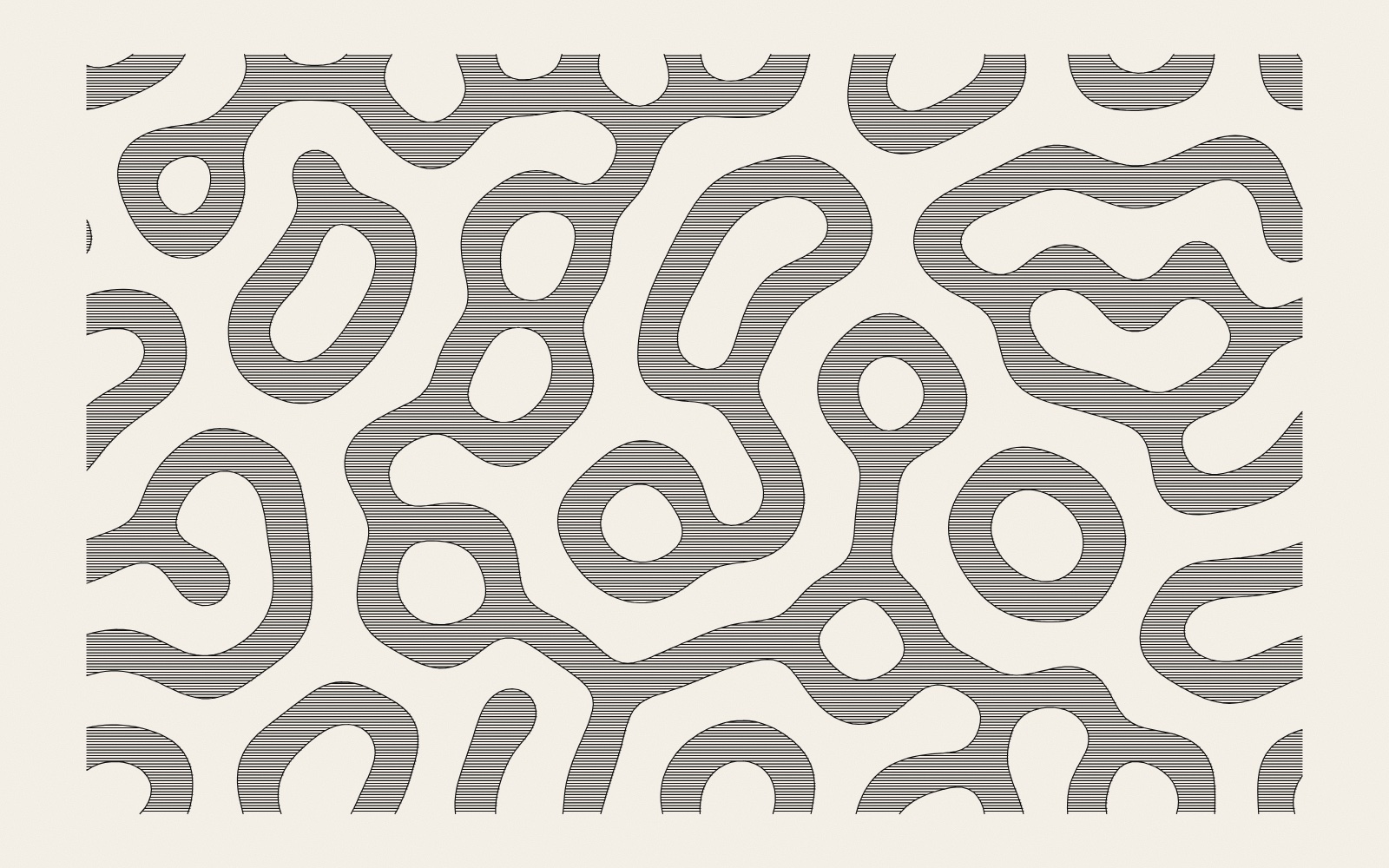
Reaction–diffusion is a way for patterns to appear by themselves: two or more chemicals react with each other and spread out at different speeds, and an even mixture breaks up into spots or stripes. Alan Turing proposed it in 1952 in "The chemical basis of morphogenesis", as a possible explanation of how a growing embryo gets its form.1 The same equations can be run step by step on a grid of numbers, as in the sketch below.
Turing's idea
The paper was published on 14 August 1952. It opens: "It is suggested that a system of chemical substances, called morphogens, reacting together and diffusing through a tissue, is adequate to account for the main phenomena of morphogenesis." Such a system can start out "quite homogeneous" and still develop a pattern, "due to an instability of the homogeneous equilibrium, which is triggered off by random disturbances".1 Turing suggested that "a few particular cases" could be treated "with the aid of a digital computer".1
Gierer and Meinhardt independently described a theory of the same kind in 1972, with two substances: an activator and an inhibitor. In a commentary on Turing's paper, Philip Ball writes: "Crucially, they must have different rates of diffusion, the inhibitor being faster". Patterns like these were first reported in a real chemical reaction in 1990.2
The Gray-Scott model
A model often used for pictures is the one by Gray and Scott, which John E. Pearson explored with computer simulations in Science in 1993. It has two reactions: one molecule of U and two of V make three of V, and V turns into an inert product. U is fed in from outside.3 In Karl Sims's tutorial the chemicals are called A and B, and every cell of a grid holds one number for each.4 At each step:
- Diffusion. Each chemical spreads to the neighbouring cells, A twice as fast as B (rates 1.0 and 0.5).
- Reaction. Where there is B, two B's turn one A into B: B grows by using A as food.
- Feed and kill. A is added everywhere at a feed rate f (for example 0.055); B is removed at a kill rate k (for example 0.062).4
Other values of f and k give other patterns.4 Pearson found regular hexagons, irregular patterns that stay still, patterns that never settle, and spots that grow until they "divide in two".3 Strictly, these are not Turing's patterns: Pearson notes that with his ratio of diffusion rates "there are no stable Turing patterns". They arise instead when the even state is disturbed hard enough.3
In living things
Ball describes how the idea has been applied to animal markings: the morphogens would switch on the genetic pathways that make pigments, such as melanin in the skin of mammals. He also notes a limit: in zebrafish the stripes come from direct contact between cells, not from diffusing chemicals.2 For other ways that rules and chance make surfaces, see Perlin noise and Generative art.
Sources
- A. M. Turing, “The chemical basis of morphogenesis”. Philosophical Transactions of the Royal Society of London B 237, no. 641 (14 August 1952), pp. 37–72 (scan)
Received 9 November 1951, revised 15 March 1952. “It is suggested that a system of chemical substances, called morphogens, reacting together and diffusing through a tissue, is adequate to account for the main phenomena of morphogenesis.” Pattern “due to an instability of the homogeneous equilibrium, which is triggered off by random disturbances”; ring of cells; “It might be possible, however, to treat a few particular cases in detail with the aid of a digital computer.” - Philip Ball, “Forging patterns and making waves from biology to geology: a commentary on Turing (1952)”. Philosophical Transactions of the Royal Society B 370 (2015), 20140218
Gierer and Meinhardt (1972): activator and inhibitor, “they must have different rates of diffusion, the inhibitor being faster”; first reported in a real chemical system in 1990 (the CIMA reaction); idea that morphogens switch on pigment pathways; in zebrafish the interactions are cell to cell, not diffusion. - John E. Pearson, “Complex Patterns in a Simple System”. Science 261 (1993); arXiv:patt-sol/9304003
Model “due to Gray and Scott”: U + 2V → 3V, V → P; feed term for U; spots “which grow until they reach a critical size at which time they divide in two”; “For the ratio of diffusion coefficients used, there are no stable Turing patterns.” - Karl Sims, “Reaction-Diffusion Tutorial”
“Chemical A is added at a given “feed” rate.” “Chemical B is removed at a given “kill” rate.” “two Bs convert an A into B”; DA = 1.0, DB = 0.5, f = 0.055, k = 0.062, Δt = 1.0; Laplacian 3 × 3 with centre −1, adjacent 0.2, diagonals 0.05.
- Published
- JAEV Notes, October 2026.
- Use
- Text CC BY 4.0. Free to use and quote with credit to JAEV and a link to this page. Images and quotations by others keep their own terms.
All texts as one file: archive.json - Cite
- JAEV Notes, “Reaction–diffusion (Alan Turing, 1952)”, jaev.gallery/notes/reaction-diffusion/, 2026.
- Corrections
- Additions and corrections are welcome: info@jaev.gallery
- Share
A link from your own site, course page or reading list helps others find it.- Follow
- New notes by RSS · Instagram · Bluesky
JAEV is a daemon taking shape: machines, weights, room, brain.