Digital Harmony (John Whitney, 1980)
JAEV Notes · October 2026 · 2 min read
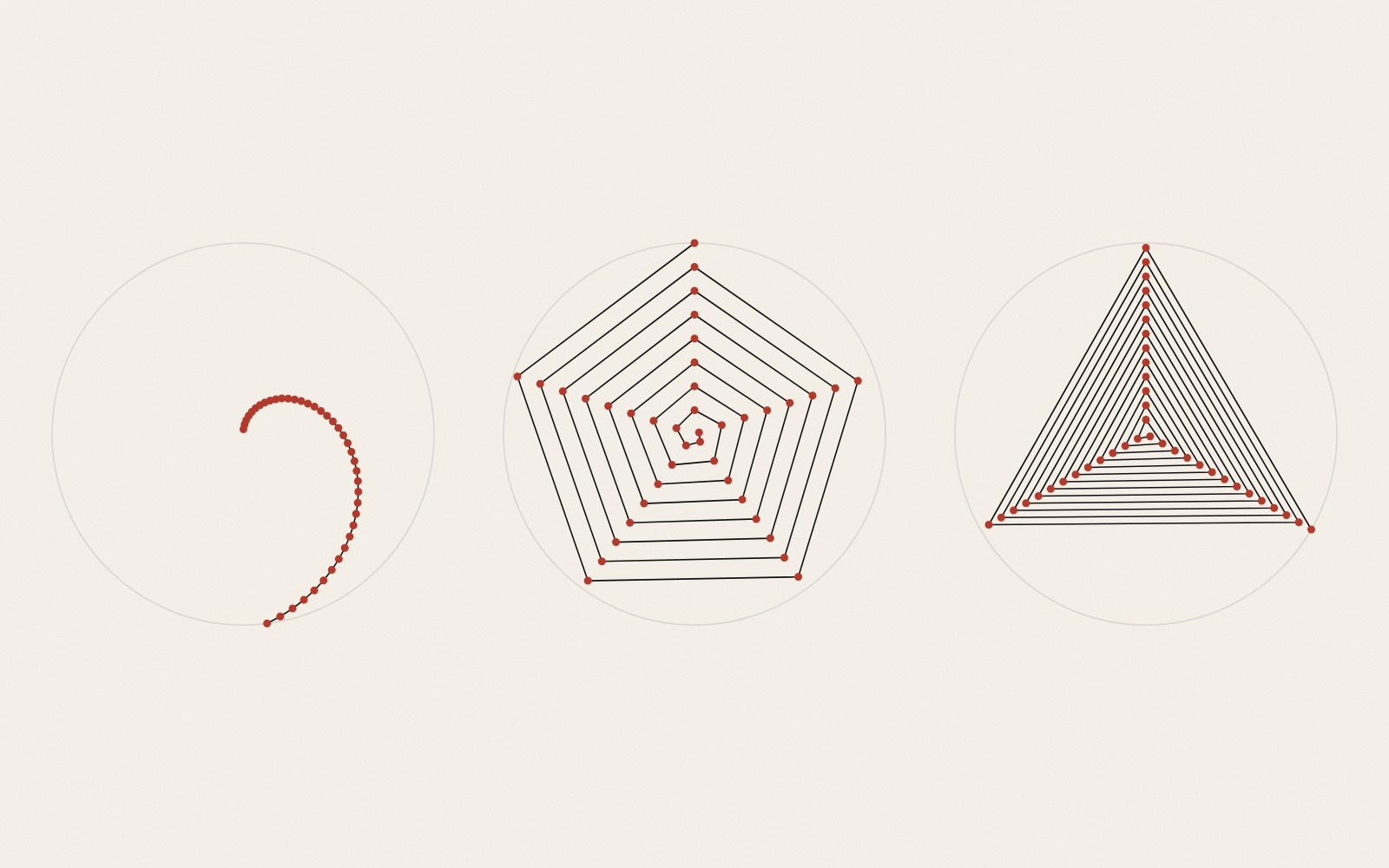
Digital Harmony is a book by the American animator John Whitney (1917–1995), published in 1980. In it he described the principle behind the computer films he had made since the late 1960s: picture and music can be built on the same kind of harmony, with movements in whole-number ratios to each other.1
From cams to computers
Before he worked with digital computers, Whitney made films on an analogue machine he had built from a wartime anti-aircraft gun director; that machine and the film Catalog (1961) are described in the note on John Whitney's Catalog.2 In 1966 IBM took him on as artist in residence, the first major corporation to have one, and until 1969 he worked with the company's digital computers. Jack Citron wrote the programs for the IBM 360.1, 2
His first computer film there was called Homage to Rameau, after the composer whose Treatise on Harmony (1722) had given Whitney his direction. In the films that followed, Permutations (1968), Matrix I–III (1971–72) and Arabesque (1975), he showed what he called "harmonic progression". The film historian William Moritz sees the book as the culmination of that work.1
The principle
Give every element of the picture its own speed. "If one element were set to move at a given rate, the next element might be moved at two times that rate."3 The third moves three times as fast, and so on: the same ratios as the harmonic series in music. Because every speed is a whole-number multiple of the slowest, all the elements line up again each time the slowest has gone round once.4
Between those moments the elements form figures. When the slowest element has gone a fifth of the way round, every fifth element is back in the same direction, and the line through them draws a five-pointed figure; at a third of the way round, a three-pointed one.
The same whole-number ratios make the closed curves in Lissajous figures and the Spirograph. The wider history of art made from rules and systems is in JAEV's Generative Art.
Sources
- William Moritz, “Digital Harmony: The Life of John Whitney, Computer Animation Pioneer”. Animation World Network, 1997
IBM fellowship 1966–69; “Jack Citron programmed the IBM 360 Digital computers for him”; Homage to Rameau, after Rameau's Treatise on Harmony, “culminating in his 1980 book Digital Harmony”; Permutations (1968), Osaka 1-2-3 (1971), Matrix I–III (1971–72) and Arabesque (1975) demonstrate “harmonic progression”; Arabesque programmed by Larry Cuba. - Gene Youngblood, Expanded Cinema. New York: E. P. Dutton, 1970, p. 208 (chapter “Computer Films”)
An M-5 Antiaircraft Gun Director the basis of Whitney's first mechanical analogue computer in the late 1950s; in spring 1966 IBM became the first major corporation to take an artist in residence. - Jim Bumgardner, “Visual Harmony”. KrazyDad blog, 2006, quoting John Whitney, Digital Harmony (1980), p. 38
“For example, if one element were set to move at a given rate, the next element might be moved at two times that rate.” - Bill Alves, “Visual Microtonality”. Microfest
Whitney's “differential dynamics”: “the second traveling twice as fast as the first, the third three times as fast as the first, and so on”; the speeds match the harmonic series.
- Published
- JAEV Notes, October 2026.
- Use
- Text CC BY 4.0. Free to use and quote with credit to JAEV and a link to this page. Images and quotations by others keep their own terms.
All texts as one file: archive.json - Cite
- JAEV Notes, “Digital Harmony (John Whitney, 1980)”, jaev.gallery/notes/john-whitney-digital-harmony/, 2026.
- Corrections
- Additions and corrections are welcome: info@jaev.gallery
- Share
A link from your own site, course page or reading list helps others find it.- Follow
- New notes by RSS · Instagram · Bluesky
JAEV is a daemon taking shape: machines, weights, room, brain.