Lissajous figures and the harmonograph
JAEV Notes · October 2026 · 3 min read
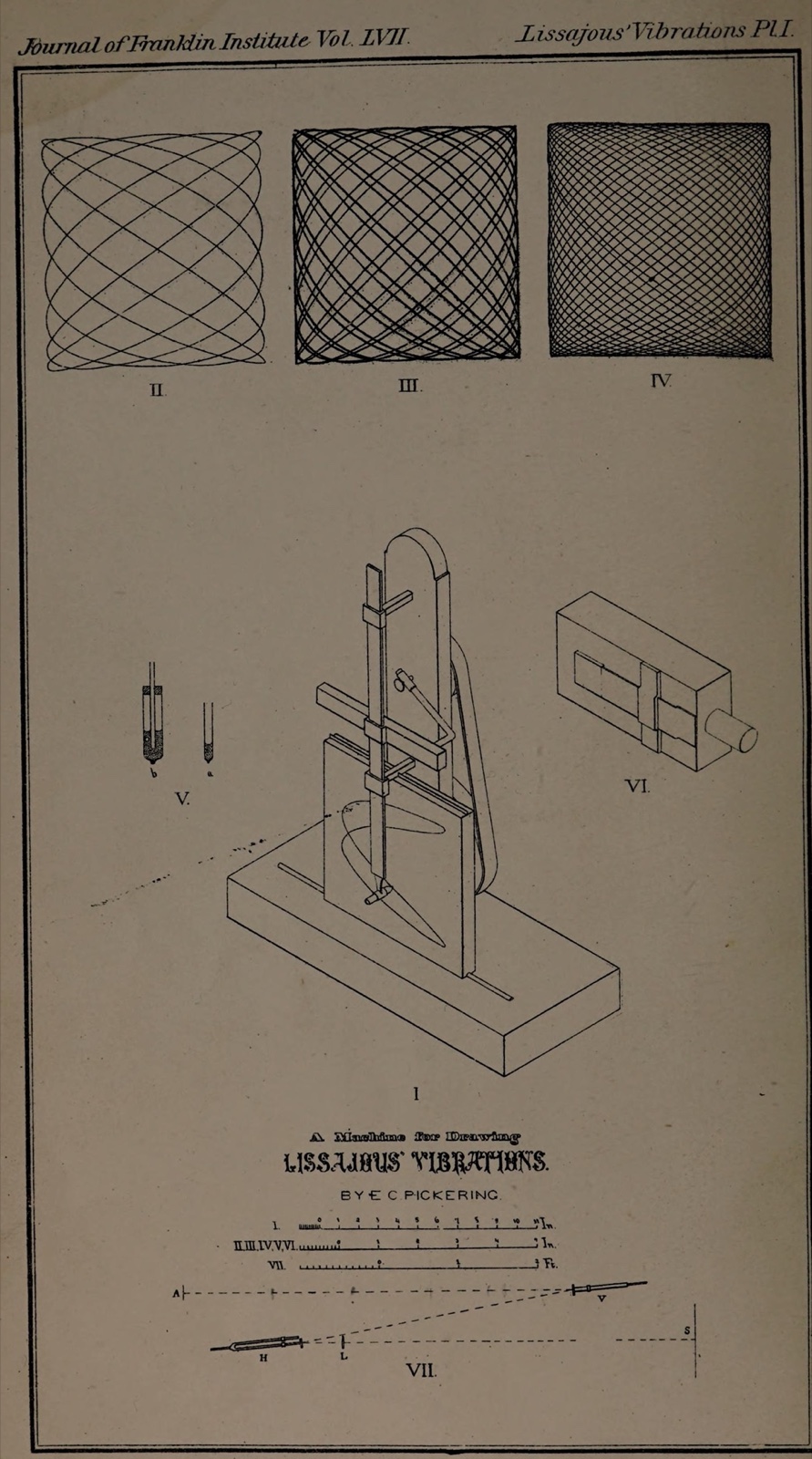
A Lissajous figure is the curve traced by a point that swings in two directions at right angles at the same time. It is named after the French physicist Jules Antoine Lissajous (1822–1880), who studied such curves in 1857 with light reflected from two tuning forks. Nathaniel Bowditch had already produced them in 1815 with a pendulum.1, 2 A harmonograph is a machine that draws curves of this kind with pendulums.3
Lissajous's tuning forks
Edward C. Pickering of the Institute of Technology in Boston described the experiment in 1869: "Mirrors are attached to the prongs of two tuning forks, whose planes of vibration are at right angles to one another." A ray of light falls on the first mirror, then the second, and a lens projects it onto a screen. One fork alone moves the spot of light along a horizontal line, the other along a vertical line. "When both vibrate at the same time, various curves are produced, dependent on the relative pitch of the two forks."1
The curve
Written as a formula, the point is at x = A sin(at + δ), y = B sin(bt) at time t. A and B are the widths of the two swings, a and b their frequencies, and δ the difference in phase, how far one swing is ahead of the other. When a and b are in a ratio of whole numbers, the curve closes on itself; when they are not, it never quite repeats.4
Drawing machines
Pickering wanted the curves on paper, large enough to show a lecture audience, since "their geometrical construction is somewhat laborious". His machine has two wheels joined by a belt. A crank on one wheel moves the paper to and fro horizontally; a crank on the other moves the pen up and down. The ratio of the wheel diameters sets the ratio of the frequencies, and sliding the belt on a wheel changes the phase. His specimens show the ratios 5:8 (a minor sixth), 15:16 (a semitone) and about 44:59, which "does not close exactly, since the ratio is incommensurable".1
Pendulums do the same thing without gears. In the Blackburn pendulum, described by Hugh Blackburn in 1844, a weight hangs from a string that itself hangs from a V-shaped pair of strings, and its path resembles a Lissajous curve.5 The word harmonograph is found from the 1870s for drawing machines of this kind. In a lateral harmonograph two pendulums move a pen relative to the paper. A swinging pendulum slowly loses energy, so each swing is a little smaller than the one before, and the drawing spirals inwards.3
On a screen
An oscilloscope in X-Y mode draws a Lissajous figure from two electrical signals, and engineers use it to see how far one signal is ahead of the other, for example the left and right channels of a stereo recording.4 In the 1950s Ben F. Laposky, a draftsman by profession, built circuits that drew patterns on the screen of an oscilloscope, photographed them and called them oscillons. Fifty-six of them were shown at the Sanford Museum in Cherokee, Iowa, in 1953.6 See also Generative art.
Sources
- Edward C. Pickering, “Description of a machine for drawing the curves of Lissajous”. Journal of the Franklin Institute, offprint, Philadelphia 1869. Internet Archive
“In 1857, M. Lissajous studied the curves produced in the following experiment. Mirrors are attached to the prongs of two tuning forks, whose planes of vibration are at right angles to one another.” “When both vibrate at the same time, various curves are produced, dependent on the relative pitch of the two forks.” Belt, wheels and cranks; ratios 5:8, 15:16, about 44:59 “does not close exactly, since the ratio is incommensurable”. - J. J. O'Connor and E. F. Robertson, “Jules Antoine Lissajous”. MacTutor History of Mathematics, University of St Andrews
Born 4 March 1822, Versailles; died 24 June 1880. 1855: light beam reflected from a mirror; “Mémoire sur l'étude optique des mouvements vibratoires” (1857), 85 pages. Bowditch “had produced them in 1815 with a compound pendulum”; Lissajous's work “entirely independent”. - “Harmonograph”. Wikipedia
“A harmonograph is a mechanical apparatus that employs pendulums to create a geometric image.” Term attested in the 1870s with A. E. Donkin and devices by Samuel Charles Tisley; lateral harmonograph, two pendulums; damped motion x(t) = A sin(tf + p) e^(−dt). - “Lissajous curve”. Wikipedia
x = A sin(at + δ), y = B sin(bt); the pattern closes if the frequencies are whole-number ratios; Bowditch 1815, Lissajous 1857; oscilloscope in X-Y mode, phase of stereo channels. - “Blackburn pendulum”. Wikipedia
A bob on a string hanging from a V-shaped pair of strings; named after Hugh Blackburn, who described it in 1844; James Dean and Nathaniel Bowditch 1815; path resembling a Lissajous curve; one of the harmonographs. - S. Denisov and A. V. Ponomarev, “Oscillons: an encounter with dynamical chaos in 1953?”. Chaos 21, 023123 (2011); arXiv:1007.4790
Laposky (1914–2000), a draftsman; “oscillons” on the screen of a cathode ray tube oscilloscope; booklet with “the fifty-six oscillons, which were exhibited at the Sanford Museum (Cherokee, Iowa) in 1953”.
- Published
- JAEV Notes, October 2026.
- Use
- Text CC BY 4.0. Free to use and quote with credit to JAEV and a link to this page. Images and quotations by others keep their own terms.
All texts as one file: archive.json - Cite
- JAEV Notes, “Lissajous figures and the harmonograph”, jaev.gallery/notes/lissajous-figures-harmonograph/, 2026.
- Corrections
- Additions and corrections are welcome: info@jaev.gallery
- Share
A link from your own site, course page or reading list helps others find it.- Follow
- New notes by RSS · Instagram · Bluesky
JAEV is a daemon taking shape: machines, weights, room, brain.