Catalog (John Whitney, 1961)
JAEV Notes · October 2026 · 2 min read
Catalog is a short abstract film by the American animator John Whitney (1917–1995), dated 1961. It runs just under seven minutes, on 16 mm colour film with sound, and shows squares, spirals and circles of points that appear, turn and merge.1 As the title says, it is a catalogue: a record of the effects Whitney had perfected on a mechanical analogue computer he built from a wartime anti-aircraft gun director.2
Why it was made
In 1960 Whitney founded Motion Graphics Incorporated to make title sequences and commercials, much of it with his machine.2 He edited a sample reel of the effects he could produce, to show clients. It was released as Catalog and became, in the words of the film historian William Moritz, "a popular classic of 1960's psychedelica".3
The machine
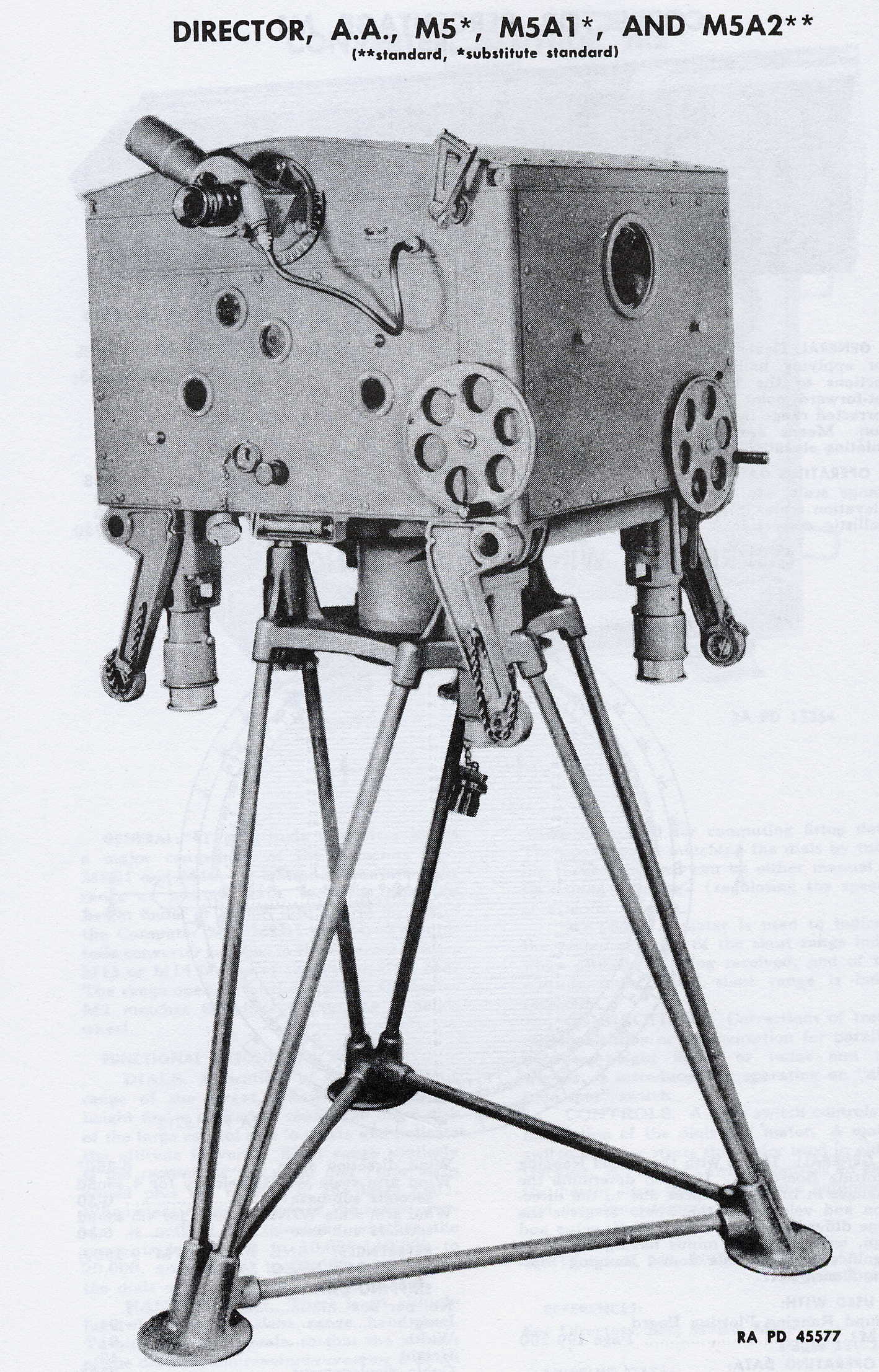
In the Second World War, anti-aircraft batteries were aimed by gun directors. Two men on a telescope table followed an enemy aircraft; analogue computers worked out the trajectory that would meet it and set the fuses of the shells, and motors aimed the guns.2
A decade later Whitney could buy such mechanisms as war surplus.3 An M-5 gun director was the basis of his first machine in the late 1950s; later he added the more sophisticated M-7 and combined the two into a device about twelve feet high.2 Instead of aiming a gun, the mechanism now moved artwork and camera:2
- design templates lay on primary, secondary and tertiary rotating tables, with cam systems to program image and motion;
- the tables spun on their own axes while also revolving around another axis and moving across the field of view;
- the camera could itself turn or zoom, and the shutter could stay open for the whole of a movement or only part of it.
Whitney's son John Jr. described the machine in 1970: the camera's input shaft turned at 180 rpm, but one frame took about nine seconds, because the secondary tables needed nine seconds to go round once, and during those nine seconds several motions ran at once.2 Moritz calls it a "cam machine" and credits it with pioneering motion control, the computer-steered camera movement later used in special effects.3 The film ends with a Lissajous curve repeated many times, a figure explained in the note on Lissajous figures.3
Afterwards
In 1966 IBM took Whitney on as artist in residence; Youngblood calls it the first major corporation to have one. From then on Whitney made his films with digital computers.2, 3 The principle he worked out there, every element moving at its own whole-number multiple of one speed, is described in the note on John Whitney's Digital Harmony.
Other machines that turned military calculators into drawing machines are described in Desmond Paul Henry's drawing machines; a mechanical drawing machine without any calculator is Tinguely's Méta-Matic. The wider history of art made from rules and systems is in JAEV's Generative Art.
Sources
- Catalog, John Whitney, 1961. BAMPFA (Berkeley Art Museum and Pacific Film Archive) film collection
Running time 06:58; 16 mm, colour, optical sound; “Copyright date on film: 1961, Motion Graphics, Inc.”; distributed by the Museum of Modern Art Film Library; “Analog computer-generated pointillistic squares, spirals, and circles appear and merge together”. - Gene Youngblood, Expanded Cinema. New York: E. P. Dutton, 1970, pp. 208–213 (chapter “Computer Films”)
Motion Graphics Inc. founded 1960 for title sequences and commercials, much of it with his mechanical analogue computer; an M-5 Antiaircraft Gun Director the basis of his first machine in the late 1950s, later augmented with the M-7 into a twelve-foot-high device; primary, secondary and tertiary rotating tables and cam systems; John Whitney Jr.: input shaft at 180 rpm, nine seconds per frame because the secondary tables take nine seconds per revolution; Catalogue completed 1961, a visual catalogue of the effects he had perfected; in spring 1966 IBM became the first major corporation to take an artist in residence. - William Moritz, “Digital Harmony: The Life of John Whitney, Computer Animation Pioneer”. Animation World Network, 1997
Built largely from surplus WWII anti-aircraft guidance hardware; his “cam machine”, which pioneered “motion control”; the sample reel “was released as Catalog and became a popular classic of 1960's psychedelica”; it ends with a multiplied Lissajous curve; IBM 1966–69.
- Published
- JAEV Notes, October 2026.
- Use
- Text CC BY 4.0. Free to use and quote with credit to JAEV and a link to this page. Images and quotations by others keep their own terms.
All texts as one file: archive.json - Cite
- JAEV Notes, “Catalog (John Whitney, 1961)”, jaev.gallery/notes/john-whitney-catalog/, 2026.
- Corrections
- Additions and corrections are welcome: info@jaev.gallery
- Share
A link from your own site, course page or reading list helps others find it.- Follow
- New notes by RSS · Instagram · Bluesky
JAEV is a daemon taking shape: machines, weights, room, brain.