Voronoi diagrams and Delaunay triangulation
JAEV Notes · October 2026 · 2 min read
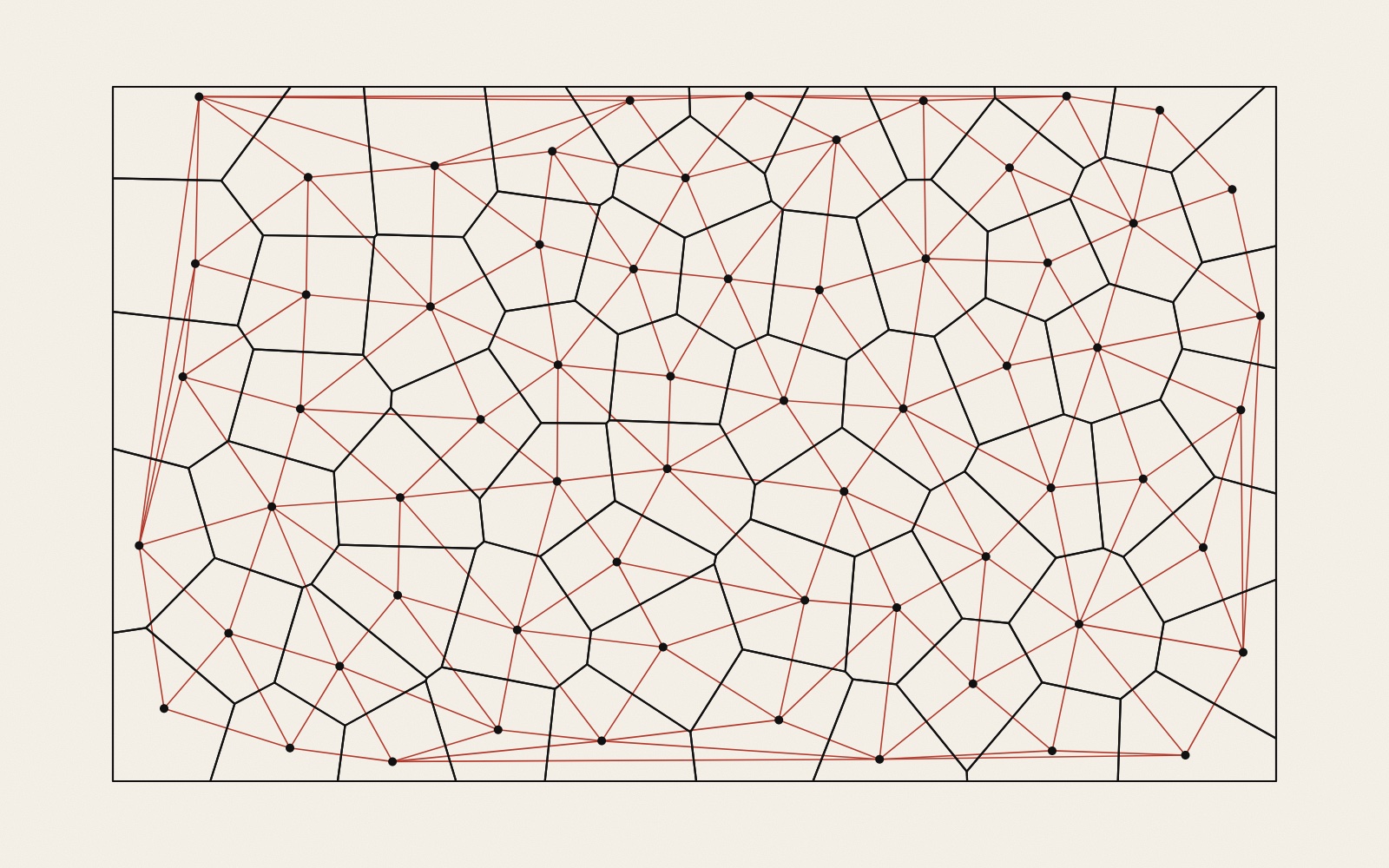
A Voronoi diagram divides a plane among a set of points, giving each point the area of all places that are nearer to it than to any other point. The Delaunay triangulation joins every point to the points whose areas touch its own. The two are named after the mathematicians Georgy Voronoy (1868–1908) and Boris Delaunay (1890–1980), and each can be made from the other.1, 2, 3, 4
The cells
Start with some points, called sites. For one site, take every other site in turn and draw the line exactly halfway between the two, at right angles to the line joining them (the perpendicular bisector). Everything on this site's side of that line is nearer to it. What is left after all the other sites have cut their half away is the site's Voronoi cell.1 The image at the top and the sketch below are made exactly like this.
The idea is older than the name. Dirichlet used such cells in 1850 in a study of quadratic forms, and Alfred H. Thiessen used them in 1911 to estimate rainfall, which is why they are also called Thiessen polygons. Voronoy defined and studied the general case, in any number of dimensions, in 1908, the year he died.1, 2
The triangles
Join each site to every site whose cell shares an edge with its own, and the plane is covered with triangles: the Delaunay triangulation, the "dual" of the Voronoi diagram.1, 3 It has a simple test: the circle through the three corners of any triangle has no other site inside it. Of all the ways of joining the same points into triangles, it is the one whose smallest angle is as large as possible.3
Delaunay (in Russian Delone) gave a talk called "Sur la sphère vide", on the empty sphere, at the International Congress of Mathematicians in Toronto in 1924; Wikipedia dates his work on the triangulation from 1934.3, 4
Faster methods, and art
The method used here cuts every cell against every other site, so the work grows quickly with the number of sites. Fortune's algorithm builds the whole diagram in time proportional to n log n, and the Bowyer–Watson algorithm builds the Delaunay triangulation by adding one point at a time.1, 3
In Lloyd's algorithm the sites are moved, again and again, to the centre of their own cells, which spreads them out evenly.1 A weighted version of the idea, which places dots for drawings made only of points, is the subject of Weighted Voronoi stippling. For another way to spread points evenly, see Poisson disc sampling. See also Generative Art.
Sources
- “Voronoi diagram”. Wikipedia
“a partition of a plane into regions close to each of a given set of objects”; informal use back to Descartes 1644; Dirichlet 1850; Voronoy “defined and studied the general n-dimensional case in 1908”; Thiessen 1911, rainfall; “dual to that set's Delaunay triangulation”; Fortune's algorithm O(n log n); Lloyd's algorithm moves seeds to the centres of their cells. - J. J. O'Connor and E. F. Robertson, “Georgy Fedoseevich Voronoy”. MacTutor History of Mathematics
Born 28 April 1868, Zhuravka (now Ukraine); died 20 November 1908, Warsaw. “Voronoy introduced what are today called Voronoi diagrams or Voronoi tessellations.” - “Delaunay triangulation”. Wikipedia
No point inside any triangle's circumcircle; named after Boris Delaunay “for his work on it from 1934”; maximises the minimum angle; dual graph of the Voronoi diagram; Bowyer–Watson algorithm. - J. J. O'Connor and E. F. Robertson, “Boris Nikolaevich Delone”. MacTutor History of Mathematics
Born 15 March 1890, St Petersburg; died 17 July 1980, Moscow. Name “sometimes written Delaunay”; invited address “Sur la sphére vide”, International Congress of Mathematicians, Toronto, August 1924; “an exceptional mountain climber”.
- Published
- JAEV Notes, October 2026.
- Use
- Text CC BY 4.0. Free to use and quote with credit to JAEV and a link to this page. Images and quotations by others keep their own terms.
All texts as one file: archive.json - Cite
- JAEV Notes, “Voronoi diagrams and Delaunay triangulation”, jaev.gallery/notes/voronoi-delaunay/, 2026.
- Corrections
- Additions and corrections are welcome: info@jaev.gallery
- Share
A link from your own site, course page or reading list helps others find it.- Follow
- New notes by RSS · Instagram · Bluesky
JAEV is a daemon taking shape: machines, weights, room, brain.