SHA-256 as a source of chance
JAEV Notes · October 2026 · 2 min read
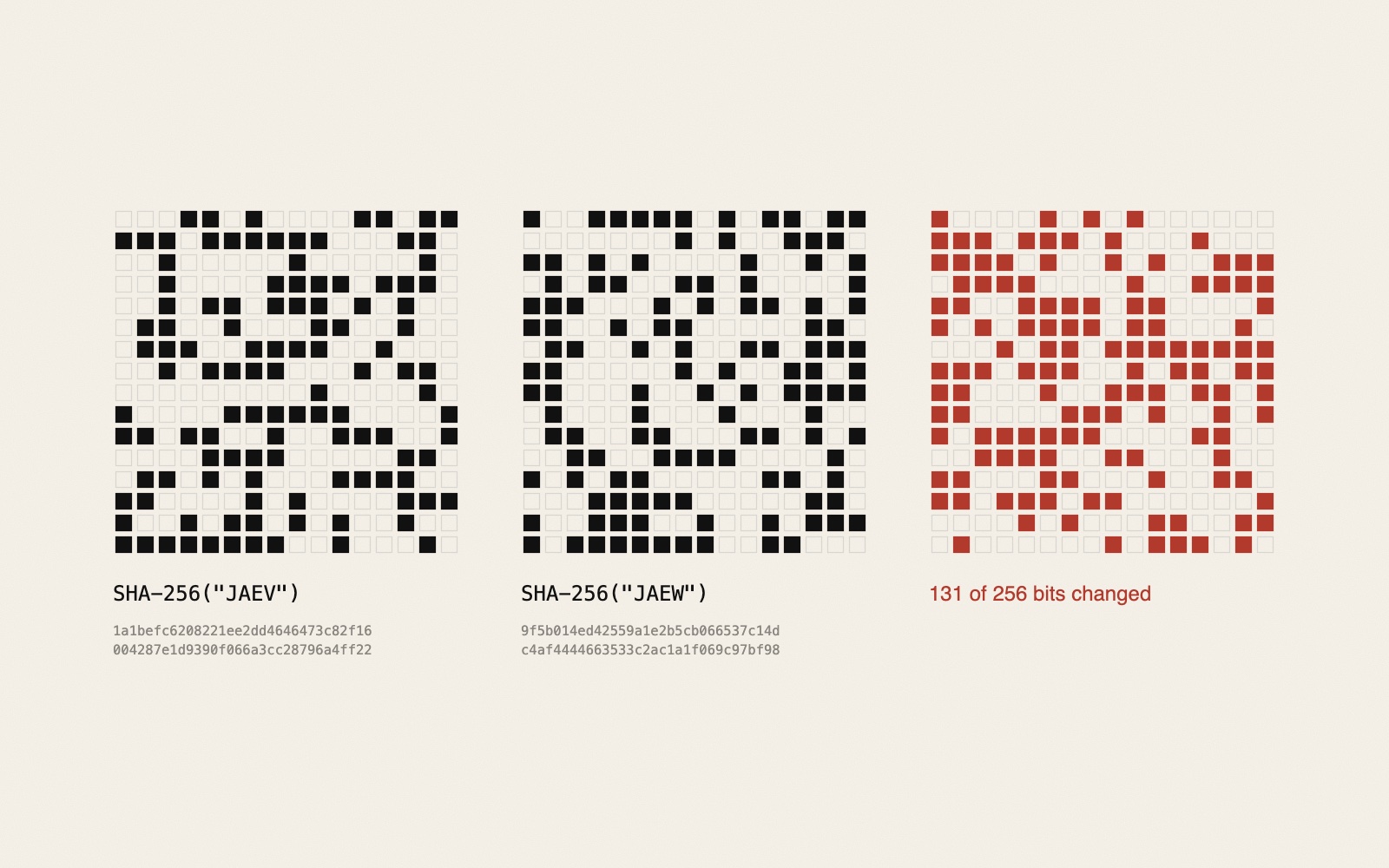
SHA-256 is a hash function: it turns any text or file into a number 256 bits long. It belongs to the SHA-2 family, designed by the United States National Security Agency and first published in 2001.1 It was made for security, but its output looks random while being completely fixed by its input, so artists use it as a source of chance that can be repeated.
What the function does
The current standard, FIPS 180-4 from the US National Institute of Standards and Technology, describes hash algorithms that produce a "digest" of a message, so that anyone can check whether the message has been changed since.2 Whatever goes in, a single word or a whole film, SHA-256 gives back 256 bits, usually written as 64 hexadecimal digits.1, 3
Two properties make it useful outside cryptography:
- The same input always gives the same output. There is no hidden state, and no clock is involved.
- A small change gives a completely different output. If one bit of the input is flipped, about half of the output bits change: the avalanche effect, a term the cryptographer Horst Feistel first used in 1973.4
Together this means the hash behaves like a dice roll that can be rolled again with exactly the same result.
From hash to choices
A generative program reads the 256 bits as 32 numbers from 0 to 255 (one per byte) and lets each one decide something: how many shapes, which kind, which colour, where. The sketch below does that with the text you type.
On the platform Art Blocks, each work's script is given a 32-byte hash as its seed, and the documentation tells artists: "This is your only randomness source." The same hash must always produce the same image.5 SHA-256 is also the function behind proof of work in Bitcoin, explained in the note on Bitcoin's difficulty.1
Where to see it
JAEV's own work Content makes one image a day from a short text recording what the world paid most attention to the day before. The text is turned into a fingerprint, its SHA-256 hash, and the hash makes one choice in each of seven parts of the work: composition, shape, edge, colours, movement, symmetry and layers. The same text always gives the same work.6, 7 Each work's page prints the hash and the seven choices it made.7
Sources
- “SHA-2”. Wikipedia
“designed by the United States National Security Agency (NSA) and first published in 2001”; SHA-256 gives a 256-bit digest; “Several cryptocurrencies, including Bitcoin, use SHA-256 for verifying transactions and calculating proof of work.” - FIPS 180-4, Secure Hash Standard (SHS). National Institute of Standards and Technology, August 2015
“This standard specifies hash algorithms that can be used to generate digests of messages. The digests are used to detect whether messages have been changed since the digests were generated.” - “SubtleCrypto: digest() method”. MDN Web Docs, Mozilla
“A digest is a short fixed-length value derived from some variable-length input.” “Cryptographic digests should exhibit collision-resistance.” SHA-256: 256 bits. - “Avalanche effect”. Wikipedia
Flipping one input bit changes about half the output bits; the strict avalanche criterion: each output bit changes with a 50% probability; term first used by Horst Feistel (1973). - “1. Building Your Project”. Art Blocks documentation
“tokenData.hash is a 32-byte hex string — the unique, on-chain random seed for this token.” “This is your only randomness source.” “Same hash → same output, always”. - “Content”, JAEV. JAEV, Lund
“The text is turned into a fingerprint, a long number that changes completely if a single character changes. The number makes one choice in each of seven parts of the work … The same text always gives the same work.” - “Hôtel de Ville, Limoges × ImmunityBio −8.3% × Alberta separation referendum”, Content, 19 October 2026. JAEV, Lund
“The text at the top of this page was turned into a fingerprint, the SHA-256 hash below.”
- Published
- JAEV Notes, October 2026.
- Use
- Text CC BY 4.0. Free to use and quote with credit to JAEV and a link to this page. Images and quotations by others keep their own terms.
All texts as one file: archive.json - Cite
- JAEV Notes, “SHA-256 as a source of chance”, jaev.gallery/notes/sha-256-as-random-source/, 2026.
- Corrections
- Additions and corrections are welcome: info@jaev.gallery
- Share
A link from your own site, course page or reading list helps others find it.- Follow
- New notes by RSS · Instagram · Bluesky
JAEV is a daemon taking shape: machines, weights, room, brain.