The rule is the work. A prompt is a wish.
On generative art, image generators and who wrote the system
JAEV Editorial · 10 October 2026 · 7 min read
Between 20 February and 5 March 2025, Christie's in New York held Augmented Intelligence, which the auction house presented as its first sale devoted entirely to art made with artificial intelligence. Twenty-eight of thirty-four lots sold, for a total of $728,784.1 Before it opened, an open letter asked Christie's to cancel it. The letter, which had more than 4,000 signatures within days of its publication on 8 February and 6,566 (5,720 of them verified) by October 2026, alleged that many of the works were made with models "known to be trained on copyrighted work without a license"; artists in the sale disputed that description.2 3 1
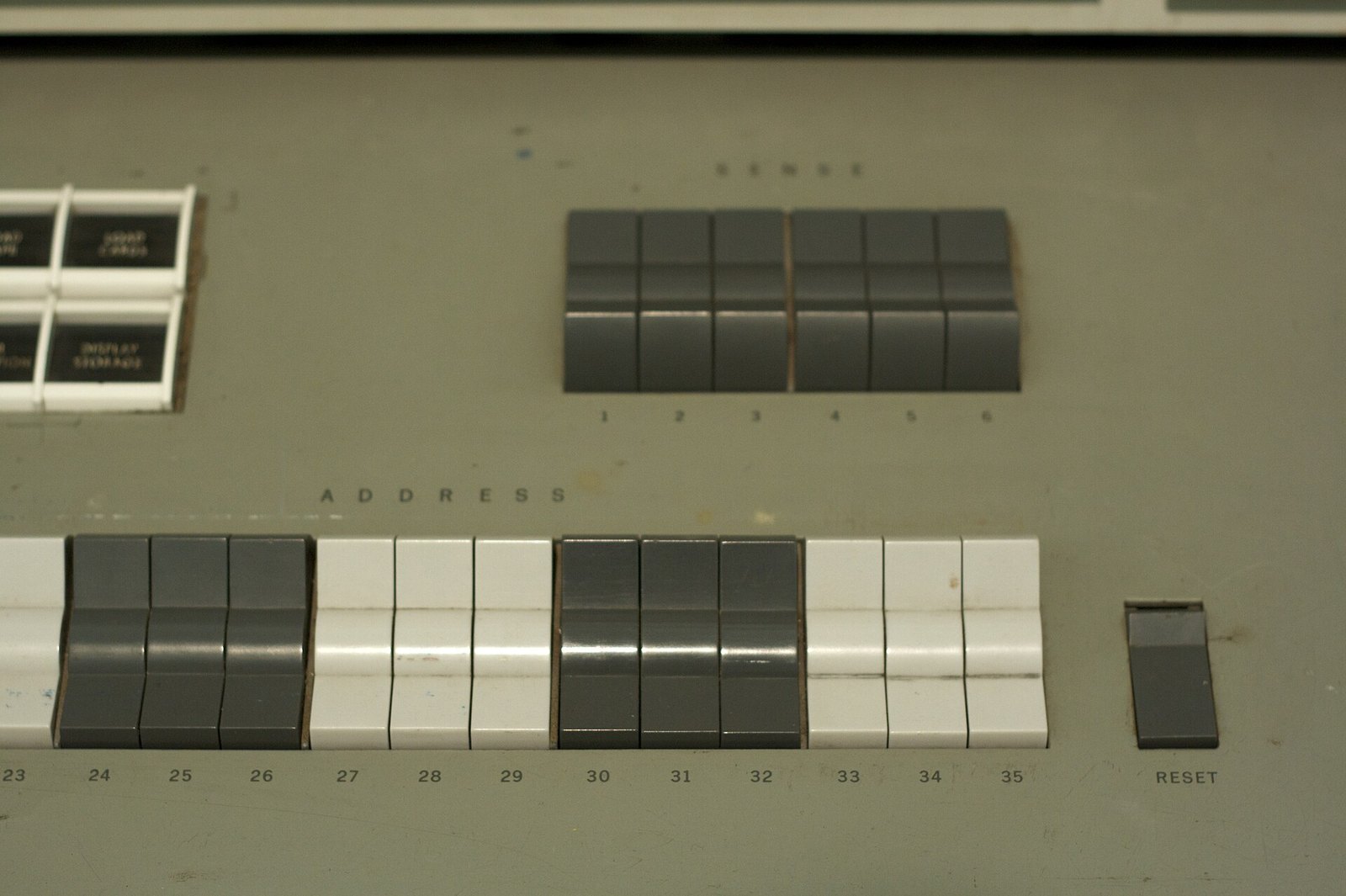
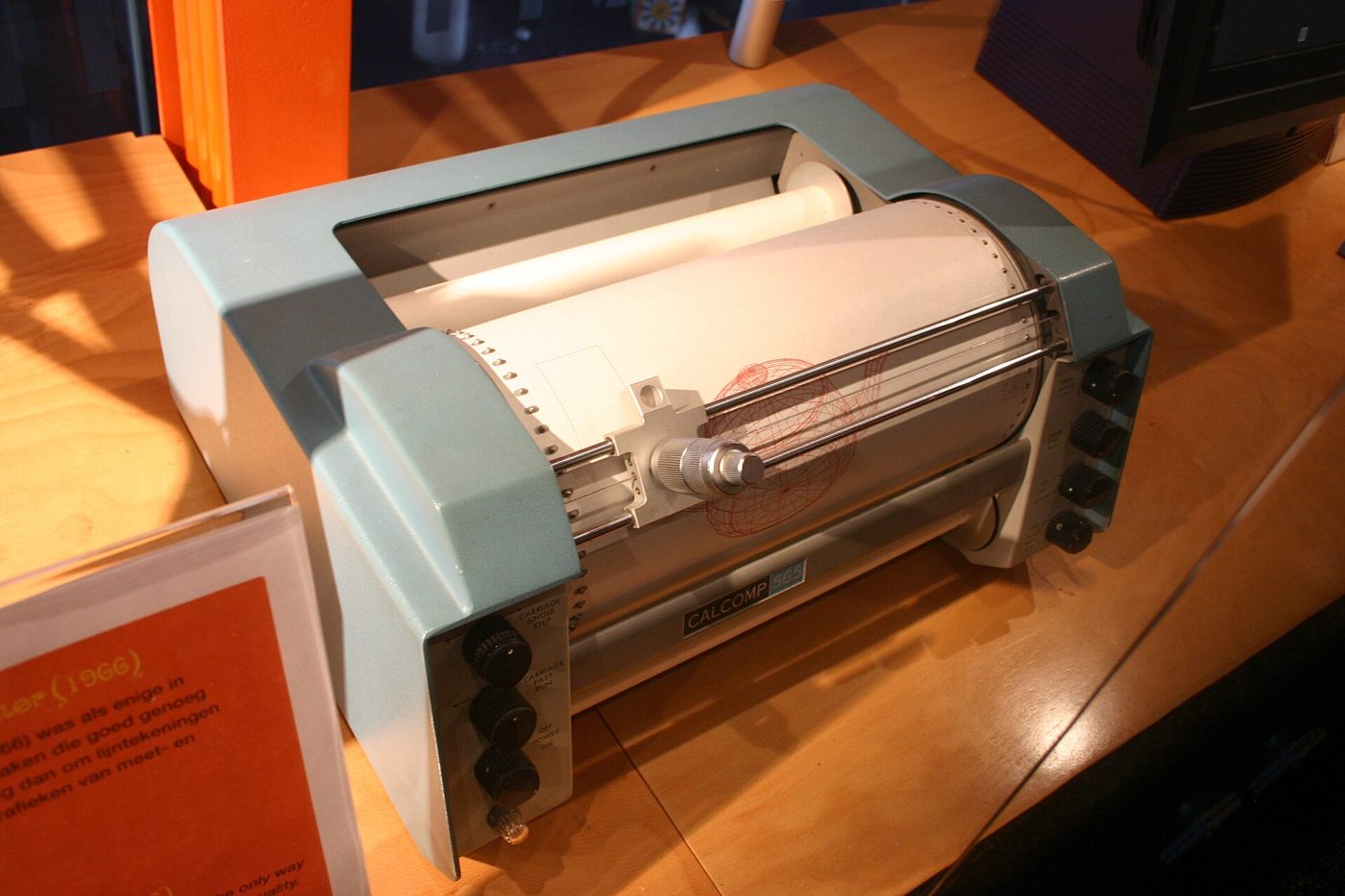
The catalogue put three very different things under one heading. There was Bspline Men, a drawing in ink made in 1966 by Charles Csuri with an IBM mainframe and a drum plotter, which sold for $50,400. There was Untitled (i23-3758), a drawing from 1987 by Harold Cohen's program AARON, which sold for $11,340, just above its low estimate. And there were recent works, among them the top lot, Refik Anadol's Machine Hallucinations – ISS Dreams – A (2021), which sold for $277,200 and was made, according to Christie's catalogue, with a model trained on more than a million images from the International Space Station and satellites.1 4 All three were sold as "AI art". None of the three was made by typing a request into somebody else's image generator. What ties them together is an older idea: that the artist writes the system that makes the work.

A rule with one per cent of disorder
In 1976 Vera Molnár made a plotter drawing called 1% de désordre (1% of disorder): ink on Benson paper, 36 × 55 cm.5 The Victoria and Albert Museum describes the program she used, Molnart, written with her husband François Molnár, and the principle it calls "1% disorder": slight deviations from a strict pattern.6
In JAEV's reading, the plotter's part was the simplest: it drew what the program told it to draw. What made the drawing a work came before that: the choice of forms, the size of the field, and above all the decision that the order should fail, and by how much. The rule was Molnár's. So was the exception.

A program as a self-portrait of a method
Harold Cohen was an established painter in London when he conceived the software in the late 1960s at the University of California, San Diego; he named it AARON in the early 1970s. The Whitney Museum, which showed the program's history in 2024, says that he "devoted his life to exploring the potential of artificial intelligence to translate an artist's knowledge and process into code", and that he built his own plotters and painting machines to carry out what it produced.7 The Whitney calls AARON "the earliest artificial intelligence (AI) program for artmaking". It is more exact to call it Cohen's account of how he himself drew, written as rules, which he went on revising until his death in 2016.7
In February 1965 the philosopher Max Bense published a three-page text, "Projekte generativer Ästhetik" (Projects of generative aesthetics), in issue 19 of the series rot, which was sold at the opening of Georg Nees's exhibition in Stuttgart on 5 February, an event billed as "Generative Computergrafik". Frieder Nake has written that the text, "in retrospect, must be considered the first manifesto of computer art", though he adds that "the style is not manifesto-like at all".9 Sol LeWitt, writing about conceptual art in Artforum in 1967, described it this way: "The idea becomes a machine that makes the art."10 In each case someone wrote the machine.
What the definition says
A widely quoted definition of generative art is Philip Galanter's, from 2003: "any art practice where the artist uses a system, such as a set of natural language rules, a computer program, a machine, or other procedural invention, which is set into motion with some degree of autonomy contributing to or resulting in a completed work of art."11
Read literally, that includes typing a prompt into a commercial image generator: the generator is a system, it runs with a great deal of autonomy, and the result is an image. Galanter's definition does not say who has to have made the system.
This is JAEV's reading, not Galanter's: the definition needs that criterion to be useful. Molnár, Cohen and LeWitt each made the system that then made the work. They took responsibility for its decisions, even the ones they left to chance. An artist who trains a model on material of their own choosing, as several in the Christie's sale did, is doing the same thing with a different tool. Someone who writes a sentence for a model a company built, from images they did not choose and mostly cannot see, has used a system without writing one.
What a prompt is
The American writer Ted Chiang made a related argument in The New Yorker in 2024. "Art is something that results from making a lot of choices," he wrote. A prompt, in his account, makes very few. Of an image made from a prompt in a program like DALL-E, he wrote: "Most of the choices in the resulting image have to be borrowed from similar paintings found online; the image might be exquisitely rendered, but the person entering the prompt can't claim credit for that."12
That is Chiang's description. It is not a technical account of how such models work, but the consequence he points to can be seen. In JAEV's observation, images made this way tend to arrive at the same few qualities – the same polished skin, the same cinematic light, the same evenly distributed detail – which belong to the system, not to the person who asked for them. A prompt is a wish. It states what one would like to see and leaves undecided how anything is made.
What AI is for
None of this makes AI useless to artists, since much of an artist's working life is spent on things other than making art: applications, budgets, press releases, CVs, translations, deadlines and correspondence. That is where these tools are good. It is also where a few saved hours go straight back to the work.
The rule at the top of this page
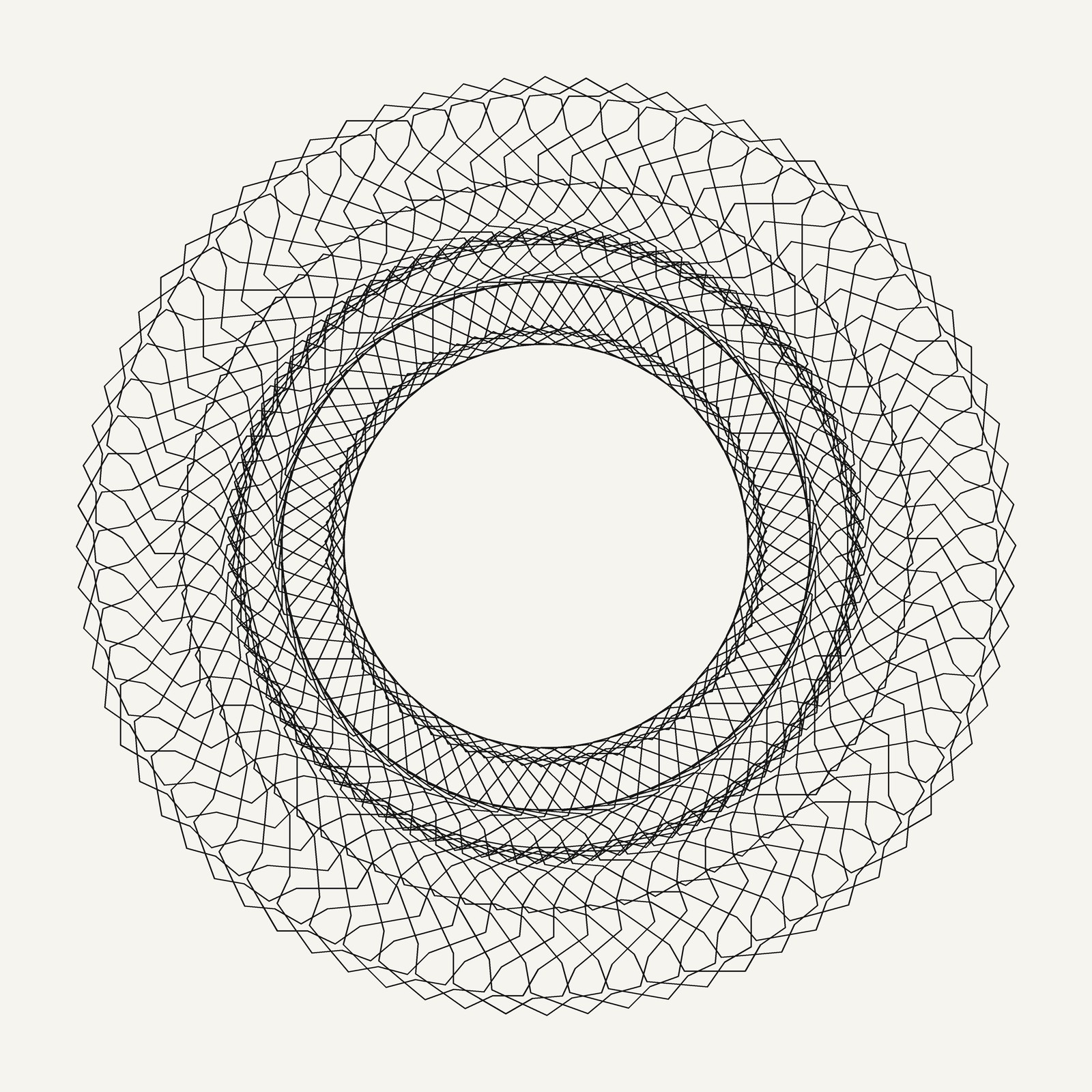
The image at the top of this page was made by a rule, written for this text:
Walk through the sentence "The rule is the work. A prompt is a wish." one character at a time, taking one step of equal length for each. After a vowel, turn 60 degrees to the right; after any other letter, turn 25 degrees to the left; after a space or a full stop, go straight on. Repeat the sentence until the line is back where it began.
One pass through the sentence turns the line by 185 degrees in all, so it takes 72 passes, 2,952 steps, before the line returns exactly to its starting point, facing the same way. Anyone can draw it again from the rule, by hand or by program, and get the same figure; only where it starts and which way it first faces are left free, and they turn the figure without changing it. The program that drew the images here is published with this text.
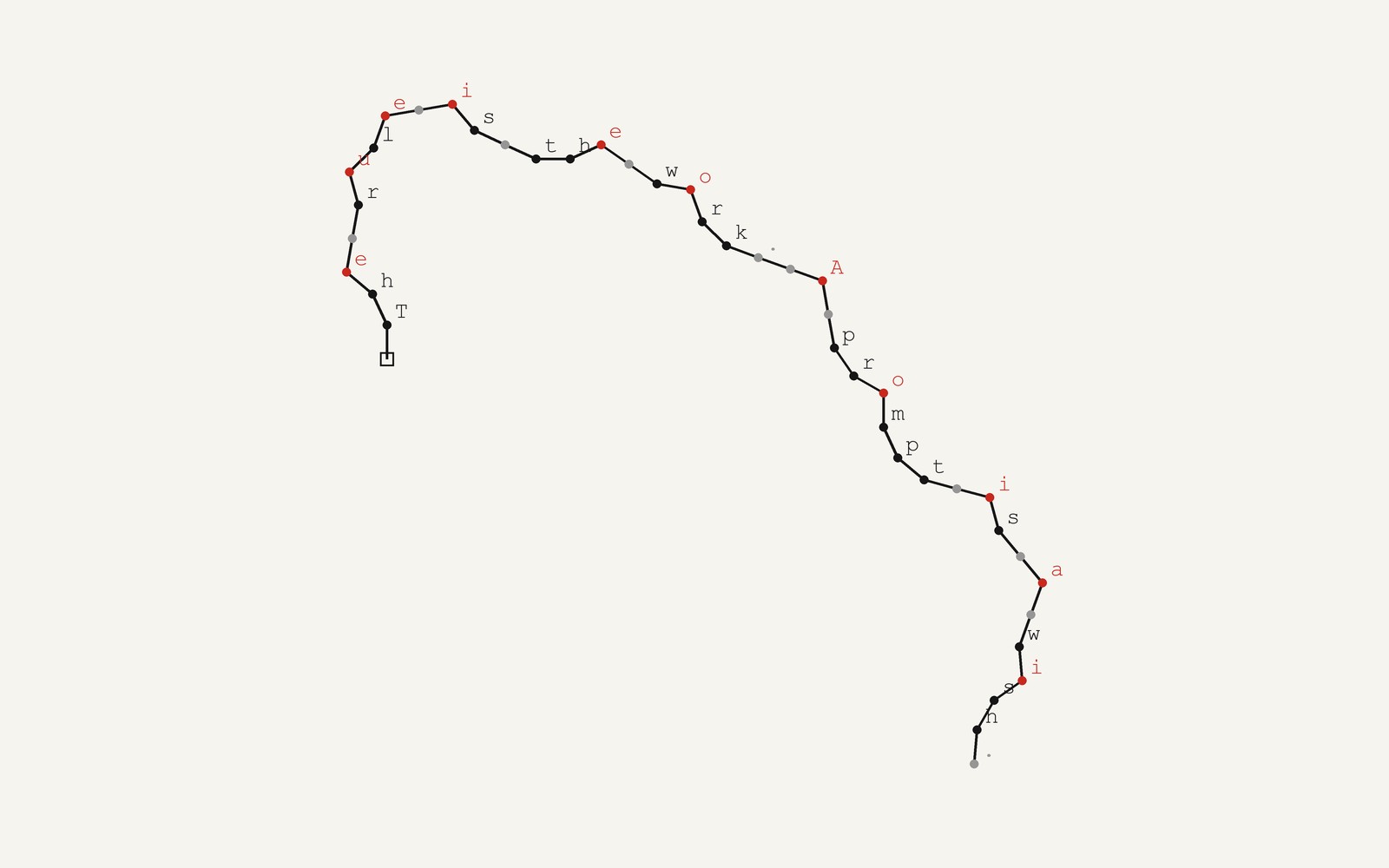
Molnár's one per cent was a decision about where her own rule should break. Writing a prompt involves no rule that could break by one per cent.
Further reading
- Generative Art, JAEV's introduction to the field.
- Vera Molnár and Sol LeWitt: the rule and the instruction.
- Harold Cohen and AARON: a painter's rules for drawing, written as a program.
- Whitney Museum of American Art: Harold Cohen: AARON (2024).
- Philip Galanter, "What Is Generative Art?" (2003).
- Ted Chiang, "Why A.I. Isn't Going to Make Art", The New Yorker (2024).
Sources
- “Christie's All-A.I. Sale Surpasses Expectations”. Artnet News, March 2025
28 of 34 lots sold, $728,784; Cohen's 1987 AARON work at $11,340, just above its low estimate; Csuri 1966 at $50,400; Anadol at $277,200. - “Thousands Call on Christie's to Nix AI Art Auction”. Hyperallergic, 11 February 2025
More than 4,000 signatories since the letter was published on 8 February. - “Cancel the Christie's AI Art Auction”. Open letter, openletter.earth
Signature count as shown on the page when read, 10 October 2026. - Charles Csuri, Bspline Men, 1966; Harold Cohen, Untitled (i23-3758), 1987; Refik Anadol, Machine Hallucinations – ISS Dreams – A, 2021. Lot pages, Christie's, Augmented Intelligence, 2025
Titles, dates and techniques as catalogued by Christie's. - Vera Molnár, 1% de désordre (1% of disorder), 1976. Sotheby's, Natively Digital 1.3: Generative Art, 2022
Computer plotter drawing on Benson paper, 36 × 55 cm; provenance Galerie Oniris, Rennes. - Vera Molnár, Parcours 10x10 cinq rectangles, 1976. Victoria and Albert Museum, London
The museum's description of the program Molnart, written with François Molnár, and of the principle it calls “1% disorder”. - “Harold Cohen: AARON”, 3 February – 19 May 2024. Whitney Museum of American Art, New York
- Harold Cohen, “What is an Image?”. Invited paper, proceedings of the 6th International Joint Conference on Artificial Intelligence, Tokyo, 1979
The text dates itself to December 1978. Publication details from Cohen's own bibliography, aaronshome.com/aaron/bibliography. - Frieder Nake, “The Semiotic Engine: Notes on the History of Algorithmic Images in Europe”. Art Journal, Spring 2009
Bense's text in issue 19 of the series rot, sold at the opening on 5 February 1965. - Sol LeWitt, “Paragraphs on Conceptual Art”. Artforum 5, no. 10, June 1967
- Philip Galanter, “What Is Generative Art? Complexity Theory as a Context for Art Theory”. Generative Art conference, Milan, 2003
- Ted Chiang, “Why A.I. Isn't Going to Make Art”. The New Yorker, 31 August 2024
- Published
- JAEV Editorial, 10 October 2026.
- Use
- Text CC BY 4.0. Free to use and quote with credit to JAEV and a link to this page. Images and quotations by others keep their own terms.
All texts as one file: archive.json - Cite
- JAEV Editorial, “The rule is the work. A prompt is a wish.”, jaev.gallery/editorial/the-rule-is-the-work/, 2026.
- Corrections
- Additions and corrections are welcome: info@jaev.gallery
- Share
A link from your own site, course page or reading list helps others find it.- Follow
- New texts by RSS · Instagram · Bluesky
JAEV is a daemon taking shape: machines, weights, room, brain.