The RGB colour cube
JAEV Notes · October 2026 · 2 min read
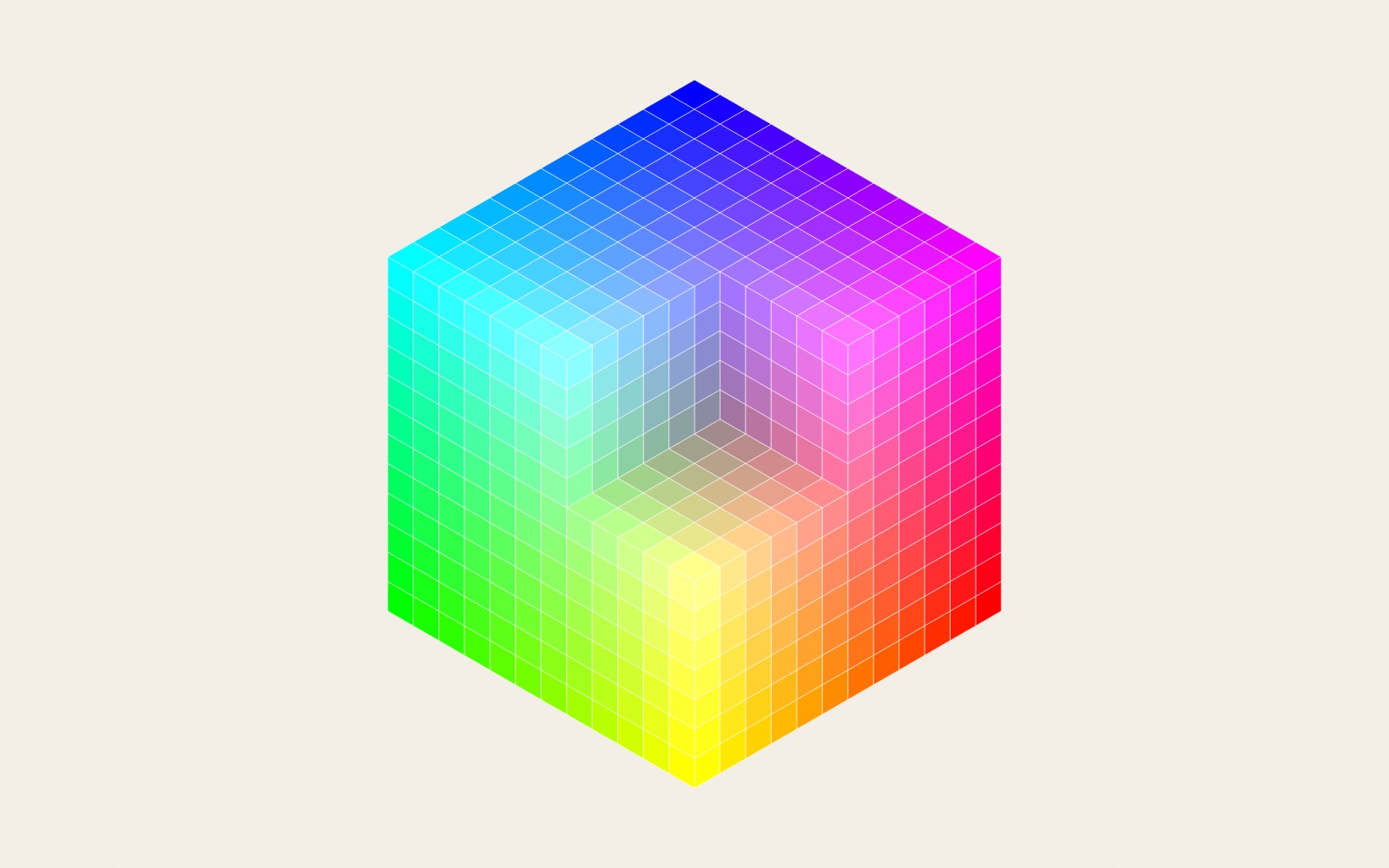
The RGB colour cube draws every colour a screen can show as a point inside a cube. Its three edges measure the screen's three lights, red, green and blue. Black sits in one corner and white in the opposite one.1
Three lights, three axes
Each pixel on a screen is made of three small lights. RGB is an additive colour model: light is added to light, so the more of each, the brighter the result.1 If each light gets a value from nothing to full, any colour the pixel can show is three numbers, and three numbers are a position in space. Put red on one axis, green on the second and blue on the third, and all the possible colours fill a cube.
The corner where all three values are zero is black; the opposite corner, all three at full, is white.1 The diagonal between them runs through the greys, where the three values are equal. Three corners hold red, green and blue on their own. The last three hold two full lights each: yellow, cyan and magenta, each the complement of the light that is missing (cyan of red, magenta of green, yellow of blue).1
16,777,216 colours
Modern systems usually store each of the three values in 8 bits, giving 256 levels, from 0 to 255.1 The cube then has 256 steps along each edge and 256 × 256 × 256 = 16,777,216 points: the "16.7 million colours" of a screen with 24 bits per pixel.1
The same cube in ink
Print works the other way round. Ink takes light away from white paper, so a printed colour cube is built from the complements, cyan, magenta and yellow, with unprinted paper in the corner where no ink is used.1, 2
In Lund in the 1970s, the mathematician Mikael Jern wrote software for Lund University's ink-jet colour plotter, built by Hellmuth Hertz, that drew such a cube: 17 × 17 × 17 small cubes.3, 4 The plotter printed three inks on top of each other, and Jern made lighter and darker tones with a matrix of 4 × 4 dots.4 His cube had 4,913 colours where a screen's has more than sixteen million. How it was made, and who later signed it, is told in JAEV's editorial The colour cubes and in the notes on the colour plotter and Jern's COLOR program.
Where to see it
Olof Broström's Automatic Colour Cubes, 122 works made one a day on JAEV's server from 10 October 2026, starts from Jern's ink cube rather than the screen's. Each work reduces the cube to its outer shell and opens it along the edges that one of Sol LeWitt's Incomplete Open Cubes leaves out, so the inside of the colour range becomes visible. The works exist as print files in the three inks plus black; the images on the exhibition page are, in its words, "translations for the screen".2
Sources
- “RGB color model”. Wikipedia
“assigning black to the origin at the vertex (0, 0, 0) … up to white at the vertex (1, 1, 1)”; “16,777,216 (256³ or 2²⁴) discrete combinations of R, G, and B values”; “cyan complements red, magenta complements green, and yellow complements blue” - “Automatic Colour Cubes”, Olof Broström. JAEV, Lund
122 works, one a day from 10 October 2026; Jern’s cube reduced to its shell and opened along the edges left out by one of LeWitt’s variants; print files in the three inks plus black; “The images on this page are translations for the screen.” - Anna Orrghen, Från matematikmaskin till IT. Fokusgrupp: Media. Slutrapport. Tekniska museet, Stockholm
“Programmet kunde rita upp en färgkub som bestod av 17x17x17 mindre kuber.” - Mikael Jern, interviewed by Anna Orrghen, 4 October 2007. Från matematikmaskin till IT, Tekniska museet, Stockholm
Three inks, cyan, yellow and magenta, at 150 dots per inch; tones made with a matrix of 4 × 4 dots. In Swedish; summarised in JAEV’s editorial The colour cubes.
- Published
- JAEV Notes, October 2026.
- Use
- Text CC BY 4.0. Free to use and quote with credit to JAEV and a link to this page. Images and quotations by others keep their own terms.
All texts as one file: archive.json - Cite
- JAEV Notes, “The RGB colour cube”, jaev.gallery/notes/rgb-colour-cube/, 2026.
- Corrections
- Additions and corrections are welcome: info@jaev.gallery
- Share
A link from your own site, course page or reading list helps others find it.- Follow
- New notes by RSS · Instagram · Bluesky
JAEV is a daemon taking shape: machines, weights, room, brain.