Casey Reas
The instruction before the code
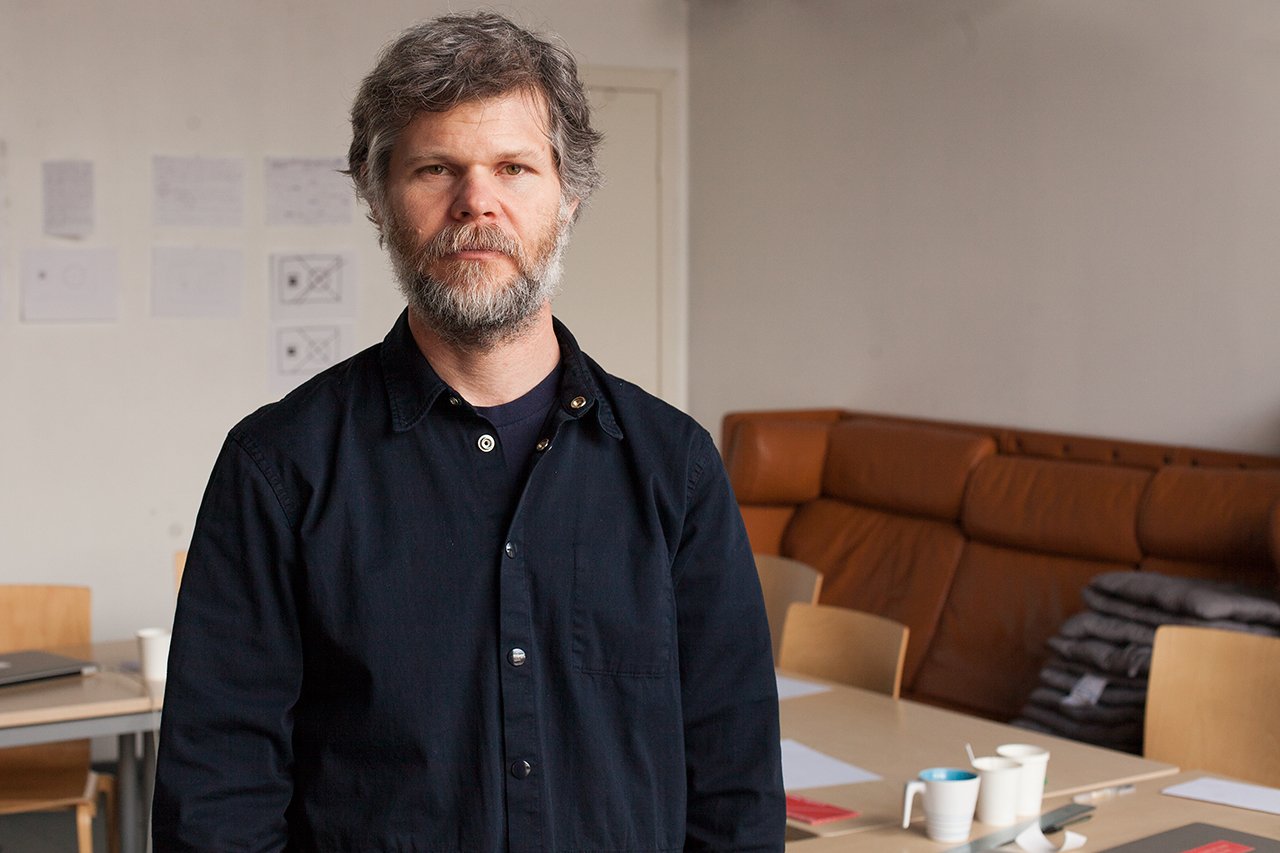
Casey Reas (born 1972 in Troy, Ohio) is an artist and educator based in Los Angeles, and a professor in the Department of Design Media Arts at the University of California, Los Angeles. In 2001 he co-founded Processing, the programming environment for artists and designers, and in 2020 the online platform Feral File.1
It is tempting to see his work as the point where the history told in JAEV's earlier texts ends: Vera Molnár's rules moved to the computer, Sol LeWitt's instructions became programs, and the machine took over. Reas's work shows something else. He writes his systems as instructions in English first, and treats the code as one interpretation of them. The computer does not remove the step where someone interprets an instruction. It moves that step earlier, to the person who writes the program.

{Software} Structures: LeWitt as software
The question first came up in a commission for the Whitney Museum of American Art's online space, Artport. Reas described its starting point: "The catalyst for this project is the work of Sol LeWitt, specifically his wall drawings. I had a simple question: 'Is the history of conceptual art relevant to the idea of software as art?'"2
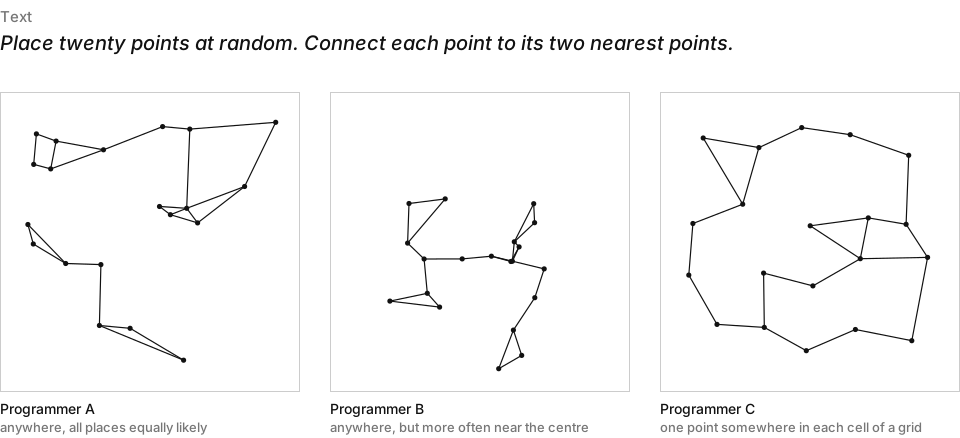
He began by implementing three of LeWitt's wall drawings in software. Then he wrote three structures of his own, which he describes as "text descriptions outlining dynamic relations between elements". In his words, they "develop in the vague domain of image and then mature in the more defined structures of natural language before any thought is given to a specific machine implementation." Twenty-six programs were then written from these texts, by Reas together with Jared Tarbell, Robert Hodgin and William Ngan, written to isolate different components of the structures, including interpretation, material and process.2
The result is the software equivalent of a wall drawing installed several times. One text, several programs, and each program is different because each programmer had to decide what the text left open.
Process: a grammar for systems
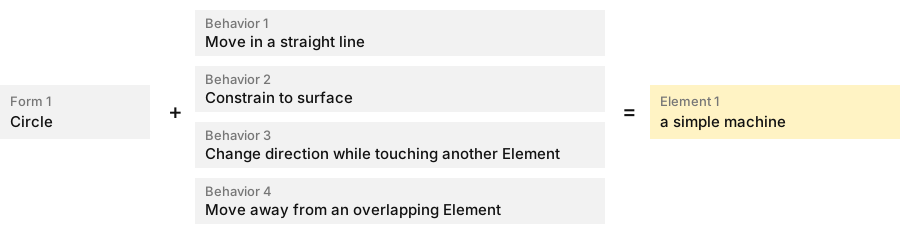
The method that grew out of this became the series Process. Its central part, Process 4 to Process 18, was developed between 2004 and 2010.3 It is built on a small grammar. A Form is a visual primitive, such as a line or a circle. A Behavior is a rule for action, such as "move in a straight line". An Element is a Form combined with one or more Behaviors, which Reas describes as a simple machine. His own example, Element 1, is a circle with four Behaviors: move in a straight line, constrain to surface, change direction while touching another Element, and move away from an overlapping Element.3
When a Process runs, every Element changes a little at each step according to its Behaviors, and the traces of those changes build up the image. Each work in the series is a short English text that defines an environment of Elements and how their interactions are drawn. Reas's website states the principle directly: the text is primary, "the rules are the artwork, while software and hardware are secondary interpretations that can shift over time." It also says that "to implement a Process in code is itself an act of interpretation, requiring the artist-programmer to make choices not specified in the text."3
This is the core of Reas's position. The programmer is in the same place as LeWitt's drafter: given words, making decisions, producing one realisation among many possible ones. In Reas's work, the result of those decisions is code, which a computer can then execute repeatedly.
The tool for everyone else
Reas also made it easier for others to work this way. Processing, which he started with Ben Fry while both were connected to the Aesthetics and Computation Group at MIT, was made to make programming more accessible to artists and designers.4 It is free and open source, and Reas's website describes it as having "widely expanded creative coding for artists and designers". In 2012 he also co-founded the Processing Foundation.1 Its history is a subject of its own; here it matters because it put the means of writing a system into many more hands.
What changes with code
Code does change some things. A program can run indefinitely and produce an endless series of images from the same rules. Reas's website describes the consequence for the artist: "the artist's role was not to compose pictures, but to define systems."3
But code also ages. The programs for {Software} Structures were first written as Java applets, which modern web browsers no longer support; in 2016 Reas restored the project in JavaScript so that it could run again.2 His website describes hardware as "incidental—fragile and replaceable—while the instructions endure as the work's essence."3 The text outlives the machine it was first written for, and can be implemented again.
That is where the chain from Molnár and LeWitt leads. Code is not the end of it. It is one more realisation of an instruction, made by someone who had to interpret it, and it can be made again when the machines change.