Harold Cohen
AARON, and how to colour without seeing
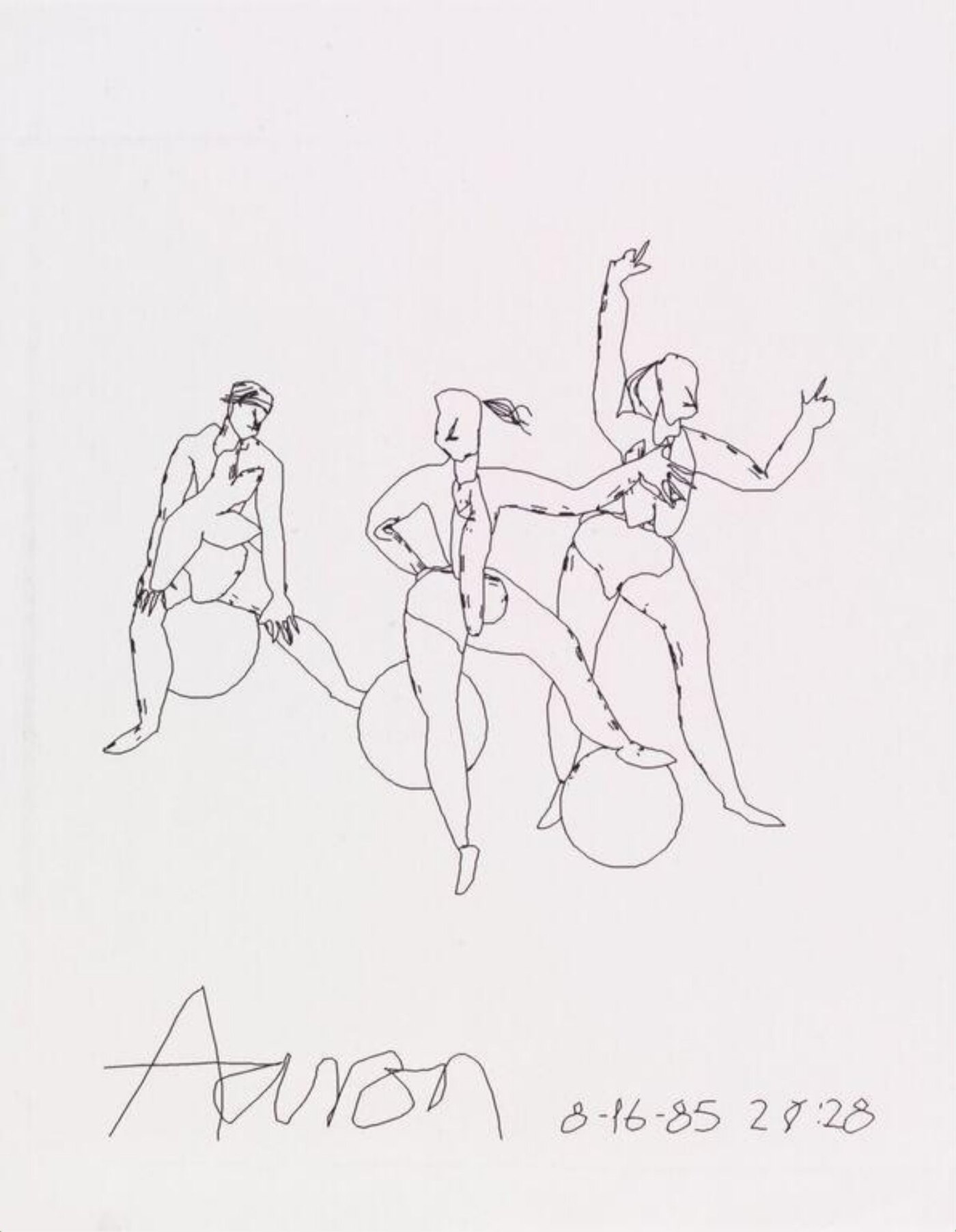
On 16 August 1985, at 20:28, a plotter finished a drawing of three figures and three balls: a seated man and two women who seem to be dancing. Below them it wrote "Aaron 8-16-85 20:28". The Victoria and Albert Museum, which owns the sheet, notes that the signature was made by the program itself, unlike other AARON drawings, which Harold Cohen signed.1
AARON was the program Cohen wrote, rewrote and extended from the early 1970s until his death in 2016.2, 3 Three years after that drawing he wrote that he regarded style as "the signature of a complex system".4 The question his work keeps returning to is what such a system has to know before it can make a picture, and what it can do without. Its answer, reached slowly and against his own expectations, was that it could do without seeing.
A painter in a laboratory
Cohen was born in 1928 and studied painting at the Slade School of Fine Art in London.1 He represented Britain at the Venice Biennale in 1966.5 In 1968 he went to the University of California, San Diego, as a visiting lecturer, and from there he spent two years at the Artificial Intelligence Laboratory at Stanford, at the invitation of Edward Feigenbaum. That is where AARON took shape; the museum records give the Stanford years as 1971 or as 1973–75.3, 5 He named the program AARON in the early 1970s,2 and stayed at San Diego until he retired in 1994.3
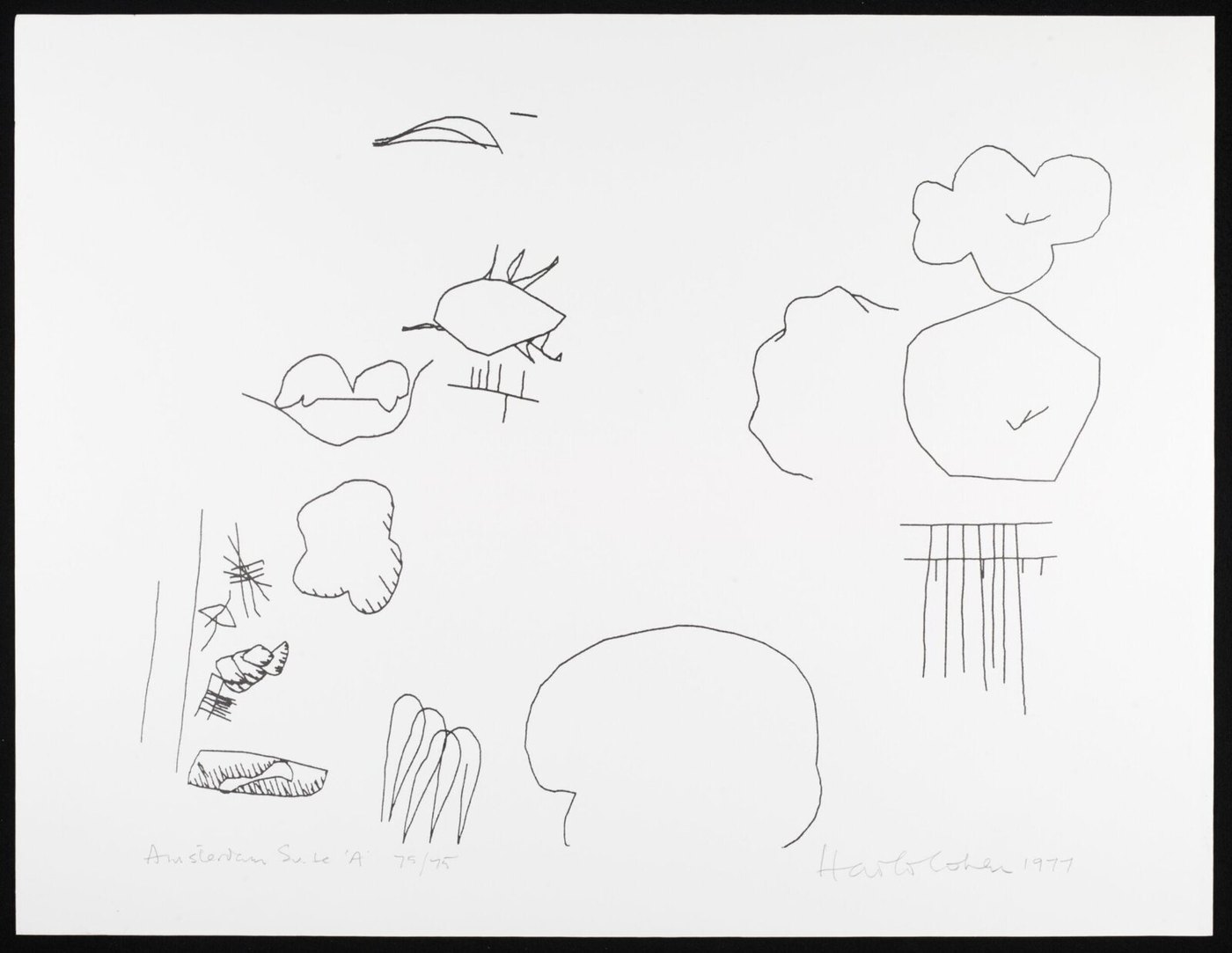
Unlike most of the artists in this series, Cohen did not use the computer to vary a geometric rule. He wanted a program that would make drawings in the way he thought people make them, and he began from very little. In 1979 he wrote that he had chosen, "at the outset", three abilities: to differentiate between figure and ground, between open and closed forms, and between insideness and outsideness.6
The rules
The program was built as a set of rules of the form if this, then that. Cohen did not publish AARON's code, which by the 1990s ran to more than a megabyte of Lisp.7 But in 1979 he printed some of its rules in his own notation, and they are the closest thing to AARON's source that can be read today:6
If (this is a first development
   and the last figure was open
   and at least n figures have been done
   and at least q of them were open
   and at least t units of space are now available)
Then
   This figure will be closed
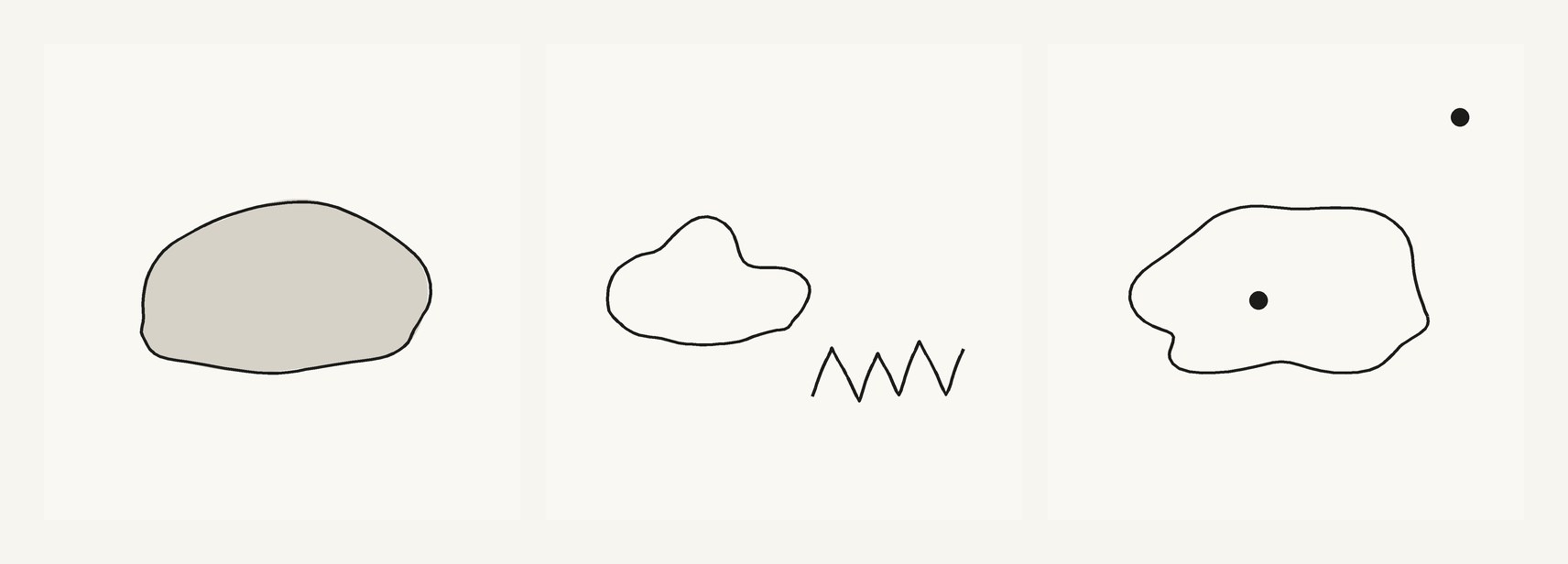
A further rule, for a figure whose first two developments were closed forms, chose between shading it as "a boulder with a hole in it", "a flat shape with a hole" or "a penumbra". Above all the rules sat what Cohen called an avoidance protocol, which prohibited the program "from ignoring the existence of one figure in drawing another one".6 AARON did not decide in advance what the picture would show. Each decision depended on what was already on the paper.
Steering, not plotting
By the end of the 1970s AARON drew on the floor with a small turtle: two wheels, each driven by its own stepping motor. Cohen did not let the program send it to coordinates. He found it "entirely unreasonable" to have built a device that could be driven like a car and then use it to simulate a plotter. Instead the program steered. For each command it looked at the angle to the next signpost and at how far it still had to go, set the speeds of the two wheels, and drove a short arc, moving more carefully near the end. A sonar system then reported where the turtle actually was. In Cohen's words, the program did not say "go to x,y" but "do the following and then say where you are".6
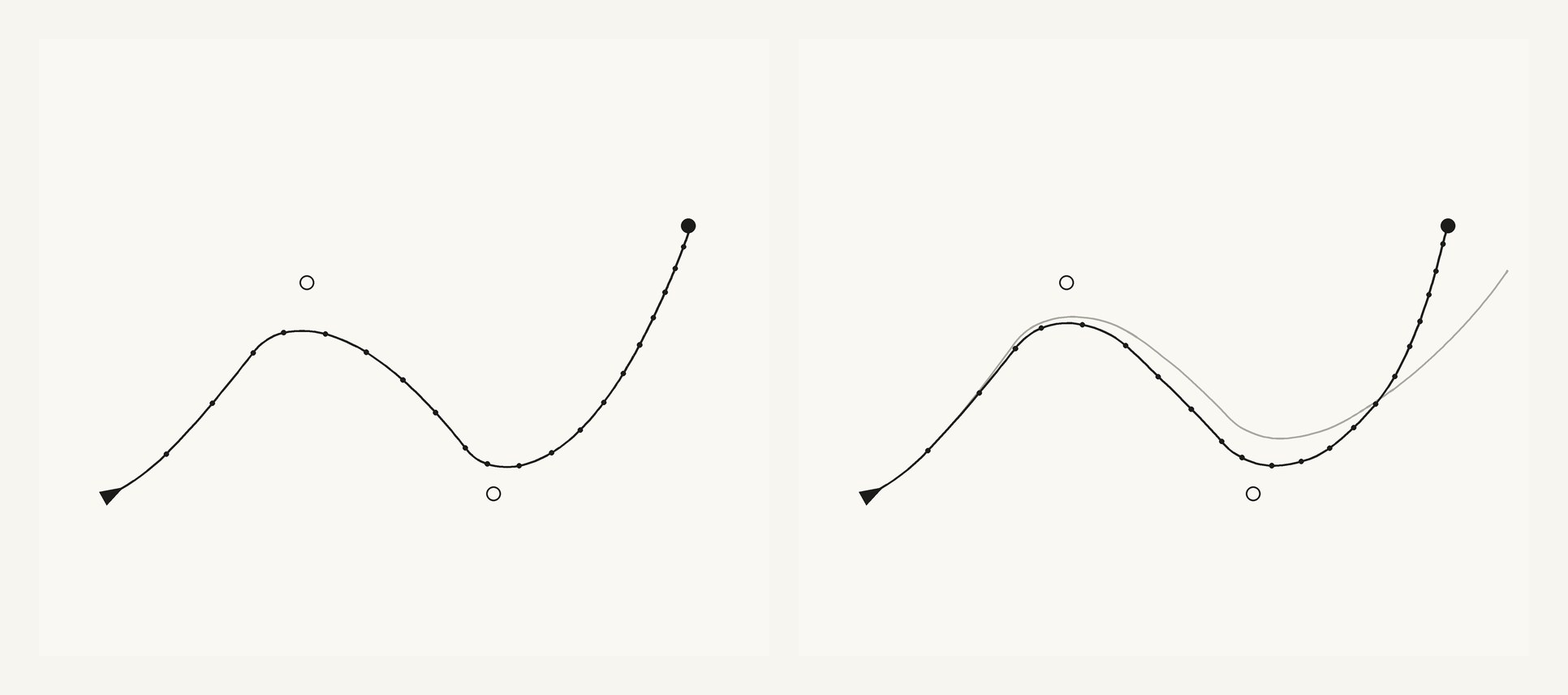
Cohen added that the generating algorithm "simplified enormously" and that the freehand quality of the line "improved noticeably".6 A drawing that steers looks drawn. The same thinking shaped the program's later figures: in the 1980s AARON built each body from an inner "core figure" of articulation points, then traced an enclosing line around it. Cohen insisted that neither then nor later did AARON have "any knowledge pertaining to the surfaces of things".8
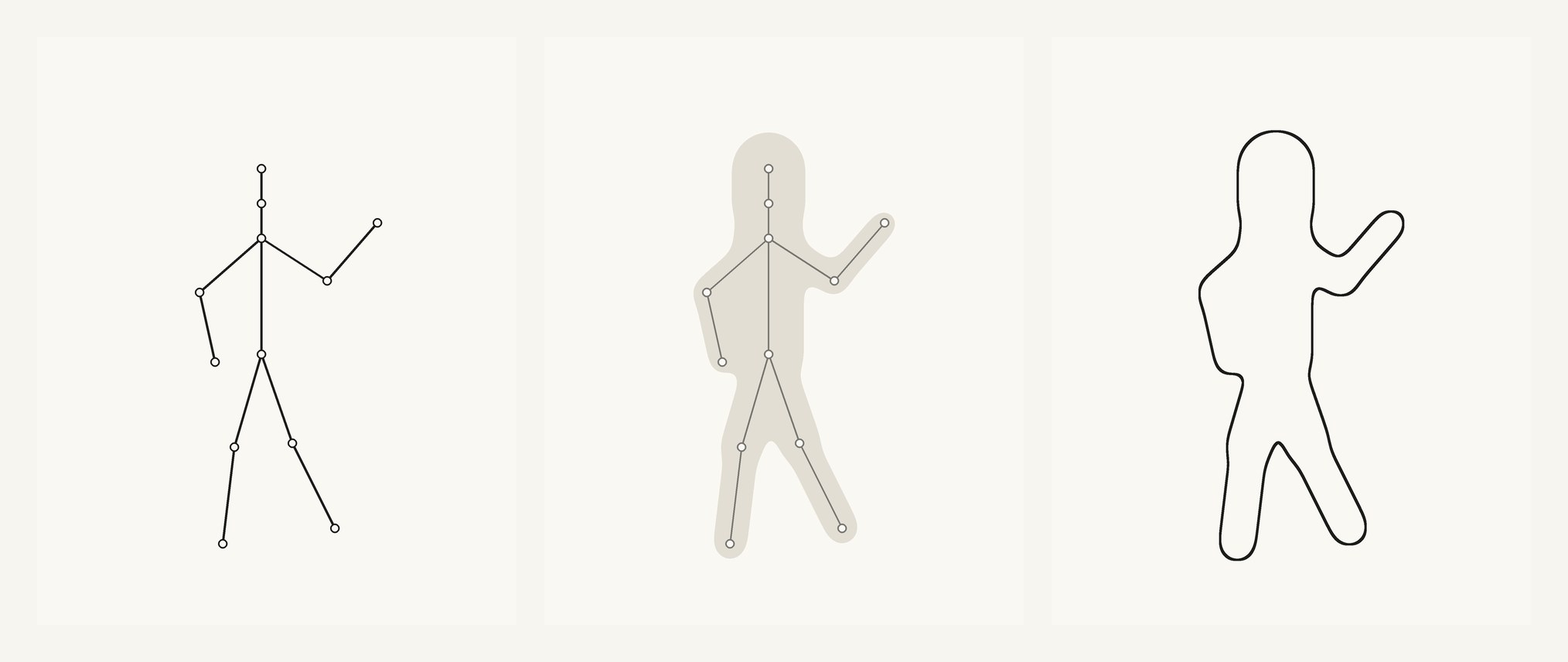
The program knew which part of a body was in front of which, and drew the nearest parts first, without erasing anything. In 1994 Cohen gave an example of the rules involved, "deliberately over-simplified":8
if the left wrist is closer (in 3-space) than the left elbow,
   and the left elbow is closer (in 3-space) than the left shoulder,
   and the left wrist is to the right (in 2-space) of the left shoulder,
   and the left wrist is not higher (in 2-space) than the right shoulder:
then the left arm will obviously obscure the torso,
   and will have to be drawn before the torso is drawn.
Colour without seeing
For most of its life AARON drew and Cohen coloured. He "had always colored some number of AARON's drawings", and many became paintings and murals.8 By 1986 it seemed to him "inappropriate that a program smart enough to generate an endless stream of original drawings was incapable of doing its own coloring".8
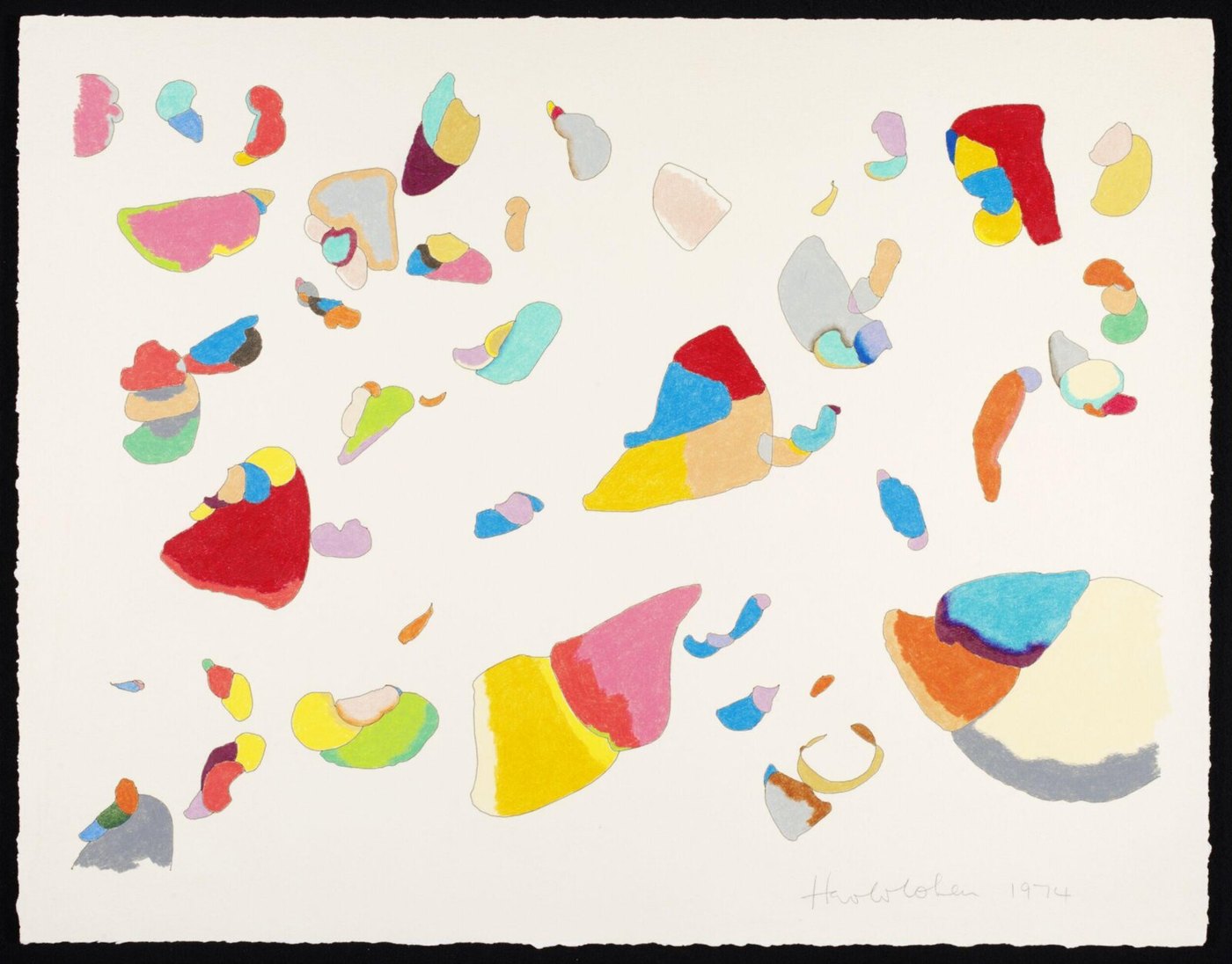
The difficulty was not knowing what a painter knows. It was that a painter sees. "Human beings can see the results of putting two colors next to each other, and can proceed on the basis of this feedback," Cohen said in 1995; the program "can't see in the same sense that you or I can see", so he had to come up with rules "that would serve in place of the visual feedback that humans use".9 He found the key in something he had told painting students for years: "the most important single thing about color is not spectral hue; it's how light or dark it is."9
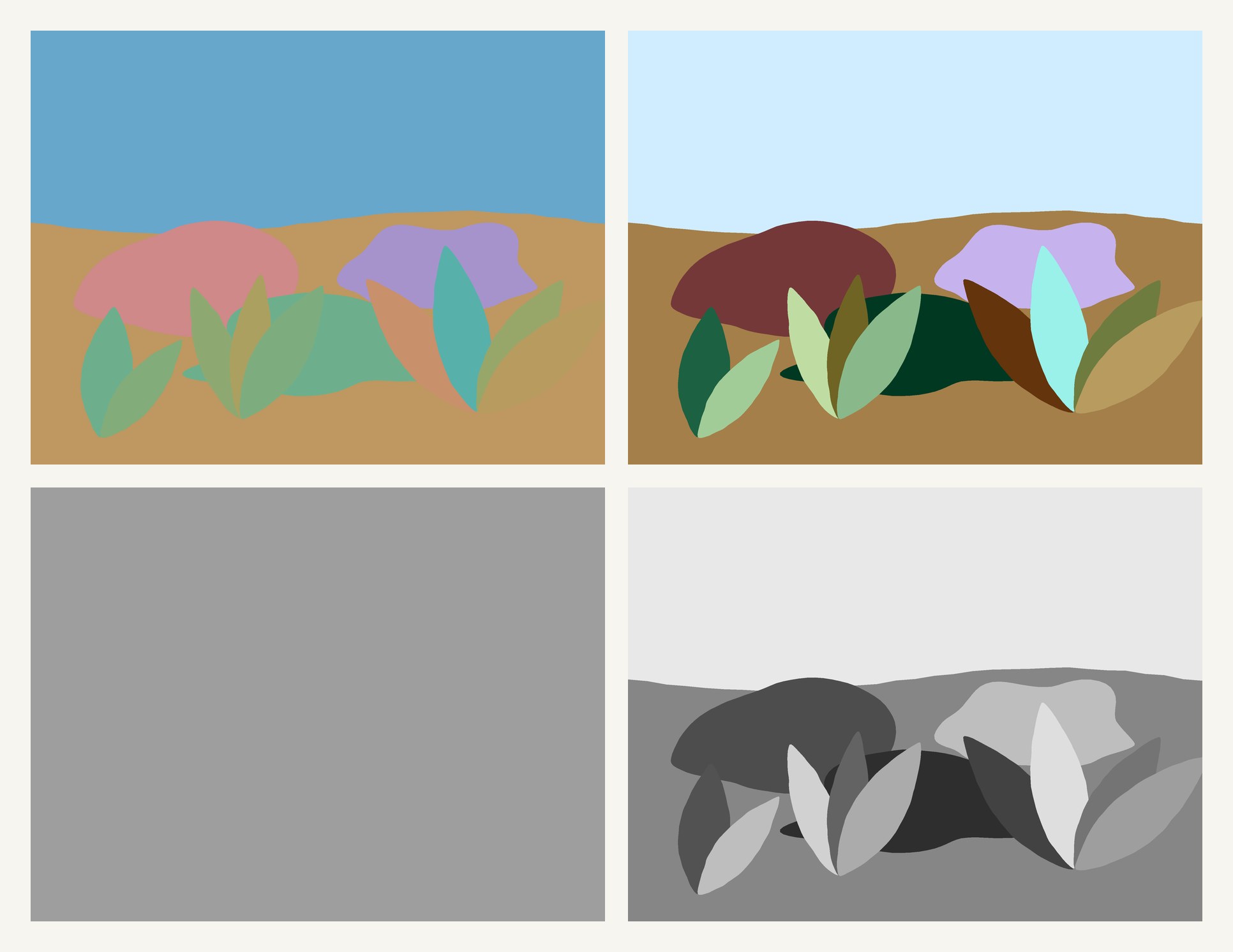
He went further in a later paper. Increasing the difference in hue between two colours "only increases legibility if there is adequate separation in brightness"; at near-equal brightness, the eye has more difficulty finding the edge as the hue difference grows, not less.7 For the painting machine he mixed 1,200 samples of dyes, kept about 800, and arranged them by eye around a circle of 180 positions. From these AARON built what he called colour chords. First it spaced the colours evenly around the circle, then by an additive series. Then it sorted the chord by brightness and diluted each colour to an equal step. Since water can make a dye lighter but never darker, a colour that was already too light could not be corrected; so in the last step the program searched the less pure samples at that position, and then the neighbouring positions, until it found one dark enough. The result, Cohen wrote, "was a guaranteed minimum perceptual separation between any two components of the chord".7
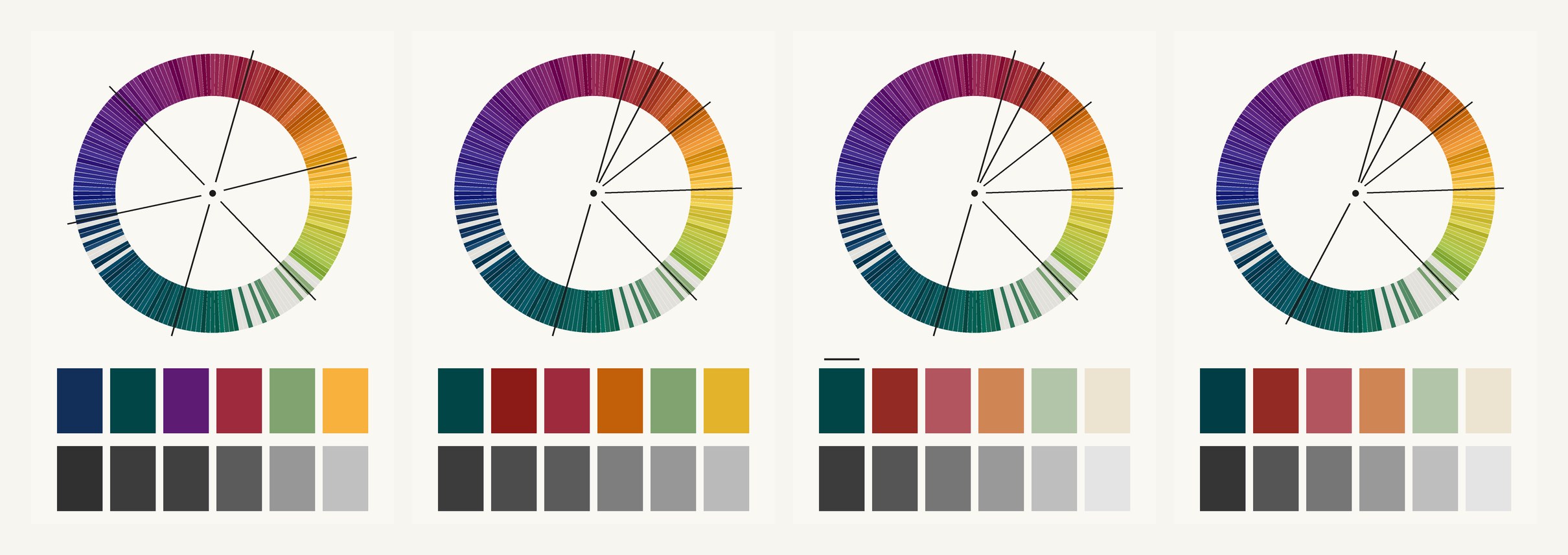
The first paintings made this way, at the Computer Museum in Boston in 1995, were "quite varied in quality", Cohen admitted, until he solved the dilution problem.7, 9 The program also kept knowledge that was not about colour at all. "It would never decide to paint a face green," he said, "because it doesn't believe that faces can be green."9
In the 2000s AARON left the figures and returned to abstraction.3 For the large prints it made from 2002, Cohen insisted that labels and image credits should read "Digital print by AARON, a computer program written by Harold Cohen".10 It is a more deliberate statement than the signature on the 1985 drawing, because it is an instruction from Cohen to a museum about who made the work.
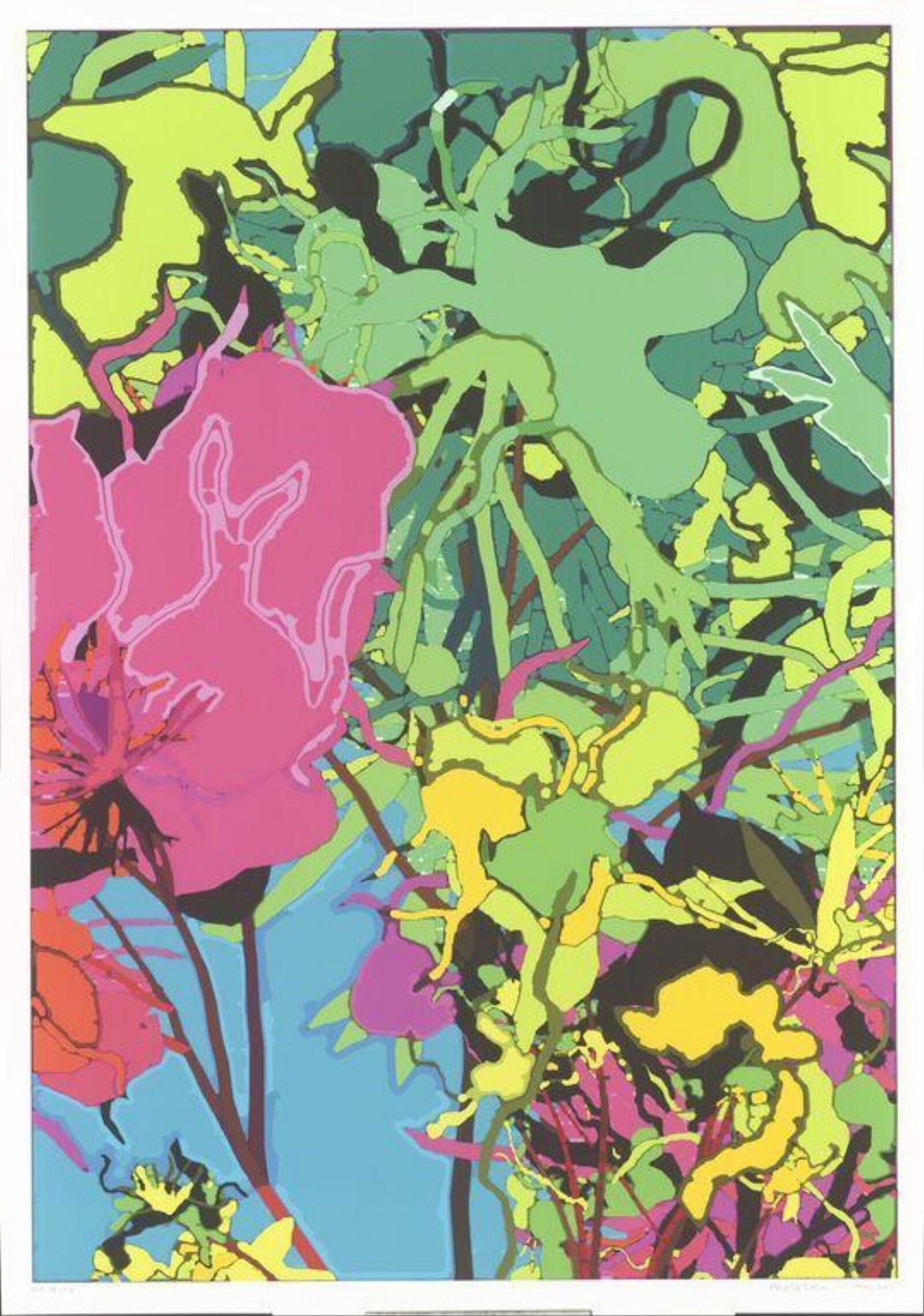
Back to the hand
In the last years the division of labour turned around once more. AARON made drawings on one computer; Cohen coloured them with his fingers on a touch screen that he described as seven-foot, mixing colours that the program stored as "pots", so that a colour could be changed throughout a painting at once. In February 2016, a little over two months before he died, he wrote that he had changed the terms of his relationship with "my collaborator": "Now I am working almost entirely in the program's space."3, 11
In 2024 the Whitney Museum of American Art showed AARON with plotters drawing live in the gallery, alongside screen-based versions of the program; its collection includes AARON KCAT (2001).2
In JAEV's reading this makes Cohen the opposite case to Casey Reas, who writes his systems in English first so that they can be made again when the machines change. Apart from the few rules Cohen chose to print, almost nothing of AARON's rules was written down outside the program. What can be read are his descriptions of them, and they are unusually exact: exact enough to follow a turtle to its signpost, or a colour around a wheel until it is dark enough. The rules of Sol LeWitt, Vera Molnár and Georg Nees could be stated in a sentence or two. Cohen's aim was harder to state: not a rule for a picture, but what an artist knows, including how to colour without seeing. The signature under the drawing from 1985 was written by the program, but by his own definition the style was the signature of the whole system, and he built that system for more than forty years.
About the images: the works by Harold Cohen are shown with credit to the Victoria and Albert Museum, which holds them, and to the Harold Cohen Trust, which the Whitney credits as the holder of the copyright. We have not been in contact with the trust. If it or the museum would rather the images were not shown, we will remove them.
Further reading
- Harold Cohen's own papers at aaronshome.com, among them What is an Image? (1979), How to Draw Three People in a Botanical Garden (1988) and Colouring without Seeing.
- Pamela McCorduck, Aaron's Code: Meta-Art, Artificial Intelligence, and the Work of Harold Cohen (1991), on the Internet Archive.
- Whitney Museum of American Art: Harold Cohen: AARON (2024).
- Victoria and Albert Museum: works by Harold Cohen in the collection.
- JAEV Editorial: Generative Art, Casey Reas, Georg Nees.
Sources
- Harold Cohen, 20:28, 1985 (E.964-2008). Victoria and Albert Museum, London
The inscription “Aaron 8-16-85 20:28” is recorded as made by the program. The record also gives Cohen's training at the Slade. - “Harold Cohen: AARON”, 3 February – 19 May 2024. Whitney Museum of American Art, New York
- Cristina Della Coletta, “Harold Cohen”, In Memoriam. University of California Academic Senate
- Harold Cohen, “How to Draw Three People in a Botanical Garden”. Invited paper, AAAI conference, 1988
- Harold Cohen, Amsterdam Suite A, 1977 (E.328-2009). Victoria and Albert Museum, London
Venice Biennale 1966, San Diego 1968 and Stanford from 1971 according to this record; the record for 20:28 gives Stanford as 1973–75. - Harold Cohen, “What is an Image?”. Invited paper, 6th International Joint Conference on Artificial Intelligence, Tokyo, 1979
- Harold Cohen, “Colouring without Seeing: a Problem in Machine Creativity”. Undated; written after 1998
- Harold Cohen, “The Further Exploits of AARON, Painter”. Text for Stanford Humanities Review, October 1994
- “The Robotic Artist: AARON in Living Color”. Exhibition booklet with a conversation between Harold Cohen and Becky Cohen, The Computer Museum, Boston, 1 April – 29 May 1995
- Harold Cohen, 0305-08, 2002 (E.264-2005). Victoria and Albert Museum, London
Records Cohen's instruction on how prints by AARON should be credited. - Harold Cohen, “Fingerpainting for the 21st Century”, 8 February 2016