Georg Nees
If you can tell me precisely
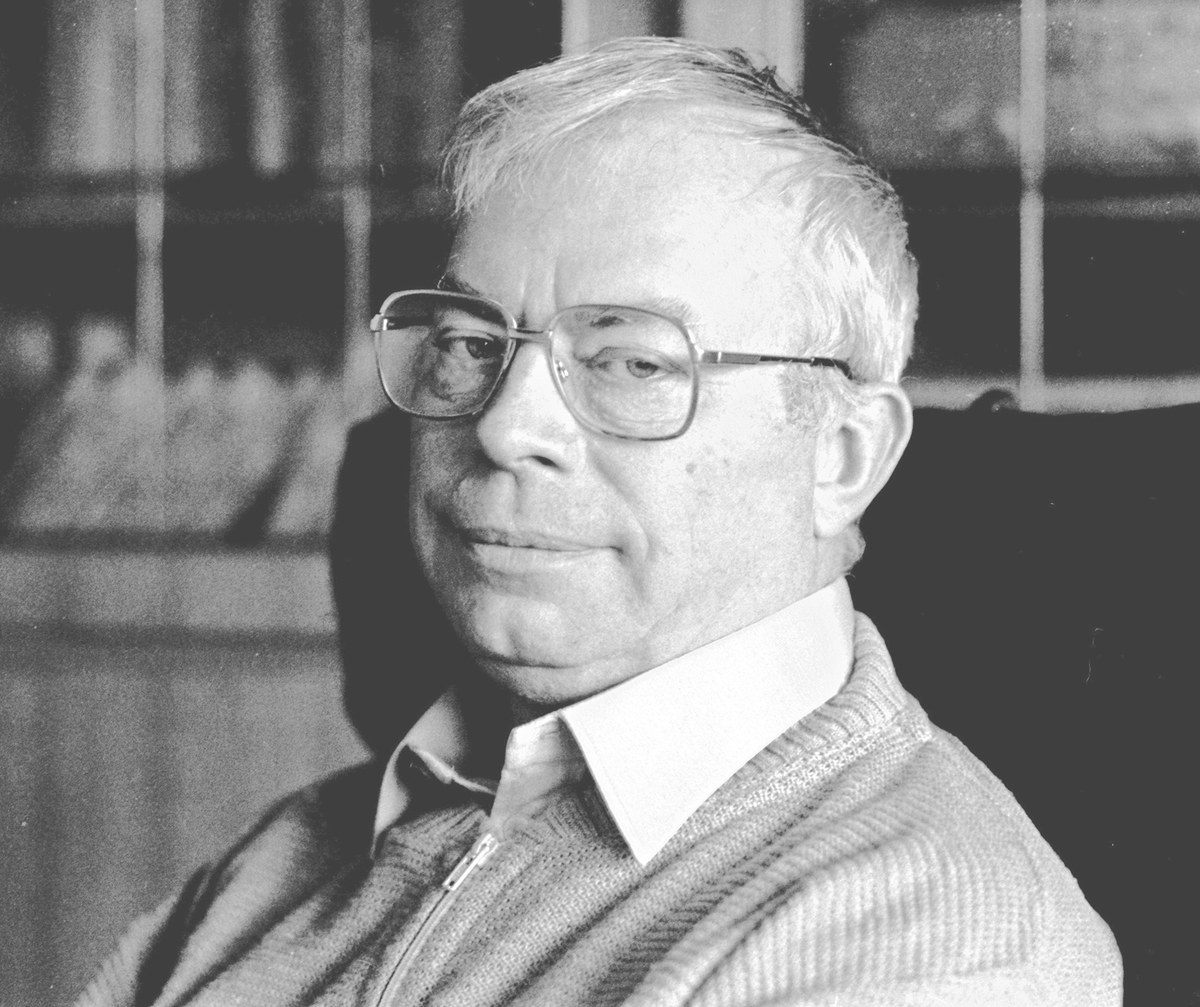
On the afternoon of 5 February 1965, a small exhibition opened in the seminar room of the Institute of Philosophy in Stuttgart, on the eighth floor of the Hahn-Hochhaus; it is usually listed as having been shown at the Studiengalerie of the Technische Hochschule. The institute's director, the philosopher Max Bense, often showed concrete art and poetry there. This time the works were thin black lines, matrices of small figures and overlapping rectangles, and the announcement said they were computer-generated. Their author, a mathematician from Siemens in Erlangen called Georg Nees, explained how his computer had drawn them.1
Frieder Nake, who was in the room and set down what he remembered of it in 2009, recalls that many of the artists present were hostile. One of them stood up and asked whether Nees could make his machine draw the way an artist draws. Nees thought for a moment and answered: "Yes, I can. If you can tell me precisely how to define your way of drawing." Professors from the Academy of Fine Art left, some slamming the doors. Bense tried to calm them: "what you see here is only artificial art."1
JAEV's reading is that this answer holds the core of what came to be called generative art: a drawing can be made by a machine if the way it is made can be described exactly. The rest of Nees's work can be read as a test of that sentence.
An engineer and a Zuse Graphomat
Nees was born in Nuremberg in 1926, studied mathematics and physics at the universities of Erlangen-Nuremberg and Stuttgart, and worked as a software engineer at Siemens.2 There he had access to a Zuse Graphomat Z64, a flatbed drawing machine built by the computer pioneer Konrad Zuse in 1963 as his last commercial product. It was precise but slow, made for cartographers and others who needed exact drawings, and could hold up to four pens or a chisel. It drew from a paper tape whose data had been calculated beforehand by a computer.1 According to the Victoria and Albert Museum, Nees was instrumental in Siemens buying a Zuse Graphomat.2
Nees did not need to borrow a machine, as the artists in Computer Art in Sweden did; he worked where it was. That brought its own caution. In the autumn of 1964 he made his first three abstract drawings and sent them to the journal Grundlagenstudien aus Kybernetik und Geisteswissenschaft. He called them Statistische Graphik (probabilistic graphics), a title chosen, Nake writes, to protect his reputation as an engineer. His notes describe only the programming, in terse technical language, and avoid anything that comes close to the idea of art.1
The program, not the hand
Nees wrote his programs in ALGOL 60, a language made for scientific computation.1 The booklet sold at the opening, issue 19 of Bense's series rot, contained six of his drawings, among them 23-Ecke (Polygon of 23 vertices) and Andreaskreuz (St Andrew's cross), both 1965, ink on paper, 29.7 × 21 cm.1 Their titles name the structure the program works with; within limits set in advance, the program decides the rest. The artist does not draw the lines. He decides how the lines are to be decided.
The same booklet contained a three-page text by Bense, "Projekte generativer Ästhetik" (Projects of generative aesthetics). Nake calls it, in retrospect, the first manifesto of computer art, and places what he calls the algorithmic principle at its heart.1 The word generative, in other words, entered computer art in the same small square booklet as Nees's drawings, on the day of the opening.
The exhibition ran from 5 to 19 February 1965. In November the same year Nees and Nake showed together at Galerie Wendelin Niedlich in Stuttgart. Nake writes that the two of them are usually considered the first to exhibit algorithmic art in Europe.1 In April 1965, between the two Stuttgart shows, A. Michael Noll and Béla Julesz of Bell Labs showed Computer-Generated Pictures at the Howard Wise Gallery in New York.3 The exhibitions of that year are told in Generative Art.

Schotter: order and disorder
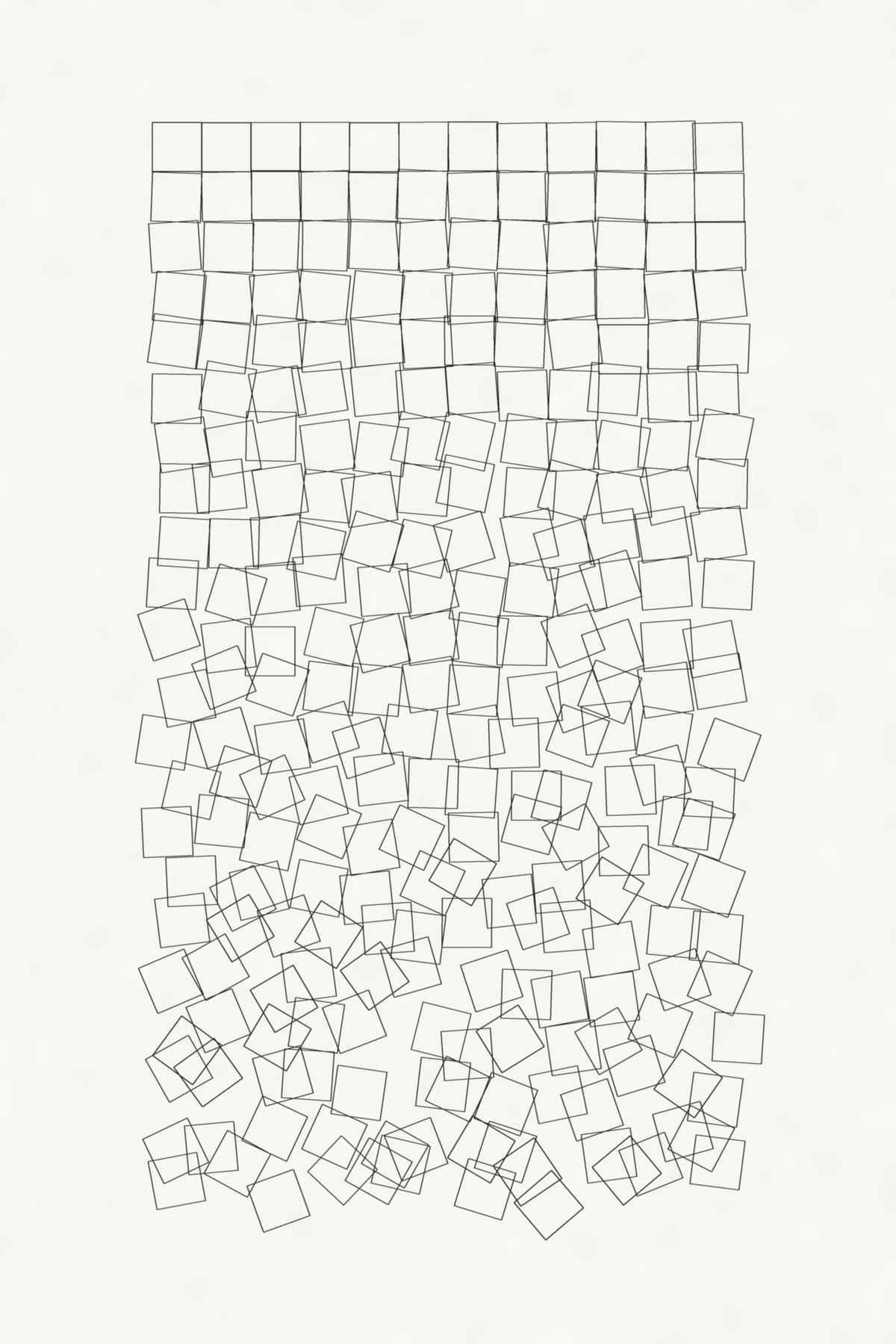
Nees's best-known work, Schotter (Gravel), from 1968, makes the rule itself visible. Twelve squares sit side by side in a row, and twenty-two rows run down the sheet. At the top the squares stand straight and touch each other. With every square the program draws, it allows a little more random displacement and a little more random rotation, so that the grid loosens row by row until, at the bottom, the squares lie scattered like stones.2, 4 The V&A, which holds a lithograph of Schotter printed in 1968–70, 28 × 21.8 cm, describes Nees's interest as "the relationship between order and disorder in picture composition".2
One variable does all the varying. A single counter, the number of squares drawn so far, sets how far each square may move and turn.4 That is what makes the drawing readable: you can see the instruction in the picture, and you can see chance growing under it. It is also an answer to the artist in Stuttgart. A way of drawing, here the gradual collapse of order, has been described precisely enough for a machine to carry out.
The image at the top of this page is not Schotter but JAEV's reconstruction of its method, made with our own random numbers. We are asking for permission to show Nees's own works, and will replace it when we have it.
Artificial art
Nees took the question further than most. In 1969 he received his doctorate under Bense with a dissertation called Generative Computergraphik.2, 5 He also made sculpture by computer. The V&A holds a screenprint, Sculpture 1 (Plastik 1), 1965–68, inscribed "COMPUTERGRAFIK MIT SIEMENS-SYSTEM 4004 / gezeichnet mit ZUSE-GRAPHOMAT". The museum describes it as made from the design for a sculpture that a computer-controlled milling machine cut from a block of wood, shown at the Venice Biennale in 1969; the record's materials field, however, says the print was made after a milled aluminium plate, and the record does not settle which.6
Bense's phrase at the opening, "artificial art", was meant to calm the room, but it also names what Nees showed. The works were made by a program and a machine owned by a company, and the question they raised was not whether a computer could be an artist. It was whether a way of drawing could be written down.
In JAEV's reading, the same question was being asked at the same time without computers. Sol LeWitt wrote instructions from the late 1960s that other people carried out on the wall, which is the difference as much as the likeness: his rules were followed by hands, Nees's by a machine. Manfred Mohr, who began writing programs in Paris in 1969, took up the cube in 1973 and worked with it for decades.
Further reading
- Frieder Nake, The Semiotic Engine: Notes on the History of Algorithmic Images in Europe (2009), an eyewitness account of the 1965 exhibitions.
- Georg Nees, Generative Computergraphik, the 1969 dissertation and the 2006 reprint, on the Internet Archive (in German).
- ZKM Center for Art and Media, Karlsruhe: Georg Nees.
- The Victoria and Albert Museum, London: Schotter and other works by Nees.
- Zellyn Hunter, Schotter – Georg Nees, a reading of the original program.
- Georg Nees on Wikipedia.
- JAEV Editorial: Generative Art, Manfred Mohr, Sol LeWitt, Computer Art in Sweden.
Sources
- Frieder Nake, “The Semiotic Engine: Notes on the History of Algorithmic Images in Europe”. Art Journal, Spring 2009
Nake's account of the opening on 5 February 1965 is, in his words, based on his memories as an eyewitness, written down in 2009. The quotations are his English rendering of what was said in German; the article gives no German original. - Georg Nees, Schotter, 1968–1970. Lithograph on paper. Victoria and Albert Museum, London, E.217-2008
- “The Earliest Public Exhibitions of Computer Art”. HistoryofInformation.com
- Zellyn Hunter, “Schotter – Georg Nees – Part 1”, 2024
A reading of Nees's ALGOL program for Schotter, with Nees's own explanation of the counter that controls the variation. - Georg Nees, Generative Computergraphik. Doctoral dissertation, 1969, with the 2006 reprint. Internet Archive
- Georg Nees, Sculpture 1 (Plastik 1), 1965–1968. Screenprint. Victoria and Albert Museum, London, E.61-2008