Computer Art in Sweden
Borrowed machines, 1960–1980
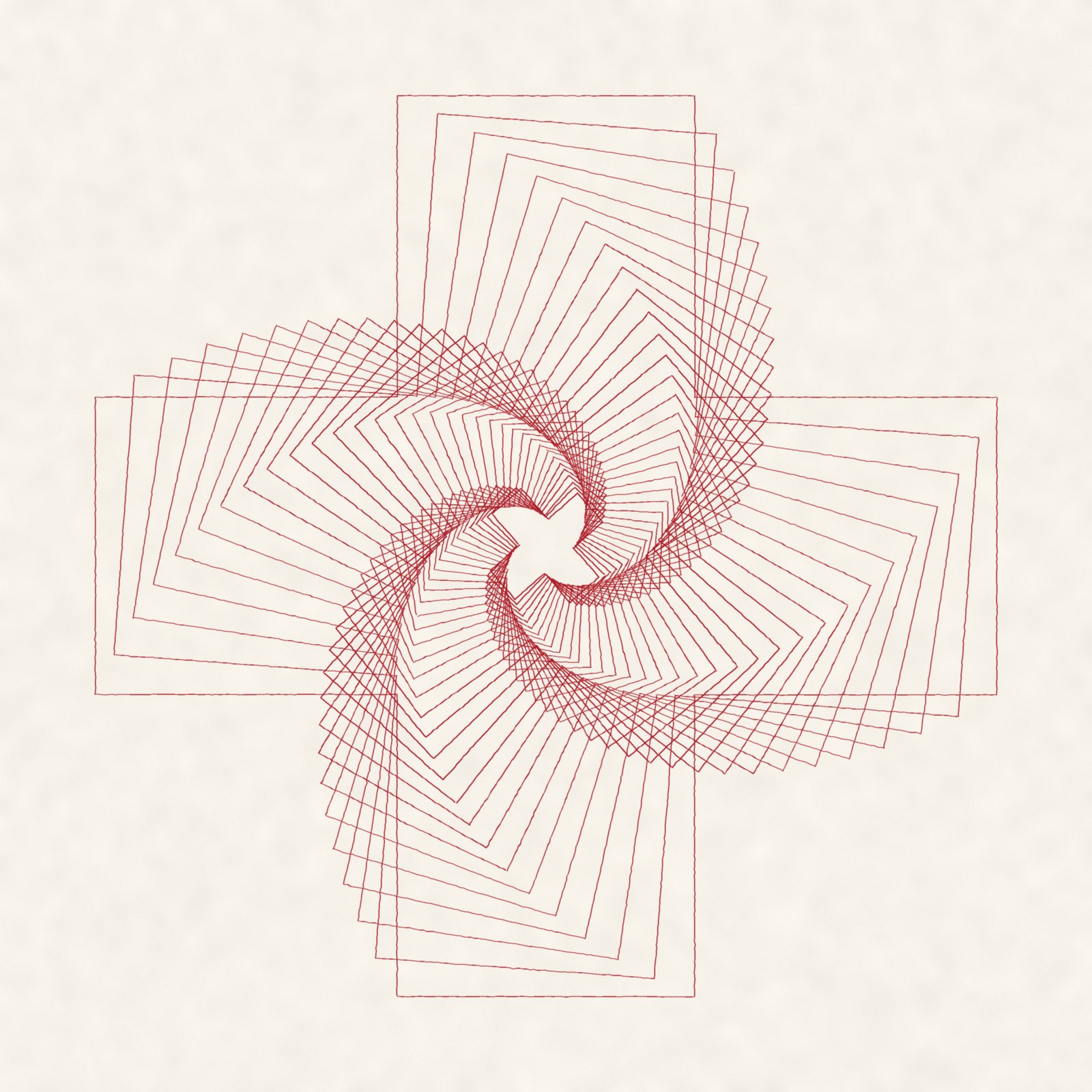
One day the textile designer Astrid Sampe, the former head of NK's textile studio in Stockholm, called IBM and asked to be put through to its design department. IBM had no design department. The switchboard passed her on to Sten Kallin, a programming teacher who was known in the company for his odd ideas: "can you talk to this lady, she wants to draw something strange on computers and we have no idea who she should talk to."1
The call is a small scene, but it shows how computer art came about in Sweden. In the 1960s and 70s almost no artist had a computer. The machines belonged to an aircraft maker, a power company, IBM and the universities, and they were built for other work. Art was made on them when someone inside opened the door, usually in the evening, when the machines were free. What could be made, and what it looked like, depended on which machine was available and what it could draw.
Most of what is known about this period comes from interviews that the historian Anna Orrghen made with ten of the people involved in 2007, for Tekniska museet's documentation project Från matematikmaskin till IT (From mathematics machine to IT). The interviews are published by the museum.2 They were recorded forty years after the events, and Orrghen built her choice of people on the art historian Gary Svensson's dissertation Digitala pionjärer (2000).3 Where possible, this text checks them against sources from the time. Quotations from the interviews are translated from Swedish; the original wording is in the list of sources.
The engineer at the door
The person who opened most doors was Göran Sundqvist. At SAAB around 1960–61, asked to impress visiting air force officers, he programmed the path of a cannonball on the D2, a prototype computer for aircraft, and showed it as dots on an oscilloscope, with a console of three dials, one of them for the angle of the gun. In the interview he calls it "the first computer game, as people say".4, 2
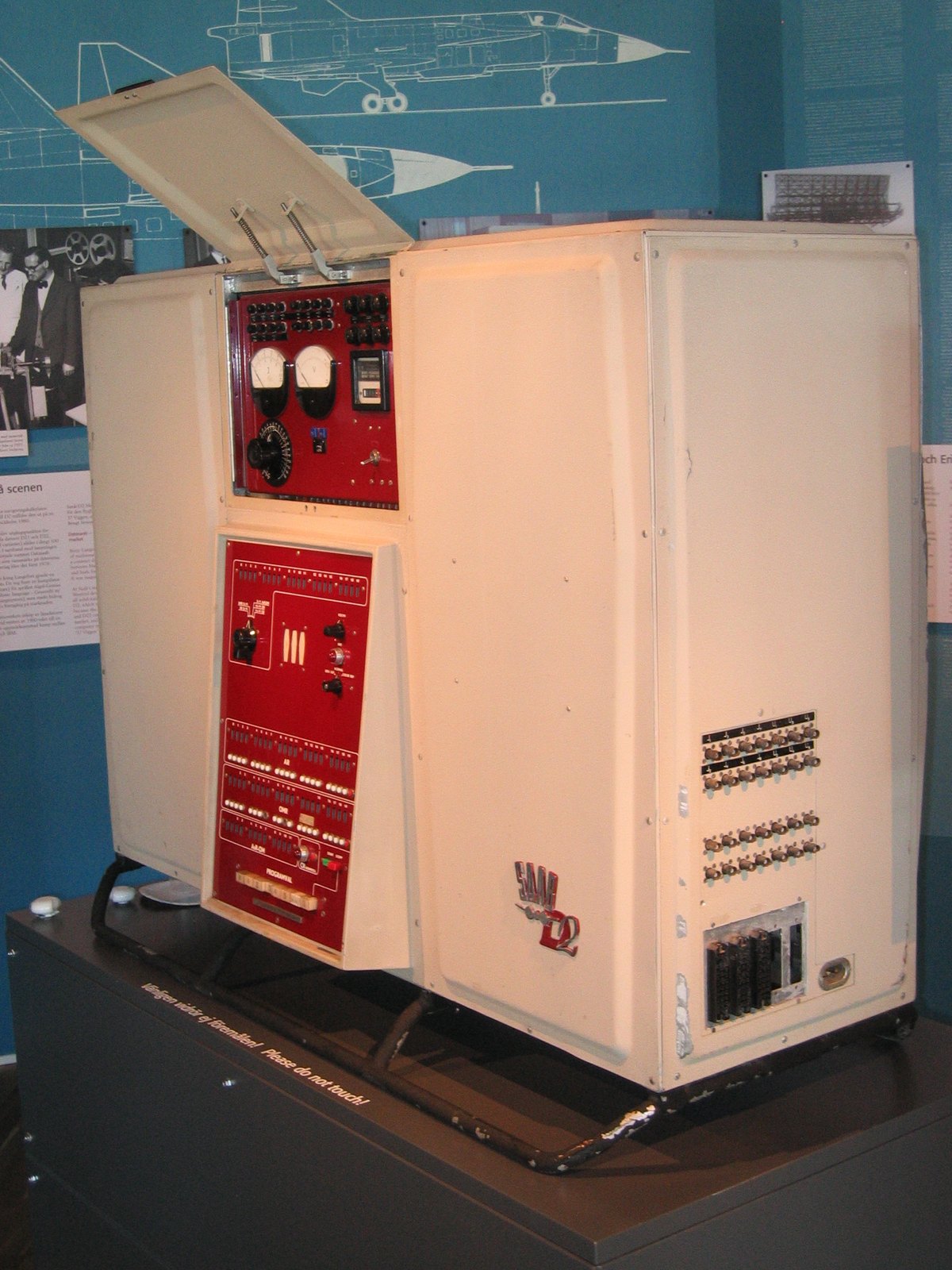


He later looked after a computer that the power company Skandinaviska Elverk used to regulate the gates of hydroelectric dams, and composers from the Stockholm music society Fylkingen came to him to use it.4, 5 Sundqvist also made pictures of his own. In August 1970 the American magazine Computers and Automation printed three of them in its eighth annual computer art contest, Fossil II, Spirals and Fire Bird, in the same contest as Manfred Mohr and Lillian Schwartz with Ken Knowlton. The magazine describes how they were made: drawn on a Tektronix 611 display connected to a SAAB D22, "from a simple program to produce a circle, with different and varying parameters for radius, center coordinates, and angles."6 All three are variations on a single circle.
Sound before pictures
The first lasting artistic use of these machines in Sweden was in music. For Jan W Morthenson's Neutron Star (1967) he wrote a program on the power company's D21: a random generator and a short loop that produced bursts of sound, which Morthenson then shaped into the piece at the Elektronmusikstudion (EMS), the studio that Sveriges Radio had built up from 1964 under the composer Knut Wiggen.4, 5, 7
The interviews give two reasons why sound came first. Lars-Gunnar Bodin, composer and artist, points out that pitch, duration and loudness are easy to translate into numbers. Morthenson adds that "sound does not take much computing power, not nearly as much as images".8, 5 There was also the price. Bodin remembers that renting computer time cost around 1,200 kronor an hour, more than any composer could pay; his own work with Sundqvist was done on the side, at night.8
Lund, 1968: the computer decides where
In 1968 Bodin showed a computer-made picture in Lund, at En festival kring konst och teknologi (A festival around art and technology), organised, he says, by Björn Springfeldt, a student of art history who later became director of Moderna Museet.8, 9 The festival programme listed his "serial and stochastic structures", made with Sundqvist.4
Bodin describes how such a picture was made. It was built from 120 or 130 small cells. He set the rules for each kind of cell and how many elements of each colour, yellow and orange, there should be. The computer decided where they went, and returned the answer as a printout of letters and coordinates. Bodin then made the picture by hand, cell by cell, the way the composer Iannis Xenakis turned computer output into a score. He made other versions with a table of random numbers in place of the computer: "You thought like a computer."8 The large picture made for Lund was later destroyed by water in storage. According to his own CV, Moderna Museet holds two of his works.8, 9
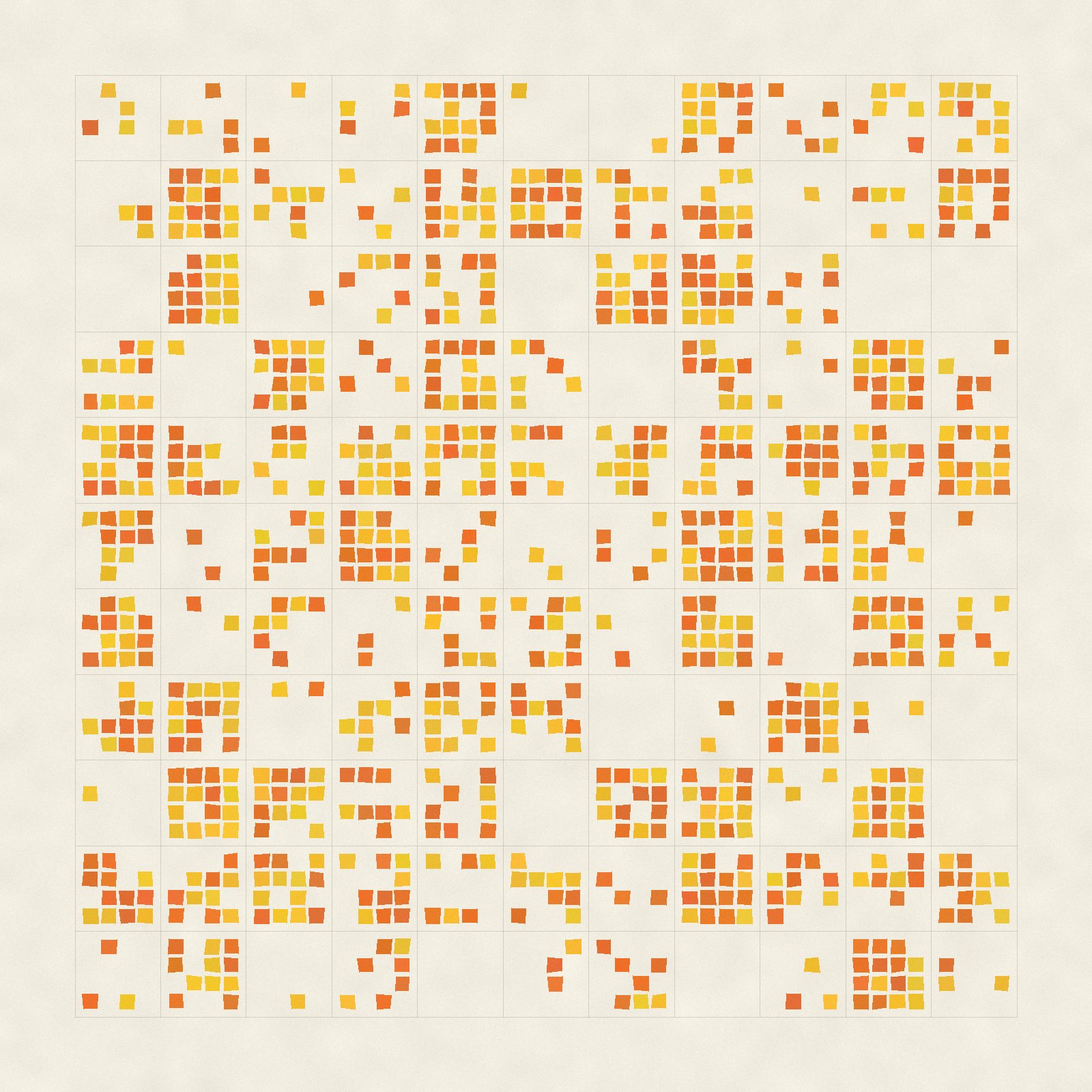
The division of labour came from the machine. The computer could choose but not paint, so the choosing was given to it and the painting stayed with the artist. It is close to what Sol LeWitt was writing in New York in the same years: the rules are the work, and the execution can be left to someone or something else.
IBM's plotter in the cupboard
Kallin, who taught programming at IBM in Solna from 1963, had the use in the evenings and at weekends of an IBM 1130 that spent its days driving printers in a small room, and of a drum plotter that no one else in the company wanted.1 That is where Sampe's call ended up. She had been asked for a picture for a Red Cross charity auction and wanted to make it with a computer. Kallin wrote a program that drew the cross again and again, smaller and turned a little each time, and gave her a menu to set the number of turns, the angle and the reduction herself. They sat at the machine one evening while she tried values.1
The plotter left a mark of its own. Its pen sat a little loose in the holder, so the lines were never quite straight: "It is somehow a little human, or it has a little character or a little chance in the line." Laid side by side, the slightly crooked lines produced moiré.1
The collaboration went on into textiles. Computer Colonne (1975), a screen-printed cotton sold by NK, is credited by the Art Institute of Chicago, which holds an example given by Sampe herself, to "Astrid Sampe with computer programmer Sten Kallin and IBM Plotter 1627", the drum plotter of the 1130.10 The museum's record lists the plotter among the makers. In a printed picture that Kallin showed in the interview, the textile is called "one of Astrid Sampe's and IBM's computer patterns". Kallin's name is not in that caption.1
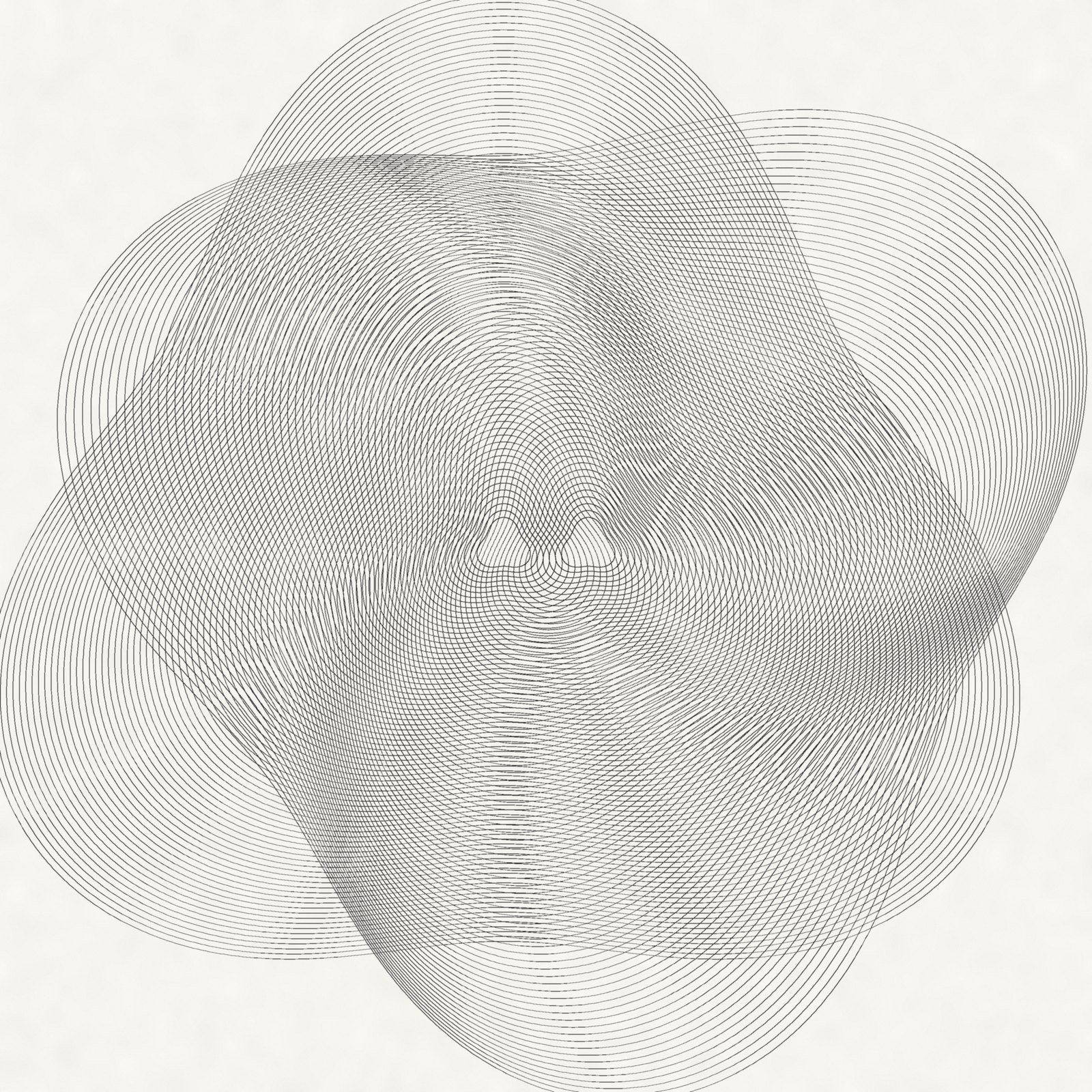
On the same kind of machine Kallin and the artist Sture Johannesson made INTRA between 1969 and 1974: curves from mathematical formulas, repeated and shifted until moiré appeared where they crossed. Johannesson later described it less as computer art than as a study of how picture elements act on each other in a picture space.2, 11
Lund University: letters, then ink
At the computing centre of Lund University, the duo Beck & Jung, the artist Holger Bäckström and the engineer Bo Ljungberg, worked with what the centre had. According to Bodin, there was no printer that could draw, so their first pictures were forms filled in with letters, which they then painted and joined together.8 In the 1970s Mikael Jern at the same centre worked with Hellmuth Hertz on a colour ink jet plotter and wrote software that drew a cube of 17 × 17 × 17 smaller cubes in graded colours.2, 12 The cubes later appeared as works by Beck & Jung. Who made them is a question of its own, told in The colour cubes.
Machines of their own
By around 1980 artists were beginning to have machines of their own. In 1976 Lars Kjelldahl and Jern founded SIGRAD, a Swedish association for computer graphics.13 Sture and Ann-Charlotte Johannesson started the Digitalteatern (Digital Theatre) in Malmö at the end of the 1970s, a studio built on Apple computers that they owned. Ann-Charlotte Johannesson, trained in textiles, saw in the grid of pixels the structure of a fabric.11 The artist Torsten Ridell learned to program himself at the Université de Paris VIII in Vincennes, without an engineer in between.14
In 1979 Ridell curated L'Artiste et l'Ordinateur (The artist and the computer) at the Centre Culturel Suédois in Paris.14 The 28-page catalogue names Beck & Jung, and the exhibition went on to Lille and Caen.15 Bodin, who took part, lists Seclin as well, and showings in Lund and Norrköping in 1980.9
What the access shaped
Read side by side, the sources suggest three ways in which access decided the art.
The output device set the look. A cannonball became dots because an oscilloscope draws dots. Beck & Jung's first pictures were made of letters because the printer could print nothing else. Kallin's crosses tremble because the pen sat loose. Sundqvist's 1970 pictures are variations on one circle, made by a short program on a display terminal.
Time and cost set the scale. Work was done in the evenings, on machines rented at prices no artist could pay, so the programs were short and the rules simple. Music came first, according to those who made it, because sound needed less of the machine than pictures did.
And the work was shared. Almost every piece depended on an engineer: Sundqvist for Morthenson and Bodin, Kallin for Sampe and Johannesson, Jern for Beck & Jung. Who made what was often settled afterwards, if at all. Kallin says that he had no artistic ambitions; a museum now credits a textile to Sampe "with computer programmer Sten Kallin and IBM Plotter 1627".
Archives and further reading
- Wikimedia Commons: photograph of the Datasaab D2 by Lars Aronsson.
- Tekniska museet, Stockholm: interviews with Swedish IT pioneers, in Swedish, including all the interviews used here.
- Computers and Automation, August 1970, with Sundqvist's three drawings: scan of the issue (Bitsavers).
- The Art Institute of Chicago: Astrid Sampe, Computer Colonne, 1975.
- Scenkonstmuseet, Stockholm: Elektronmusikstudion – art, technology and politics.
The reconstructions on this page are made by JAEV and marked as such in their captions, file names and metadata. They are free to use under CC BY 4.0, with credit to JAEV and a link to this page.
Sources
- Sten Kallin, interviewed by Anna Orrghen, 10 September 2007. Från matematikmaskin till IT, Tekniska museet, Stockholm
- Anna Orrghen, Från matematikmaskin till IT. Fokusgrupp: Media. Slutrapport. Tekniska museet, Stockholm, 2008
- Gary Svensson, Digitala pionjärer. Datakonstens introduktion i Sverige. Carlssons, Stockholm, 2000
Cited in Orrghen's report as the starting point for her interviews. Not read by JAEV. - Göran Sundqvist, interviewed by Anna Orrghen, 31 August 2007. Från matematikmaskin till IT, Tekniska museet, Stockholm
- Jan W Morthenson, interviewed by Anna Orrghen, 17 August 2007. Från matematikmaskin till IT, Tekniska museet, Stockholm
- Göran Sundqvist, “Fossil II”, “Spirals”, “Fire Bird”. Eighth Annual Computer Art Contest, Computers and Automation, August 1970, pp. 19–20
“The three drawings on this page are taken from a Tektronix 611 display terminal connected to a SAAB D22 computer. The pictures are made from a simple program to produce a circle, with different and varying parameters for radius, center coordinates, and angles.” - Elektronmusikstudion – konst, teknik och politik. Scenkonstmuseet, Stockholm
- Lars-Gunnar Bodin, interviewed by Anna Orrghen, 5 September 2007. Från matematikmaskin till IT, Tekniska museet, Stockholm
- Lars-Gunnar Bodin, Curriculum Vitae – bild, 2009
Lists “1968 Lund, Datorgenerad bild”, “1979 L’artist et la ordinateur. Paris, Caen, Lille, Seclin”, “1980 Dito, Lund, Norrköping”, and two works in Moderna Museet’s collection. - Astrid Sampe with computer programmer Sten Kallin and IBM Plotter 1627, Computer Colonne, 1975. The Art Institute of Chicago, gift of Astrid Sampe
- Sture Johannesson and Ann-Charlotte Johannesson, interviewed by Anna Orrghen, 2 October 2007. Från matematikmaskin till IT, Tekniska museet, Stockholm
- Mikael Jern, interviewed by Anna Orrghen, 4 October 2007. Från matematikmaskin till IT, Tekniska museet, Stockholm
- Lars Kjelldahl, interviewed by Anna Orrghen, 25 October 2007. Från matematikmaskin till IT, Tekniska museet, Stockholm
- Torsten Ridell, interviewed by Anna Orrghen, 21 November 2007. Från matematikmaskin till IT, Tekniska museet, Stockholm
- Artiste et ordinateur: [exposition], Paris, Lille, Caen, 1979. Centre culturel suédois, Paris, 1979. 28 pages, ill. Catalogue record, LIBRIS
Names Beck (Holger Bäckström) and Jung (Bo Ljungberg). Catalogue record only; the catalogue itself not read by JAEV. - Original wording of the quotations from the interviews
Kallin: “…kan du prata med den här tanten, hon vill rita något konstigt på datorer och vi vet inte alls vem vi skall snacka med.” — Kallin: “Det är liksom lite mänskligt, eller, det är lite karaktär eller lite slump i strecket.” — Sundqvist: “…som jag gjorde det första dataspelet som man säger, med den här kanonkulan.” — Morthenson: “Ljud tar inte så mycket datakraft, inte alls lika mycket som bilder.” — Bodin: “Man tänkte som en dator alltså.” — Bodin: “…annars skulle vi få betala, ja 1 200 kronor i timmen och så där.” — Kallin, on a printed picture of the textile: “Computer Column ett av Astrid Sampes och IBM:s datamönster.”