Bézier curves
JAEV Notes · October 2026 · 3 min read
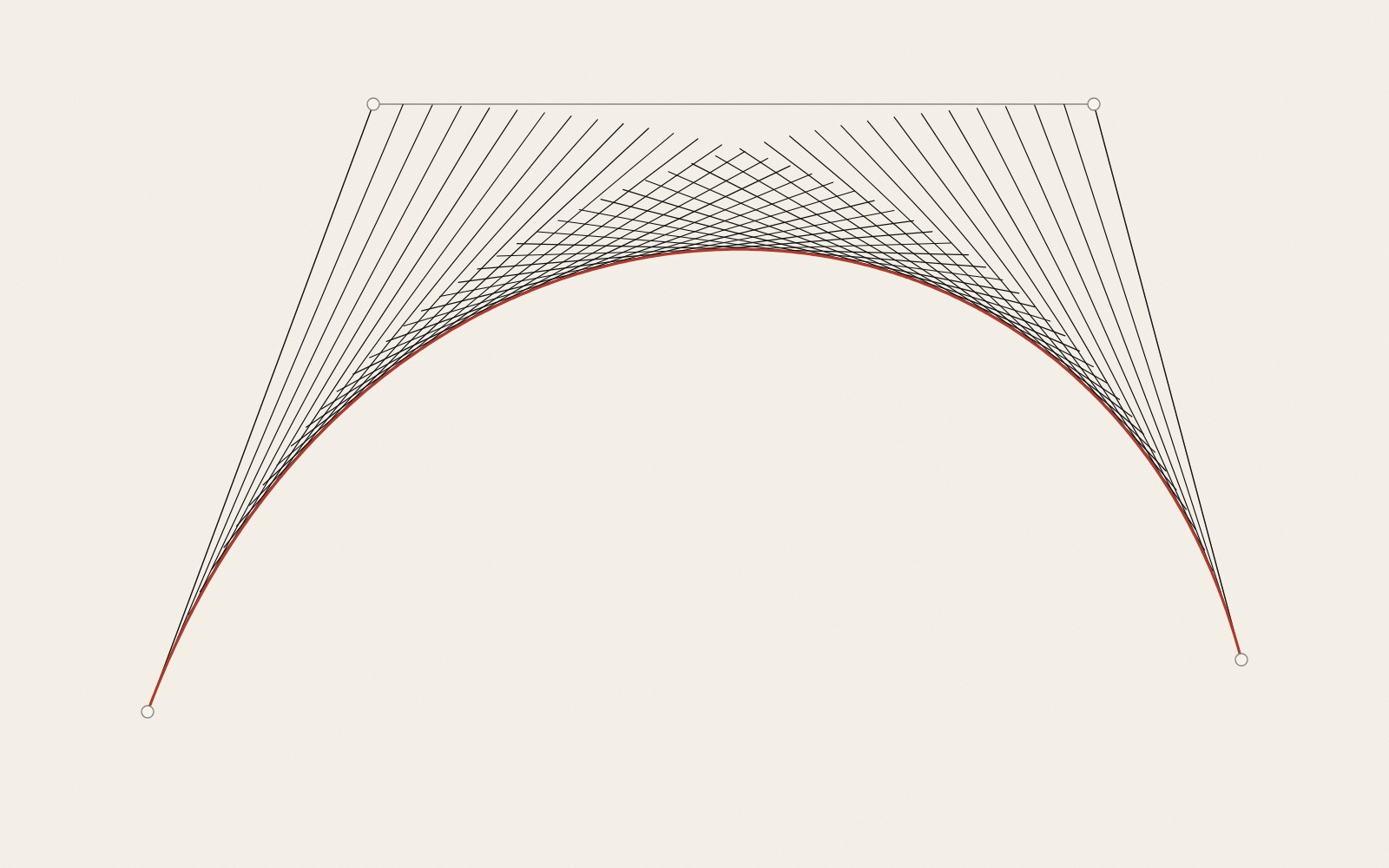
A Bézier curve is a smooth curve defined by a few points: it starts at the first, ends at the last, and is pulled towards the ones in between without passing through them. It is named after the engineer Pierre Bézier (1910–1999), who used it in the 1960s to design the bodywork of Renault cars.1 Today it describes the paths in drawing programs, the outlines of letters in fonts and the curves in SVG files.2
Two car makers
Bézier worked for Renault from 1933 to 1975, and his system for designing car bodies by computer, UNISURF, came into use in 1968.3 He made the curves known around 1962 and patented their use in computer-aided design, but he did not invent them.4, 5 At the end of the 1950s Paul de Casteljau, at Citroën, had worked out the same curves and a way to compute them.1, 4 Citroën asked him not to publish, and he could only write it up in 1985.4 So the curve carries Bézier's name, and the method of drawing it carries de Casteljau's.
How it works
The most common kind is cubic and has four points, P0 and P3 at the ends and P1 and P2 as control points. The curve leaves its start in the direction of the line from P0 to P1 and arrives at its end along the line from P2 to P3.1, 5
De Casteljau's construction finds any point on the curve with nothing but division of lines.2 Choose a number t between 0 and 1, say 0.3.
- Divide each of the three lines P0–P1, P1–P2 and P2–P3 at 30 per cent of its length. That gives three new points.
- Join them with two lines and divide those at 30 per cent too, which gives two points.
- Join those two and divide the last line at 30 per cent. That point is on the curve.
Repeat for every t from 0 to 1 and the points trace the whole curve. The last line in step 3 touches the curve at the point it finds, which is what the picture at the top shows: 49 such lines, and the curve they outline in red.
In files and fonts
The SVG format has a command for each kind: C draws a cubic curve "using (x1,y1) as the control point at the beginning of the curve" and a second one at the end, and Q a quadratic curve with a single control point.6 PostScript and SVG build their curved shapes from cubic curves; TrueType fonts use quadratic ones.1, 4
On a plotter
A pen plotter cannot draw a curve as such. The controller of the AxiDraw, for example, moves its motors "in a straight line between two points".7 So the curve is "flattened": points are computed along it and joined with short straight lines.2 The plotter program vpype does this when it reads an SVG file: every curve is "linearized and approximated by polylines", by default with segments no longer than 0.1 mm.8 How those many short lines are then put in order is described in plotter path optimisation; the language older plotters were sent is in HP-GL, and more on drawing machines in Plotter Art.
Olof Broström's Difficulty at JAEV, one drawing a day made automatically from the day's aurora forecast and the day's first block, is built of such curves: sheet no. 972396, of 21 October 2026, has 5,672 Bézier curves, 26.6 m of line if plotted at print size.9
Sources
- “Bézier curve”. Wikipedia
Named after Pierre Bézier (1910–1999), “who used it in the 1960s for designing curves for the bodywork of Renault cars”; de Casteljau in 1959, at Citroën; Bernstein polynomials 1912; endpoint interpolation, convex hull, tangents at the ends; TrueType quadratic, PostScript and SVG cubic. - Pomax, “A Primer on Bézier Curves”
De Casteljau's algorithm: “a geometric approach to curve drawing”, markers placed at ratio t, repeated until one point is left; “flattening”: joining points on the curve with straight lines. - “Pierre Bézier”. Wikipedia
1 September 1910 – 25 November 1999; “From 1933 to 1975 Bézier worked for Renault”; “UNISURF debuted in 1968”; “Bézier popularized but did not actually create the Bézier curve”. - “Bézier and de Casteljau: two engineers, one beautiful curve”. FontLab blog, 1 July 2025
“In 1958, Paul de Casteljau at Citroën worked out the mathematics”; Citroën “asked him not to publish”; written up in 1985; Bézier “published it in 1962”; PostScript and CFF cubic, TrueType quadratic. - “French Curves and Bézier Splines”. ThatsMaths, 6 February 2014
“first made popular by the automotive designer Pierre Bézier around 1962”; “Bézier patented and popularised the use of these functions in computer aided design, but he was not their inventor”; Bernstein, 1912. - “Paths”. Scalable Vector Graphics (SVG) 2, W3C
C: “Draws a cubic Bézier curve from the current point to (x,y) using (x1,y1) as the control point at the beginning of the curve”; Q: quadratic Bézier with one control point. - Brian Schmalz, “EiBotBoard” (the controller of the EggBot and AxiDraw)
“This command … will cause the motors to move in a straight line between two points”. - “Command reference”. vpype documentation
read: “All curved primitives (e.g. bezier path, ellipses, etc.) are linearized and approximated by polylines”; --quantization: “Maximum length of segments approximating curved elements (default: 0.1mm).” - Olof Broström, Difficulty no. 972396, 21 October 2026. JAEV, Lund
Aurora forecast: NOAA, 21 Oct 2026; “Curves: 5,672 Bézier curves in the drawing”; “Line length: 125,891 px; 26.6 m if plotted at print size”.
- Published
- JAEV Notes, October 2026.
- Use
- Text CC BY 4.0. Free to use and quote with credit to JAEV and a link to this page. Images and quotations by others keep their own terms.
All texts as one file: archive.json - Cite
- JAEV Notes, “Bézier curves”, jaev.gallery/notes/bezier-curves/, 2026.
- Corrections
- Additions and corrections are welcome: info@jaev.gallery
- Share
A link from your own site, course page or reading list helps others find it.- Follow
- New notes by RSS · Instagram · Bluesky
JAEV is a daemon taking shape: machines, weights, room, brain.