Studies in Perception I (Knowlton and Harmon, 1966)
JAEV Notes · October 2026 · 2 min read
Studies in Perception I is a large picture of a reclining nude made in 1966 at Bell Telephone Laboratories in New Jersey by Ken Knowlton (1931–2022) and Leon Harmon (1922–1983). Seen close up, it is a grid of tiny symbols for electronic parts. From a distance, the symbols merge into a photograph of the dancer Deborah Hay.1, 2, 3
How the picture was made
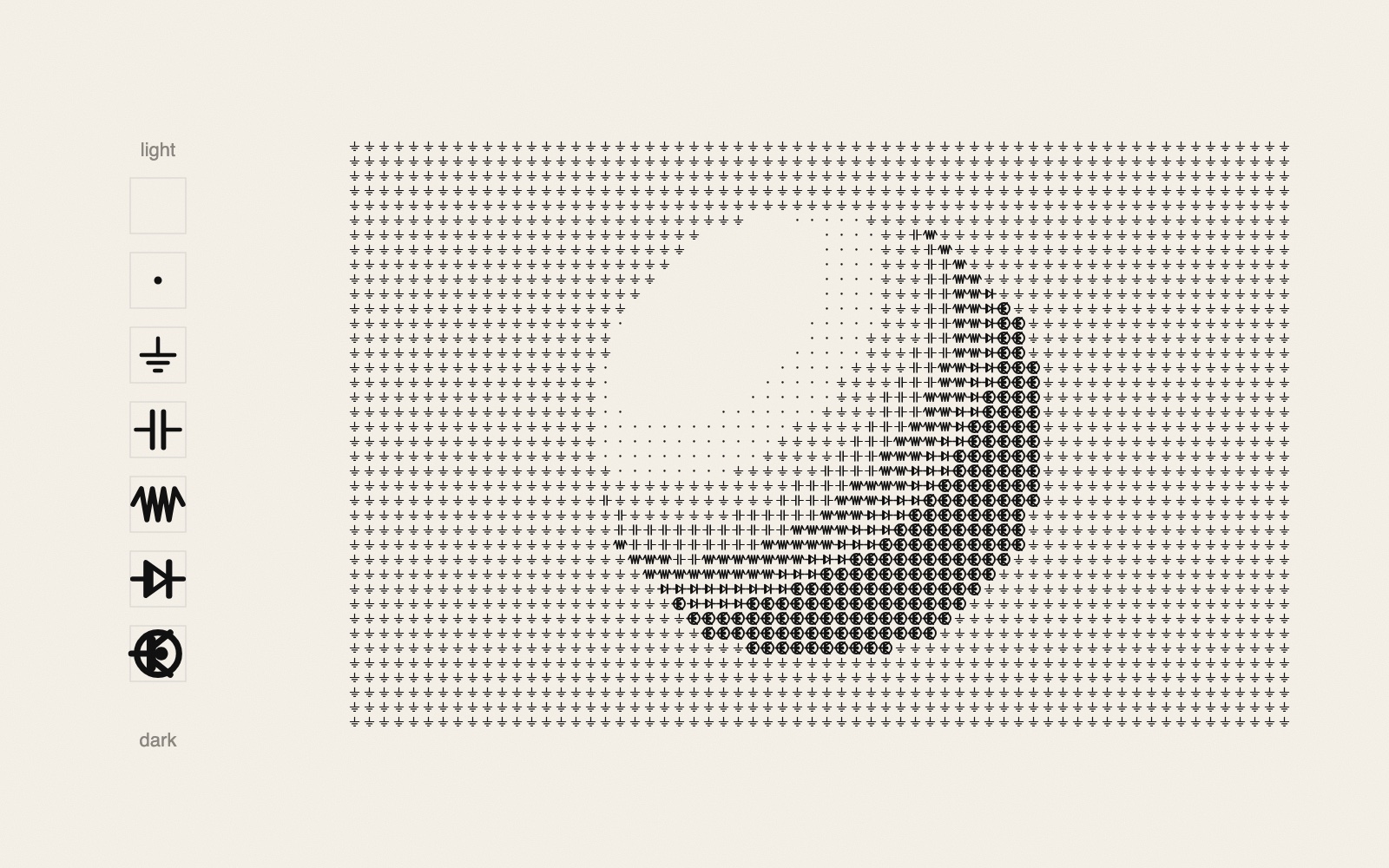
A photograph was scanned with a camera, and the analogue voltages from the scan were converted into binary numbers. Each number then chose a typographic symbol by its density, as in halftone printing: a part of the picture that should look light got a symbol with little ink, a dark part a symbol with much ink.2 The symbols were, in Knowlton's words, "small electronic symbols for transistors, resistors and such".1
The diagram above shows the principle with a scale and a test picture of JAEV's own. Making grey from black marks on white is also what dithering does.
A prank, then a press photo
Knowlton later called the picture a "sophomoric prank". While Ed David, their manager two levels up, was away, Harmon proposed covering a whole wall of his office with it. The picture was 12 feet wide, and more visitors than expected could make out what it showed. After one day it was moved to David's basement, and the public relations department told them not to associate the name of Bell Labs with it.1
Then it was shown at a press conference on art and technology in Robert Rauschenberg's loft, and on 11 October 1967 it was printed at the top of the first page of the second section of The New York Times. After that, Knowlton writes, Bell Labs' advice changed: show it, but say that it was made at Bell Telephone Laboratories.1
As art
Of the title Knowlton writes: "Sometimes it is excused by a more dignified title, like Studies in Perception I." The picture was submitted to the Museum of Modern Art's "Machine Show", The Machine as Seen at the End of the Mechanical Age, and to the Brooklyn Museum. Each time one of the two had to be named the artist; by the toss of a coin, "Leon became the artist and I remained a technologist".1, 2 In 1968 the catalogue of Cybernetic Serendipity in London printed "Computer-generated pictures" by Harmon and Knowlton.4
The work exists in several versions and sizes, and is dated 1966 or 1967. The SIGGRAPH archive lists a 1966 print of 60 × 144 inches; the screen prints at the Buffalo AKG Art Museum and the Thoma Foundation are dated 1967.5, 6, 7 The picture began, Knowlton wrote, his "fascination with large pictures made of small things", and he made mosaic portraits for decades afterwards.1 A mosaic, in his statement for SIGGRAPH, should make the viewer ask: "Why do I see what I think I see?"5 The first exhibitions of computer pictures, in 1965, are in JAEV's Generative Art.
Sources
- Ken Knowlton, “Mosaic Portraits: New Methods and Strategies”. PAGE 59, Computer Arts Society, Winter 2004/2005 (Internet Archive copy)
Bell Labs' microfilm printer “exposed letters and vectors on 35 mm film”; his greyscale pictures of “hundreds of lines of hundreds of letters chosen for their brightness”; BEFLIX; Harmon's idea: a wall covered “with a huge picture made of small electronic symbols for transistors, resistors and such” forming a nude; the “12-foot-wide picture”; one day on Ed David's wall; the PR department: do “NOT associate the name of Bell Labs with it”; press conference in Robert Rauschenberg's loft; New York Times, October 11, 1967; “Sometimes it is excused by a more dignified title, like Studies in Perception I”; MoMA's “Machine Show” and the Brooklyn Museum; the coin toss: “Leon became the artist and I remained a technologist”. - “Leon Harmon”. Wikipedia (English)
Harmon (1922–1983), Bell Labs researcher in perception; in 1966 he and Knowlton made Studies in Perception I, a reclining nude (the dancer Deborah Hay), “by scanning a photograph with a camera and converting the analog voltages to binary numbers”, “assigned typographic symbols based on halftone densities”; shown in The Machine as Seen at the End of the Mechanical Age, MoMA, 25 November 1968 – 9 February 1969. - “Ken Knowlton”. Wikipedia (English)
Knowlton, born 6 June 1931, died 16 June 2022; BEFLIX (1963); Computer Nude (Studies in Perception I), 1966. - “Cybernetic Serendipity: The Computer and the Arts”, Studio International special issue, ed. Jasia Reichardt, 1968. Contents
Contents include “Computer-generated pictures by L. D. Harmon and K. C. Knowlton” and “Computer-animated movies by Kenneth C. Knowlton”. - Kenneth C. Knowlton, Nude (Study in Perception), 1966. ACM SIGGRAPH History Archive
1966, “Alphanumeric Print”, 60" x 144"; collaborator Leon Harmon; Knowlton's statement on mosaics: the viewer asks, “Why do I see what I think I see?” - Leon Harmon and Ken Knowlton, Computer Nude (Studies in Perception I), 1967. Buffalo AKG Art Museum
Silkscreen print, sheet 34 x 72 inches; they “reenvisioned a photograph of dancer Deborah Hay as a bitmap mosaic using a program they developed”. - Kenneth Knowlton and Leon Harmon, Studies in Perception I, 1967. Thoma Foundation
Screen print in black and white inks on paper, 36 x 74 1/8 in., Murray Hill, NJ; “A nude photograph was reconstituted through a programming language using bitmap symbols.”
- Published
- JAEV Notes, October 2026.
- Use
- Text CC BY 4.0. Free to use and quote with credit to JAEV and a link to this page. Images and quotations by others keep their own terms.
All texts as one file: archive.json - Cite
- JAEV Notes, “Studies in Perception I (Knowlton and Harmon, 1966)”, jaev.gallery/notes/knowlton-harmon-studies-in-perception/, 2026.
- Corrections
- Additions and corrections are welcome: info@jaev.gallery
- Share
A link from your own site, course page or reading list helps others find it.- Follow
- New notes by RSS · Instagram · Bluesky
JAEV is a daemon taking shape: machines, weights, room, brain.