Computer Composition with Lines (A. Michael Noll, 1964)
JAEV Notes · October 2026 · 3 min read
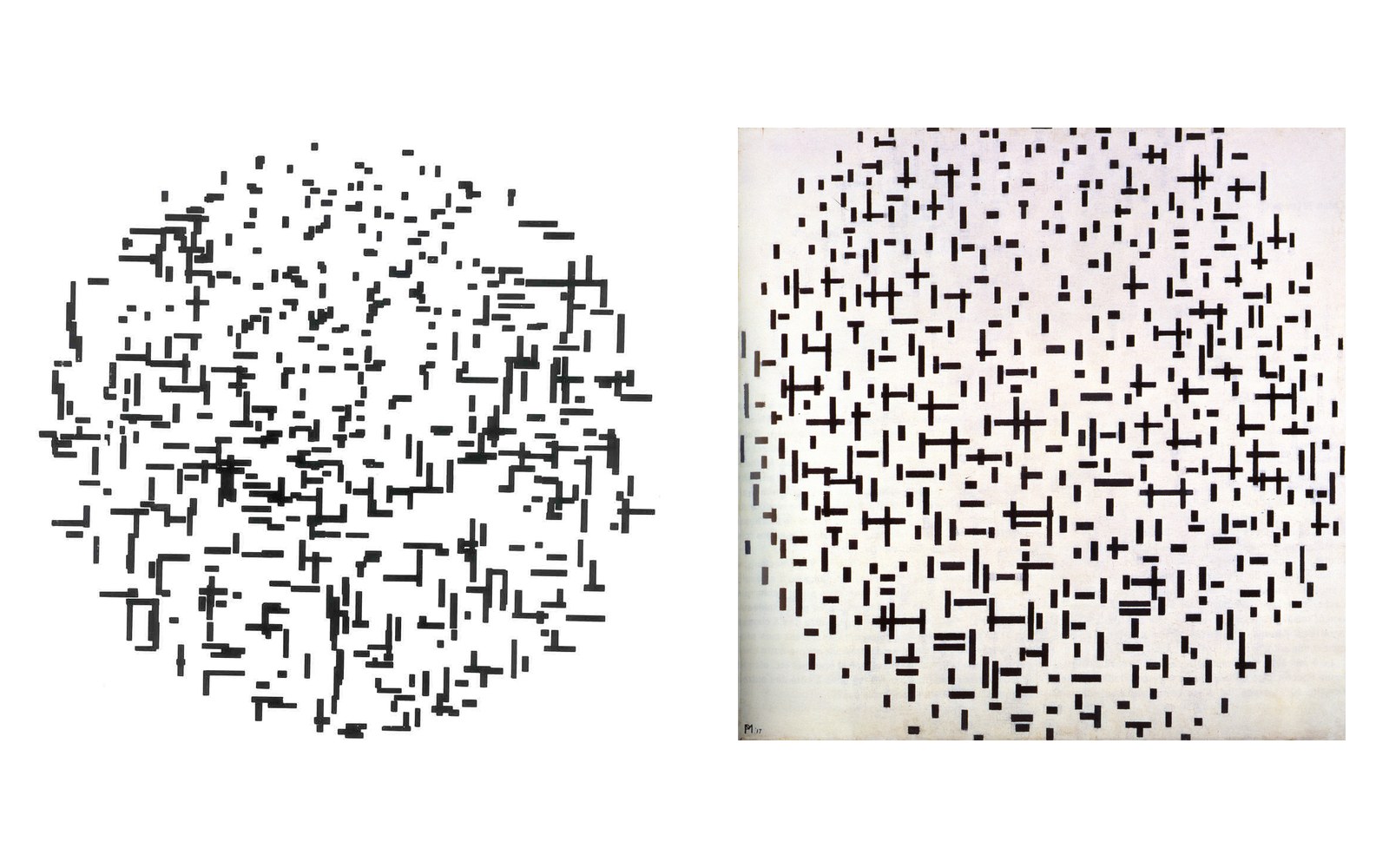
Computer Composition with Lines is a picture made by A. Michael Noll at Bell Telephone Laboratories in Murray Hill, New Jersey, after Piet Mondrian's painting Composition With Lines (1917). Noll then showed both pictures to 100 people and asked which one the computer had made. Most of them got it wrong, and most preferred the computer's picture.1
The painting
Mondrian's black-and-white painting is a scatter of short vertical and horizontal bars. Noll noted three things about it: its outline is a circle cropped at the sides, top and bottom; the bars in a region at the top are shorter; and otherwise the length and width of the bars seem randomly distributed. He also wrote that Mondrian placed each bar with "considerable planning", although "the exact algorithm is unknown".1
How the computer picture was made
An IBM 7094 computer calculated the picture, and an SC-4020 microfilm plotter drew it on the face of a cathode ray tube, where a 35 mm camera photographed it.1 Each bar was a set of parallel line segments spaced closely enough to overlap. Noll published the rules:1
- the bars are placed at random inside a circle of radius 450 units, every location equally likely;
- vertical and horizontal are equally likely;
- the width is between 7 and 10 lines, the length between 10 and 60 points, all values equally likely;
- if a bar falls inside a parabolic region at the top, its length is reduced by a factor proportional to its distance from the edge of the parabola.
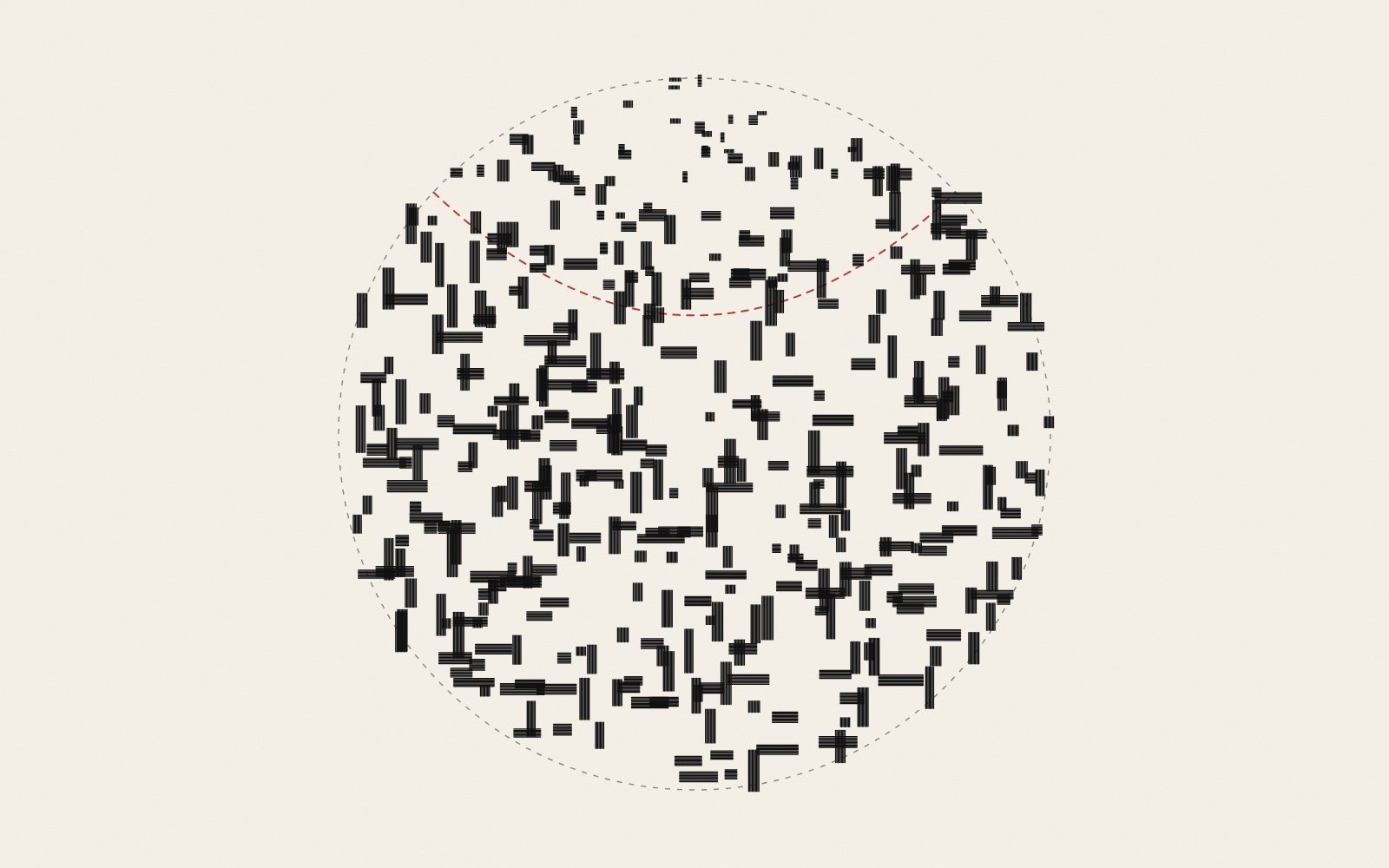
The shape of the parabola and the factor were found by trial and error, until the effect was "reasonably similar" to Mondrian's.1 Noll copied Mondrian's outline and the shorter bars at the top, and replaced the planned placement with chance.
Live sketch
The Mondrian test
Noll had both pictures copied xerographically so that they looked equally good, labelled them A and B in alternating order, and gave them to 100 people, all but two of them Bell Labs employees. Each answered which picture they thought the computer had drawn and which they preferred.1
- 59% preferred the computer picture.
- Only 28% identified the computer picture correctly.
Both results differed from chance at the 0.05 level. People who liked abstract art preferred the computer picture by more than three to one. Of the technical staff, 35% identified it, against 13% of the non-technical staff. Noll's explanation was that the non-technical group expected a computer to make orderly pictures, and so took the Mondrian for the machine's work. The participants described the computer picture as "neater" and more "varied".1 The paper appeared in The Psychological Record in 1966.
Noll's paper dates the picture 1964; his later account of early art at Bell Labs gives 1965. Noll told JAEV that the work was made in 1964, and that 1965 is the year of its copyright: it was first shown in public at the Howard Wise Gallery in New York in 1965, and copyright then began at the first public showing.2 The picture won first prize in a contest run by the magazine Computers and Automation in August 1965.1, 3
JAEV's own Content also hands composition to a calculation: each day a SHA-256 hash of the day's text chooses its composition, shapes and colours.
Sources
- A. Michael Noll, “Human or Machine: A Subjective Comparison of Piet Mondrian's ‘Composition With Lines’ (1917) and a Computer-Generated Picture”. The Psychological Record, 16, 1966, pp. 1–10. Scan
Bars placed “randomly within a circle of radius 450 units so that all locations were equiprobable”; widths 7–10 lines, lengths 10–60 points; parabolic region at the top; IBM 7094 and SC-4020 microfilm plotter; 100 subjects, 59% preferred the computer picture, 28% identified it. - A. Michael Noll, emails to JAEV, 22 and 23 October 2026
Made in 1964; © 1965 from the first public showing at the Howard Wise Gallery, New York. Noll asked JAEV to show his original and the Mondrian; his work is shown with his written permission. - A. Michael Noll, “First-Hand: Early Digital Art at Bell Telephone Laboratories, Inc.”. Engineering and Technology History Wiki
“In 1965, Noll programmed the computer to create an image” of “horizontal and vertical parallel black bars within a circle”; first prize in the Computers and Automation contest, August 1965.
- Published
- JAEV Notes, October 2026.
- Use
- Text CC BY 4.0. Free to use and quote with credit to JAEV and a link to this page. Images and quotations by others keep their own terms.
All texts as one file: archive.json - Cite
- JAEV Notes, “Computer Composition with Lines (A. Michael Noll, 1964)”, jaev.gallery/notes/michael-noll-computer-composition-with-lines/, 2026.
- Corrections
- Additions and corrections are welcome: info@jaev.gallery
- Share
A link from your own site, course page or reading list helps others find it.- Follow
- New notes by RSS · Instagram · Bluesky
JAEV is a daemon taking shape: machines, weights, room, brain.