Hummingbird (Charles Csuri, 1967–68)
JAEV Notes · October 2026 · 2 min read
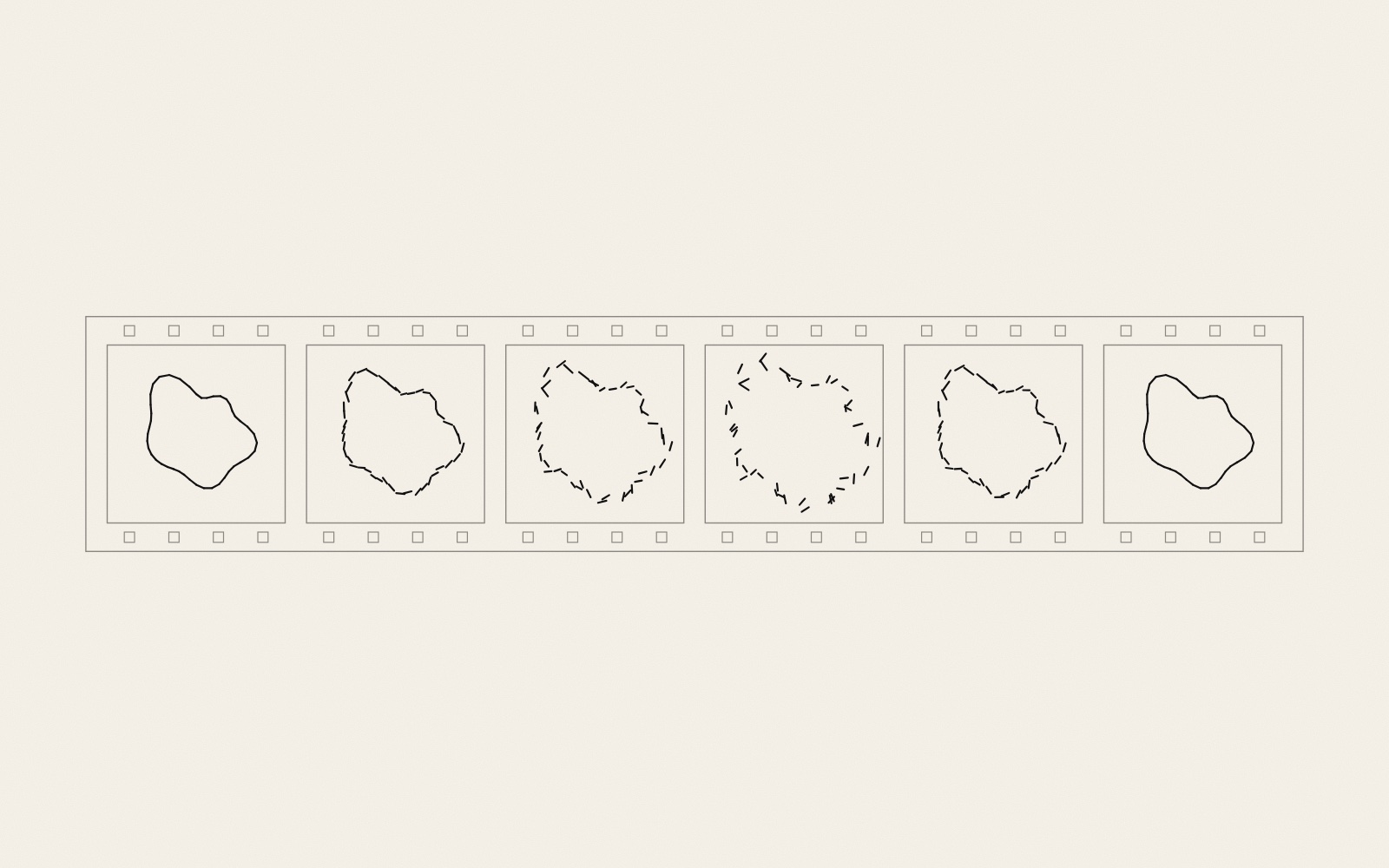
Hummingbird is a short computer-animated film by Charles Csuri, made at Ohio State University in 1967–68. A line drawing of a hummingbird in flight is broken up, scattered across the screen and put together again. The Museum of Modern Art in New York bought it for its collection, as one of the first works of computer animation.1, 2, 3
Csuri
Csuri (1922–2022) played American football for Ohio State and fought in the Second World War, where he was awarded the Bronze Star at the Battle of the Bulge. He came back to study art, took his MA and joined the university's art department.1 Around 1963 he saw a portrait of a woman produced by a computer, made by the graduate student Juris Raudseps, and began working with the university's computing experts. By 1964 he was making computer pictures.1 His Sine Curve Man drawings of 1967 were drawn by a CalComp 565 drum plotter.4 JAEV's Plotter Art counts him among the pioneers of the plotter drawing.
How the film was made
The film starts with a drawing made by hand and digitised: turned into coordinates that a program can work with. According to the Csuri Project at Ohio State, he produced more than 14,000 frames, which "exploded the bird, scattered it about, and reconstructed it", and the frames were put on 16 mm film.2 The diagram above shows the principle with an outline of JAEV's own: the same pieces, pushed further apart frame by frame, then brought back.
The Computer History Museum describes a method like that of the computer films made at Bell Labs, with Fortran programs running on the university's IBM 7094 computer and the frames output on a CalComp 835 microfilm plotter.1 The Csuri Project's record names a different machine: an IBM 1130, with punched cards.2 The date differs too, 1967 or 1968, depending on the source. Wikipedia names James Shaffer as Csuri's collaborator on the film.3
Shown and collected
The Csuri Project records an award for the film at the fourth International Experimental Film Competition in Brussels, and it dates the Museum of Modern Art's purchase to 1968.2 In the same year Csuri was in Cybernetic Serendipity in London. The catalogue printed an interview with him.2, 5
The Csuri Project calls these films "fragmentation animations", and it sees in them a forerunner of morphing, where one form changes smoothly into another.2 In Tokyo, in the same years, the Computer Technique Group had a computer turn a running man into a bottle of cola, then into the outline of Africa.6
Sources
- “Technology + Art: Charles Csuri”. Computer History Museum, Mountain View, exhibit
Csuri (1922–2022); Ohio State football; Bronze Star at the Battle of the Bulge; MA in art and faculty of the Department of Art; around 1963 saw a computer portrait by the graduate student Juris Raudseps; by 1964 computer images. Hummingbird (1967): FORTRAN programs on the university's IBM 7094, output on a CalComp Model 835 microfilm plotter; starts with a digitised hand-drawn figure whose line elements go through geometric movements and transformations; a 4-minute excerpt of the 10-minute original, courtesy ZKM and Caroline Csuri. - Charles A. Csuri, Hummingbird (fragmentation animation), C07.13169. The Charles A. Csuri Project, Ohio State University
Date 1968; hardware IBM 1130, punch cards; “over 14,000 frames, which exploded the bird, scattered it about, and reconstructed it”, output to 16 mm film; purchased by the Museum of Modern Art in 1968; award at the fourth International Experimental Film Competition in Brussels; shown in Czechoslovakia, Israel, Germany, Great Britain, the United States and Yugoslavia; his computer animation in the Cybernetic Serendipity catalogue. - “Charles Csuri”. Wikipedia (English)
Born 4 July 1922, Grant Town, West Virginia; died 27 February 2022; “his 1967 short film Hummingbird, a collaboration with James Shaffer, is in MoMa's permanent collection”. - Charles Csuri, Sine Curve Man Three, 1967. The Charles A. Csuri Project, Ohio State University
“Hardware Calcomp Drum Plotter Model 565, IBM 7094, Punch Cards”. - “Cybernetic Serendipity: The Computer and the Arts”, Studio International special issue, ed. Jasia Reichardt, 1968. Contents
Contents include “An interview with Charles Csuri by Arthur Efland”. - Computer Technique Group, Running Cola is Africa, 1967. ZKM | Center for Art and Media Karlsruhe
“A computer algorithm converts a running man into a bottle of cola”, which then becomes a map of Africa; dated 1967, 1967/68 in the description.
- Published
- JAEV Notes, October 2026.
- Use
- Text CC BY 4.0. Free to use and quote with credit to JAEV and a link to this page. Images and quotations by others keep their own terms.
All texts as one file: archive.json - Cite
- JAEV Notes, “Hummingbird (Charles Csuri, 1967–68)”, jaev.gallery/notes/charles-csuri-hummingbird/, 2026.
- Corrections
- Additions and corrections are welcome: info@jaev.gallery
- Share
A link from your own site, course page or reading list helps others find it.- Follow
- New notes by RSS · Instagram · Bluesky
JAEV is a daemon taking shape: machines, weights, room, brain.