The harmonograph
JAEV Notes · October 2026 · 3 min read
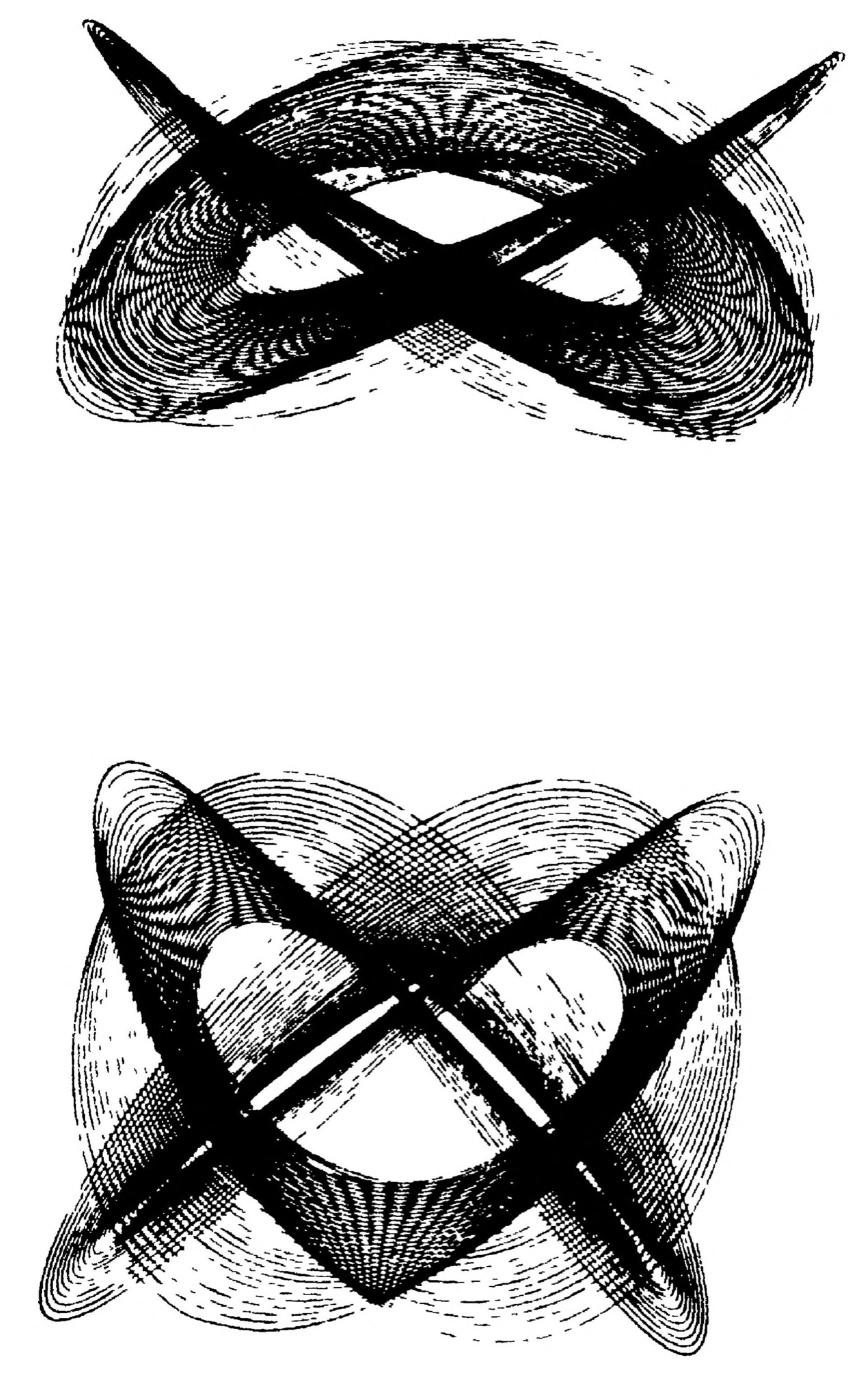
A harmonograph is a drawing machine driven by pendulums. A handbook published by the London instrument makers Newton & Co. in 1909 defines it as "an instrument for recording the curves resultant from the compounded movements of two pendulums oscillating at right angles".1 One pendulum moves the pen, the other moves the paper, and the line on the paper records both movements at once. The figures are related to the Lissajous figures, but a pendulum slowly comes to rest, so a harmonograph's lines spiral inwards instead of repeating.
Before the harmonograph
According to the handbook, the earliest form was Professor Hugh Blackburn's pendulum, "first shown in 1844": a heavy weight on a cord, hung so that it swung in two directions at once, with a pointer that traced its path "in sand or lampblack". Around 1870 Hubert Airy noticed that a shoot of an acacia tree, pulled aside and released, moved in a curious orbit as it came to rest. He tied a light pencil to it and recorded the movement on paper, then built a compound pendulum of long jointed rods carrying a weight of 50 pounds. The handbook calls it "the actual progenitor of Tisley's Harmonograph".1
Tisley's instrument
Samuel Charles Tisley (1829–1883) was a London optician and globe maker, and the harmonograph is the instrument he is remembered for; he "appears to have invented" it.2 With George Spiller he made a double-pendulum version for the lecture hall, first described by Tisley in 1873: the pen scraped soot from a plate of smoked glass lying on a projector, so the audience saw a white line drawing itself on a black screen.3 The 1909 handbook dates the first showing of the harmonograph "in practically its present form" to 1874.1 One of Tisley's instruments was used at the Cavendish Laboratory in Cambridge and is now in the Whipple Museum there.4
How it works
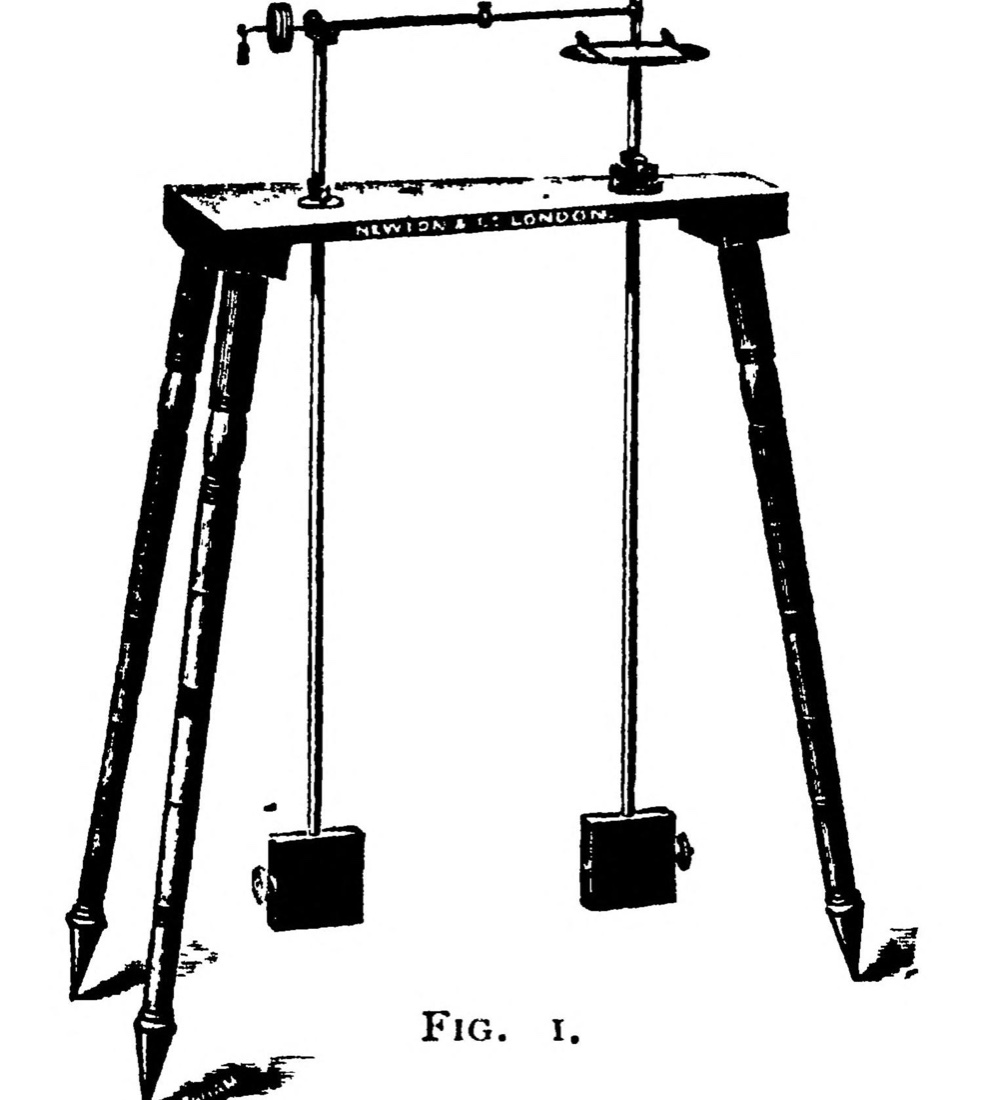
In the simple harmonograph two pendulums hang through a small table on legs. Each is a long rod with a weight that can be clamped higher or lower. One carries the platform with the paper, the other an arm with the pen, and they swing at right angles to each other.1
- Tuning. Moving a weight changes how fast its pendulum swings. The handbook advises finding the right position "by experiment and not by calculation".1
- Ratio. If one pendulum swings three times while the other swings four, the figure has three loops along one side and four along the other, as in the plate above.1
- Damping. The pen should press lightly. Pressing too heavily "means increased friction, bringing the pendulum to rest sooner", and the lines lie further apart.1
The ratios have the same names as musical intervals: 2 : 3 is a fifth, 3 : 4 a fourth. The handbook uses the comparison, but warns that it is "rather misleading to call the harmonograph figures 'music made visible'".1
The formula
Each pendulum moves like a sine wave that shrinks over time. For one pendulum, x(t) = A sin(ft + p) e−dt, where A is how far it swings, f how fast, p where in its swing it starts, and d how quickly it comes to rest. A full figure adds two such terms in each direction, one for each pendulum.5 This is how most harmonograph programs work today, and it is the rule behind the drawing in JAEV's film in the note on Lissajous figures. Other machines that draw by combining movements are described in Spirograph and Desmond Paul Henry's drawing machines.
Sources
- Joseph Goold, Charles E. Benham, Richard Kerr and L. R. Wilberforce, Harmonic Vibrations and Vibration Figures, ed. Herbert C. Newton. London: Newton & Co., 1909. Internet Archive
“The Harmonograph is an instrument for recording the curves resultant from the compounded movements of two pendulums oscillating at right angles.” Blackburn's pendulum “first shown in 1844”, traced “in sand or lampblack”; Hubert Airy's acacia shoot, “the actual progenitor of Tisley's Harmonograph”; “In 1874 Mr. S. C. Tisley and Mr. Spiller, of London, showed the harmonograph in practically its present form”; Viney's Sympalmograph “made by Browning”; period “most easily ascertained by experiment and not by calculation”; Plate IV: “three loops and four loops respectively”; pressing too heavily “means increased friction, bringing the pendulum to rest sooner”; “The best pen is one made of glass tube drawn out to a point”; tracings on smoked glass “mounted as lantern slides”; “rather misleading to call the harmonograph figures ‘music made visible’”. - “Samuel Charles Tisley”. British Map Engravers – A Supplement
Tisley (1829–1883), “London Optician & globemaker”; “particularly remembered for his harmonograph, an instrument for mapping sound vibrations, which he appears to have invented”; partnership with George Spiller (1848–1918) dissolved 25 August 1877; 172 Brompton Road, 1872–1881. - Thomas B. Greenslade, Jr., “Harmonographs”. Instruments for Natural Philosophy, Kenyon College
Tisley and Spiller's double-pendulum harmonograph, “first described by S.C. Tisley in 1873, for use in the lecture hall”; the stylus “scrapes the carbon from the surface of a smoked glass plate” on a projector, so “the audience saw a black screen on which a white line traced out the harmonic figure”. - “Tisley's harmonograph”, accession no. 2033. Whipple Museum of the History of Science, University of Cambridge
“‘Tisley’s harmonograph’ for creation of compound spiral curves, used at the Cavendish Laborayory, by S. C. Tisley and Company”; dated 1874–1894; transferred from the Cavendish Laboratory in 1974; listed in its 1894 catalogue of apparatus. - “Harmonograph”. Wikipedia
“A harmonograph creates its figures using the movements of damped pendulums”; x(t) = A sin(tf + p)e^(−dt), and for the full figure a sum of two such terms in each direction.
- Published
- JAEV Notes, October 2026.
- Use
- Text CC BY 4.0. Free to use and quote with credit to JAEV and a link to this page. Images and quotations by others keep their own terms.
All texts as one file: archive.json - Cite
- JAEV Notes, “The harmonograph”, jaev.gallery/notes/harmonograph/, 2026.
- Corrections
- Additions and corrections are welcome: info@jaev.gallery
- Share
A link from your own site, course page or reading list helps others find it.- Follow
- New notes by RSS · Instagram · Bluesky
JAEV is a daemon taking shape: machines, weights, room, brain.