Roland DXY plotters
JAEV Notes · October 2026 · 2 min read
The Roland DXY plotters are desktop pen plotters made by Roland DG of Japan from 1982, when the first model, the DXY-100, came out "to produce architectural drawings and schematics". The DXY-800 for A3 paper followed in 1983.1 Some are still in use: the plotter artist Paul Rickards draws on a DXY 1150.2
The company
Roland DG began in Osaka in 1981 as AMDEK Corporation, a subsidiary of the musical instrument maker Roland. It took the name Roland DG in 1983; DG stands for Digital Group.1
How they work
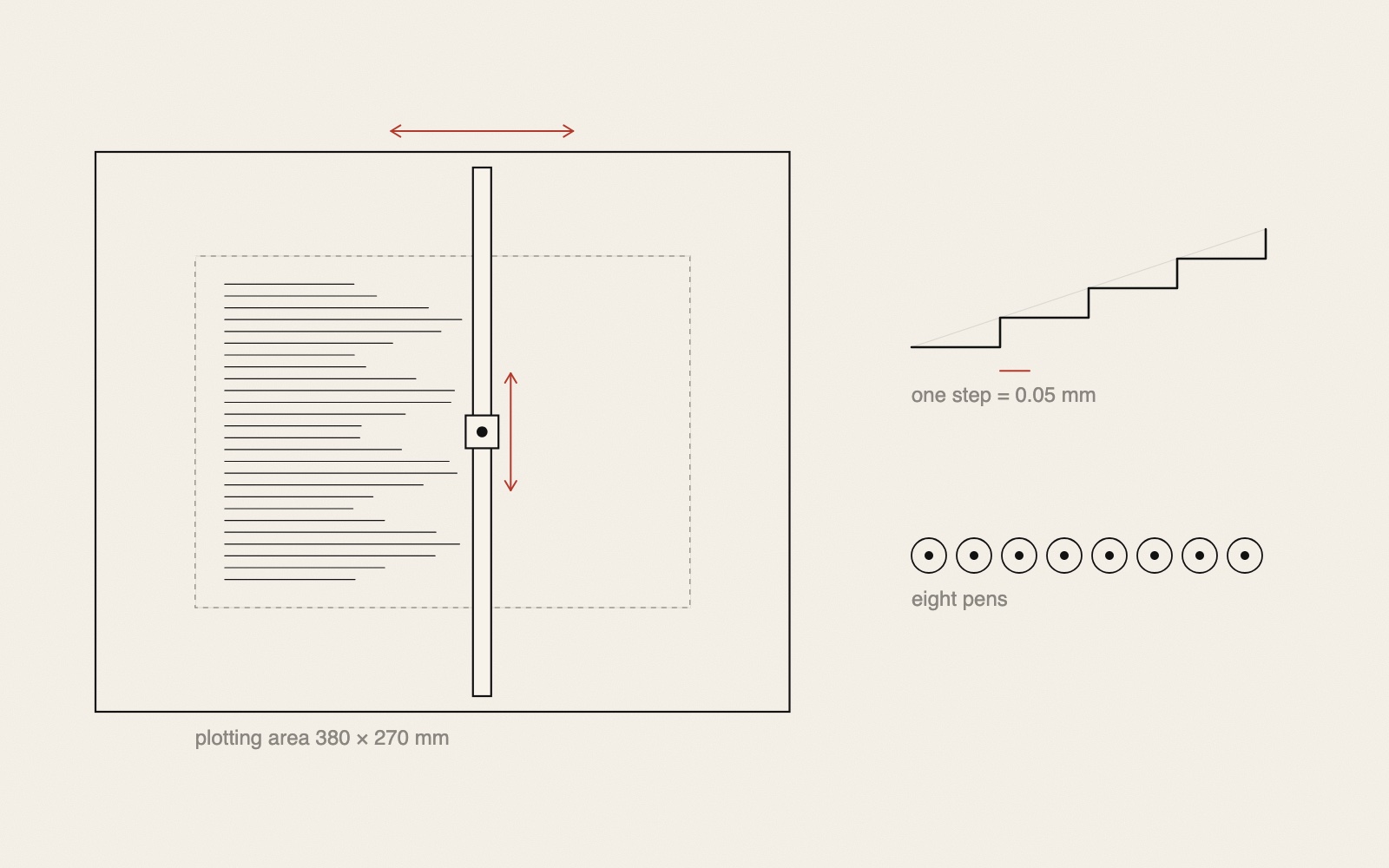
A DXY is a flatbed plotter of the gantry type: the paper lies still, an arm moves across it, and the pen carriage moves along the arm.2 The machine sits flat on a table or tilted up on a stand.2, 3
The DXY-880's manual gives a plotting area of 380 × 270 mm, a little more than A4 but less than A3, a speed of 200 mm a second in all directions, and a smallest step of 0.05 mm. It holds eight pens, connects to a computer by a parallel or a serial (RS-232C) cable, and weighs 4.3 kg.3 The DXY-990 draws at up to 300 mm a second. It holds the paper down with static electricity, and a "soft landing" mechanism lowers the pen gently enough to use ink drafting pens.4
Two languages
The DXY plotters understand two sets of commands, chosen with DIP switches. The DXY commands are one letter each and simple to send from BASIC. RD-GL, Roland DG Graphic Language, has two-letter commands.3, 5 The DXY-990's manual also advertises compatibility with the HP-GL of Hewlett-Packard's 7470 and 7475A.4
Pens
Roland sold its own pens for the DXY: water-based fibre-tip pens of 0.3 and 0.6 mm, pens for overhead film, ballpoint pens, ink pens and ceramic-tipped pens. The ceramic tip keeps "a precise line width" until the ink runs out.4 Holders let the DXY-880 use ordinary fibre-tip pens, at most 9.5 mm thick where they fit and no heavier than 7 g.3 See plotter pens.
Today
Paul Rickards prefers the gantry type, "typically made by Roland", and in 2021 showed his DXY 1150 drawing a generative circle design on a 5.25-inch floppy disk.2 The command-line tool vpype has a built-in profile for the "Roland DXY 1xxx" series: eight pens, a unit of 0.025 mm, and the expanded plot area set with the switches.6 The longer history is in JAEV's text on plotter art.
Sources
- “History”. Roland DGA
1981: “AMDEK Corporation was established in Osaka as a subsidiary of the Roland Corporation”; 1982: “Released the DXY-100 pen plotter, which could be connected to a computer to produce architectural drawings and schematics”; 1983: “Released the DXY-800 A3-size pen plotter”; renamed Roland DG Corporation (“DG stands for Digital Group”); 1985: DPX-2000 A2 pen plotter; 1988: PNC-1000, the first CAMM-1 cutting plotter. - Paul Rickards, “Pen Plotter” posts. biosrhythm.com
“My favorite type are the gantry style which are typically made by Roland”; “The DXY series of plotters were made to sit on top of a table, either laying flat or at an angle”; “my Roland DXY 1150 pen plotter drawing a generative wobbly circle design on top of a 5.25" floppy disk” (November 2021). - Roland DXY-880 X-Y Plotter Operation Manual. Roland DG, via the Internet Archive
Specifications: plotting area “X axis: 380 mm, Y axis: 270 mm”; “200 mm/sec for all directions”; “0.05 mm/step”; repeatability “± 0.3 mm or less”; parallel (Centronics) and serial (RS-232C); “8 (original pens or pen holder)”; 533 × 430 × 90 mm, 4.3 kg. DXY commands and RD-GL; “coordinates may be set in 0.1 mm steps with the DXY commands”; pen holders for ordinary fibre-tip pens, “maximum diameter of 9.5 mm”, “no more than 7g”. - Roland DXY-990 Operation Manual. Roland DG, via the Internet Archive
“0.05mm/step resolution”; “maximum plotting speed, (300mm/sec)”; “Compatible with Hewlett Packard “HP-GL™” of HP-7470/7475”; electrostatic paper holding; “mechanical soft landing device, which enables the use of drafting ink pen”; automatic pen capping; folding stand “vertically at 60 degrees”; 608 × 452 × 115 mm, 6.5 kg; ceramic pens 0.2, 0.4 and 0.6 mm, “A proper pen speed is 150mm/sec”. - Roland DXY-1300/1200/1100 Command Reference Manual. Roland DG, via the Internet Archive
Two command systems selected by DIP switch: “DXY-GL commands”, “one-letter character commands”, and “RD-GL I commands”, “two-letter character commands”; plotting unit 0.1 mm or 0.025 mm with DXY-GL, “only 0.025mm” with RD-GL I. - vpype_config.toml (built-in plotter profiles). vpype, GitHub
[device.dxy]: name = "Roland DXY 1xxx", plotter_unit_length = "0.025mm", pen_count = 8; “This profile is for use with Expanded Plot Area as set via the dip switches.”
- Published
- JAEV Notes, October 2026.
- Use
- Text CC BY 4.0. Free to use and quote with credit to JAEV and a link to this page. Images and quotations by others keep their own terms.
All texts as one file: archive.json - Cite
- JAEV Notes, “Roland DXY plotters”, jaev.gallery/notes/roland-dxy-plotters/, 2026.
- Corrections
- Additions and corrections are welcome: info@jaev.gallery
- Share
A link from your own site, course page or reading list helps others find it.- Follow
- New notes by RSS · Instagram · Bluesky
JAEV is a daemon taking shape: machines, weights, room, brain.