HP 7475A plotter (1983)
JAEV Notes · October 2026 · 2 min read
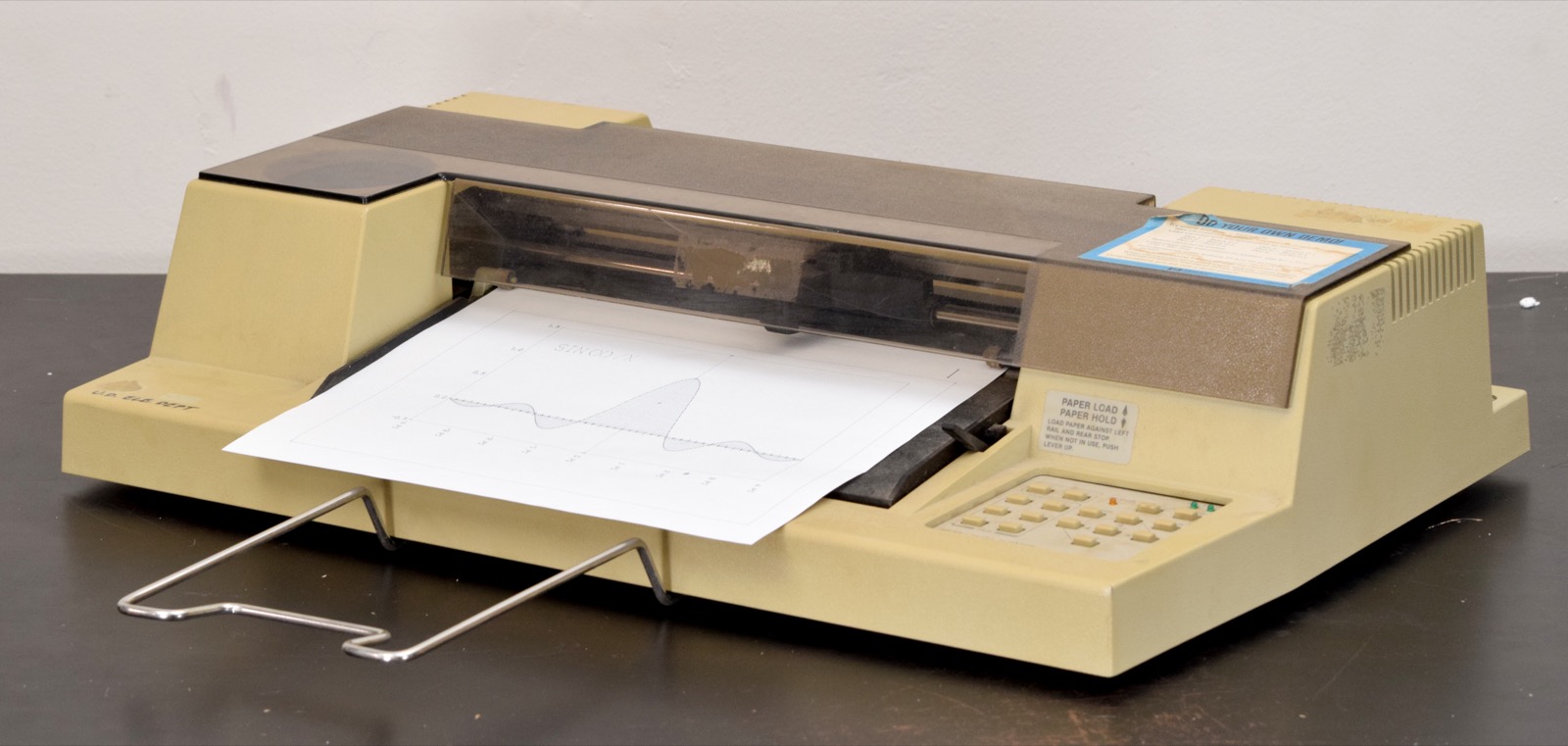
The HP 7475A is a desktop pen plotter that Hewlett-Packard introduced in 1983 at $1,895. It holds six pens in a carousel and draws on sheets up to A3. The HP Computer Museum calls it "the most popular pen plotter ever made". HP kept it in its range until 1994.1
How it moves
In the 7475A the paper moves as well as the pen: grit-covered wheels drive the sheet back and forth in one direction while the pen travels across it in the other. HP called this paper-moving technology; the 7475A took it over from the 7470A.1, 2
The pen accelerates at about 2 g and moves at up to 38.1 cm a second. HP gives an addressable resolution of 0.025 mm and a repeatability of 0.10 mm for any given pen.2 The same manuals define the plotter unit, the smallest move the machine can make, more exactly as 0.02488 mm, about 40.2 units to the millimetre.2, 3
What it is told
The plotter was sold with one of two connections, RS-232-C (option 001) or HP's own HP-IB (option 002). Both take the same commands, HP-GL: two letters and some numbers, such as PU to lift the pen and PD to put it down and draw.3 Other makers built plotters that understood it too: the manual of Roland's DXY-990 advertises compatibility with the HP-GL of the HP 7470 and 7475.4 See the note on Roland's DXY plotters.
Pens
The carousel takes three kinds of pen: disposable fibre-tip pens for paper, fibre-tip pens for overhead transparency film, and short-body refillable drafting pens with tungsten carbide points, which HP says give the best lines but need refilling and cleaning.3 The carousel for drafting pens came in 1985.1 The note on plotter pens follows the pen from these cartridges to today's fineliners.
Two details
In 1984 the 7475A was the most profitable single product HP made, helped by the IBM PC and the spreadsheet Lotus 1-2-3, which brought business charts to ordinary computer users. The museum records two oddities. The plotter's built-in lettering drew the figure 8 with a flat top, which only some customers in Japan noticed and HP never corrected. And in 1985 HP replaced the paper stop with a painted white line, as a precaution during a lawsuit with its competitor Houston Instruments, which HP then won.1
Using one today
The command-line tool vpype has a built-in profile for the 7475A. It uses the 0.02488 mm unit and knows the six pens.5 An SVG drawing becomes a file the plotter can read with vpype read input.svg layout --fit-to-margins 2cm --landscape a4 write --device hp7475a output.hpgl.6
Olof Broström's Unverified Air at JAEV is stored as files for a pen plotter, one drawing a day, in black, red and blue ink.7 The machines before the 7475A are in JAEV's text on plotter art.
Sources
- HP 7475A Graphics Plotter. HP Computer Museum
“Introduced: 1983”, “Original Price: $1895”; “Like the 7470, it used paper-moving technology. It also had a 6-pen carousel and could plot on both A/A4 and B/A3 size paper”; “In 1984, the 7475 was the most profitable single product within HP”; “The 7475 was the most popular pen plotter ever made. It was not obsoleted until 1994”; in 1985 a carousel for “short-body liquid ink pens”; the flat-topped “8”; the paper stop replaced by “a painted white line” during a lawsuit with Houston Instruments. - HP 7475A Interfacing and Programming Manual (07475-90001). Hewlett-Packard, via the Internet Archive
“grit-covered wheels to move the paper in one axis while the pen moves along the other axis”; “approximately 2 g acceleration and a maximum velocity of 38.1 cm/s (15 in./s)”; “addressable resolution of 0.025 mm (0.000 98 in.) and a repeatability of 0.10 mm”; “one plotter unit equals 0.02488 mm”, “approximately 40.2 plotter units per millimetre”. - HP 7475A Plotter Operation Manual. Hewlett-Packard, via the Internet Archive
Option 001 with RS-232-C, Option 002 with HP-IB; both use HP-GL; “A plotter unit is 0.02488 mm … and is the smallest move the plotter can make”; maximum X range 0–10 365 units (257.8 mm) on A size, 0–16 640 (413.9 mm) on B size; pinch wheels and grit-covered drive wheels; fiber-tip paper pens, transparency pens and “short-body refillable drafting pens”, “Long lasting tungsten carbide points”; ink can stay “20 seconds if the pen is uncapped and not in use”. - Roland DXY-990 Operation Manual. Roland DG, via the Internet Archive
“Compatible with Hewlett Packard “HP-GL™” of HP-7470/7475.” - vpype_config.toml (built-in plotter profiles). vpype, GitHub
[device.hp7475a]: plotter_unit_length = "0.02488mm", pen_count = 6; A4: x_range 0–11040, y_range 0–7721, “The plotter must be configured in Metric mode.” - vpype, README. GitHub
“Export a SVG to HPGL for vintage plotters”: vpype read input.svg layout --fit-to-margins 2cm --landscape a4 write --device hp7475a output.hpgl - Olof Broström, Unverified Air, 2026–2027. JAEV
“Every drawing is shown here as an image and stored as a file for a pen plotter, in black, red and blue ink”; “one drawing a day”.
- Published
- JAEV Notes, October 2026.
- Use
- Text CC BY 4.0. Free to use and quote with credit to JAEV and a link to this page. Images and quotations by others keep their own terms.
All texts as one file: archive.json - Cite
- JAEV Notes, “HP 7475A plotter (1983)”, jaev.gallery/notes/hp-7475a/, 2026.
- Corrections
- Additions and corrections are welcome: info@jaev.gallery
- Share
A link from your own site, course page or reading list helps others find it.- Follow
- New notes by RSS · Instagram · Bluesky
JAEV is a daemon taking shape: machines, weights, room, brain.