Plotter pens, from ballpoints to fineliners
JAEV Notes · October 2026 · 2 min read
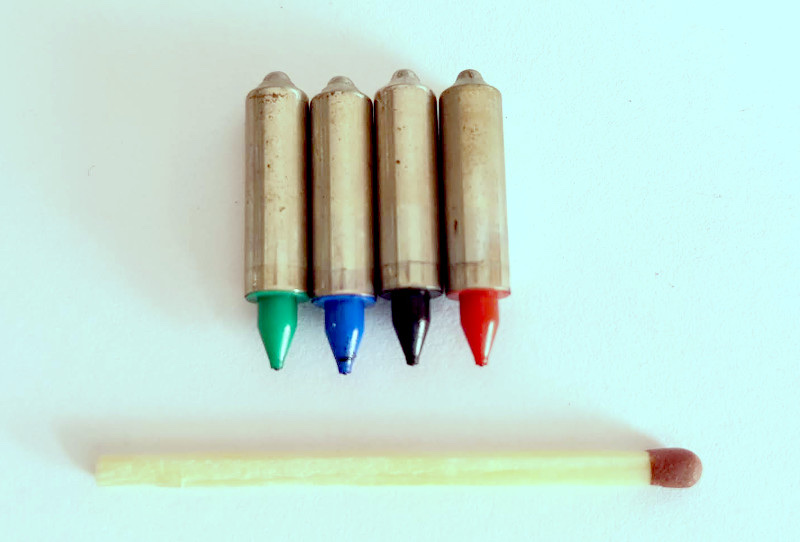
A pen plotter draws with a real pen, and the pen decides much of what the drawing looks like: the width of the line, how dark it is, whether it skips, and how fast the machine may move. Plotters have drawn with ballpoints, felt and fibre tips, refillable drafting pens and, today, almost any pen that fits the holder.
Ballpoints on the drum
IBM's 1627 drum plotter (see the note on the CalComp 565) came with a ballpoint pen that lasted "about five or six hours of continuous plotting"; a liquid ink pen was an option.1 In Stockholm, Sten Kallin drew on a drum plotter with an IBM 1130. He remembered that the pen "kunde vara en kulspetspenna eller en bläckpenna eller färgpenna eller vad du vill": a ballpoint, an ink pen, a colour pen or whatever you like. It sat a little loose in its holder, so a line built from small steps came out "lite mänskligt", a little human: "lite karaktär eller lite slump i strecket", a bit of character or a bit of chance in the line.2 His work with Astrid Sampe is described in Computer art in Sweden.
Cartridges and carousels
The desktop plotters of HP and Roland took pens made for them, kept in the machine in a carousel or in clips. The HP 7475A of 1983 took three kinds: disposable fibre-tip pens for paper, fibre-tip pens for overhead film, and refillable drafting pens with tungsten carbide points, which drew the best lines but needed cleaning after each use. HP recommended 38 cm a second for fibre tips on plain plotter paper and 10 cm a second on glossy paper and film.3
Roland's DXY plotters had their own range. The DXY-990's water-based fibre tips could draw at up to 300 mm a second, but their tips wore down and the lines grew wider. Ceramic-tipped pens of 0.2, 0.4 and 0.6 mm kept "a precise line width" until the ink ran out, at a recommended 150 mm a second. A mechanical "soft landing" lowered the pen gently enough for ink drafting pens, and the machine capped each pen when it returned to its clip.4
Any pen that fits
New plotters such as the AxiDraw need no special pens. The AxiDraw holds a pen up to 16 mm across and 45 g, and Evil Mad Scientist's list of pens that work includes fountain pens, the Pilot Precise V5 rollerball, Sharpie Ultra Fine Point markers, Pigma Micron fineliners, gel pens and technical pens. Its notes on them: technical pens must stand vertically on the paper, gel pens may skip on textured paper, ballpoints work unevenly because they need more pressure than the machine gives, and felt tips wear down.5
Olof Broström's Unverified Air at JAEV is stored as files for a pen plotter, in black, red and blue ink.6
Sources
- “1627 Plotter”. IBM 1130 Functional Characteristics, transcribed at ibm1130.net
“The 1627 is equipped with a ball point pen, which lasts for about five or six hours of continuous plotting. A liquid-flow ink pen is optional.” “The time required for execution of raise-pen and lower pen commands is 100 ms.” - Sten Kallin, interview by Anna Orrghen, 2007. Tekniska museet, Stockholm (PDF)
On the IBM 1130's drum plotter: “det kunde vara en kulspetspenna eller en bläckpenna eller färgpenna eller vad du vill”; the pen “sitter … lite löst i sin hållare”, so the line “är lite mänskligt, eller, det är lite karaktär eller lite slump i strecket”. - HP 7475A Plotter Operation Manual. Hewlett-Packard, via the Internet Archive
“fiber-tip paper pens, transparency pens, and short-body refillable drafting pens”; drafting pens: “Produces highest-quality lines. Long lasting tungsten carbide points. Requires refilling and maintenance”; “Drafting pens require cleaning after each use”; “Fiber-tip pens will last at least 30 days stored in the carousel”; drafting pen ink lasts “20 seconds if the pen is uncapped and not in use”, “One day if the pen is in a drafting pen carousel”; recommended 38 cm/s for fibre-tip pens on non-glossy paper, 10 cm/s on glossy paper and film. - Roland DXY-990 Operation Manual. Roland DG, via the Internet Archive
Water-based fibre-tip pens “able to draw up to 300mm/sec”, but long use “causes the pen tip to wear out and the lines to get wider”; ceramic pens: “a precise line width is kept from initial use until the ink runs out”, 0.2, 0.4 and 0.6 mm, “A proper pen speed is 150mm/sec”; OHP pens “within 100mm/sec”; ink pens with an ink pen holder; “mechanical soft landing device, which enables the use of drafting ink pen”; automatic pen capping. - “Pens for AxiDraw”. Evil Mad Scientist wiki
Pens “up to ⅝ inch (16 mm) in diameter”, “maximum recommended pen weight is 1.6 oz (45 g)”; Lamy Safari, Pilot Metropolitan, Rotring ArtPen; Pilot Precise V5 “our preferred choice for precision multicolor plots”; Sharpie Ultra Fine Point; Pigma Micron; technical pens “held vertically against the paper”; gel pens “may skip on certain paper textures”; ballpoints “may work inconsistently”; felt tips “will wear down”. - Olof Broström, Unverified Air, 2026–2027. JAEV
“Every drawing is shown here as an image and stored as a file for a pen plotter, in black, red and blue ink”.
- Published
- JAEV Notes, October 2026.
- Use
- Text CC BY 4.0. Free to use and quote with credit to JAEV and a link to this page. Images and quotations by others keep their own terms.
All texts as one file: archive.json - Cite
- JAEV Notes, “Plotter pens, from ballpoints to fineliners”, jaev.gallery/notes/plotter-pens/, 2026.
- Corrections
- Additions and corrections are welcome: info@jaev.gallery
- Share
A link from your own site, course page or reading list helps others find it.- Follow
- New notes by RSS · Instagram · Bluesky
JAEV is a daemon taking shape: machines, weights, room, brain.