Tektronix 4010 storage tube terminal
JAEV Notes · October 2026 · 2 min read
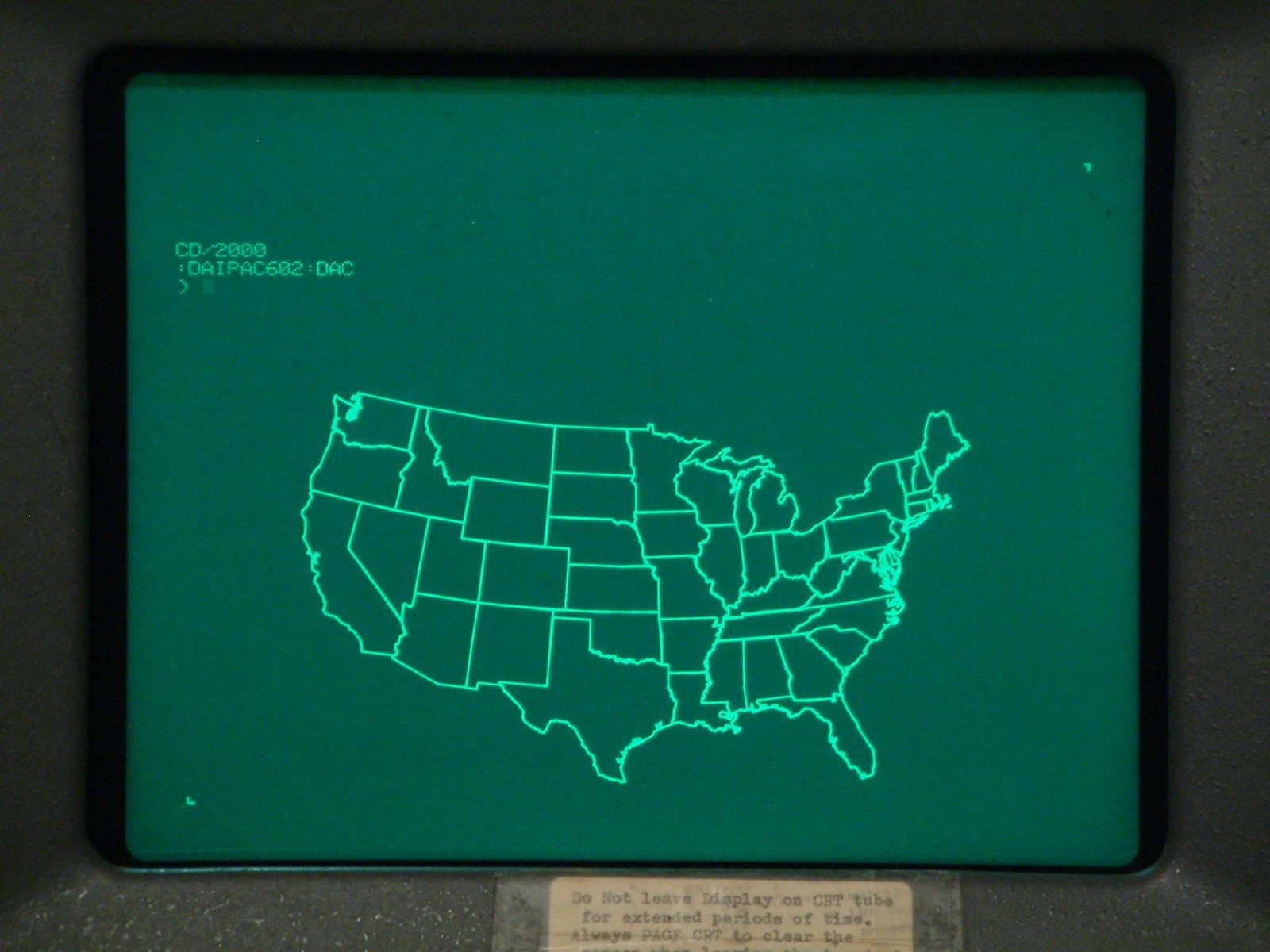
The Tektronix 4010 is a computer terminal that could draw, made by Tektronix in the early 1970s. Its screen kept every line drawn on it until it was erased, so a computer could build up a detailed drawing without any picture memory. According to TekWiki it was announced in October 1971; the University of York, which owns one, says it was released in 1973.1, 2
The storage tube
On an ordinary television-type tube a picture has to be redrawn continually, which means holding it in memory. The 4010 used a storage tube. Tektronix's manual says the data on the screen "has only to be written once"; after that the tube itself keeps the image, for up to an hour without damage to the screen.3
The price was that nothing could be removed. To change one line, the whole screen was cleared with the PAGE key and the drawing sent again.3, 4 The label on the terminal in the photograph above asks users to press PAGE rather than leave a picture on the tube for a long time.
What it draws
In text mode the 4010 showed 35 lines of up to 74 upper-case characters. A control character, GS, switched it to graph mode, and from then on the computer sent coordinates and the terminal drew straight lines, called vectors, from point to point. The screen had 1,024 addressable points across and 780 visible points up.3
This is close to how a pen plotter is told what to do: move to a point without drawing, then draw a straight line to the next (see HP-GL). Tektronix's own graphics software, PLOT-10, offered FORTRAN routines named Draw, Move, Point Plot and Dash, and was sold with its source code either on punched paper tape or on punched cards.5
Price and family
TekWiki gives $3,950 as the price in a 1971 catalogue. In Britain it sold for £3,140, and connecting it to the host computer cost another £230.1, 2 Bigger models followed. In 1974 came the 4014 with a 19-inch screen, and in 1979 the 4016 with a 25-inch one.1
The machines artists drew on in the same years are described in the note on the CalComp 565 and in JAEV's text on plotter art.
Sources
- “4010”. TekWiki
“announced at the Fall Joint Computer Conference in October 1971”; 11" direct-view storage tube “displaying vectors in 10-bit resolution (1024×780 visible)”; 1971 catalogue price $3,950; 4012/4013 (1973) added lowercase; 4014/4015 (1974) 19" display; 4016 (1979) 25"; the 4010-1 copies the screen to a 4610 hard copy unit. - “Tektronix 4010”. Department of Computer Science, University of York, 50 years exhibition
“released in 1973”; “initially released at £3,140 … and another £230 for a host adaptor”; “Because the display tube itself stored the image, there was no need for any sort of auxiliary graphics memory”; “In the exhibition we have it working with a plotter.” - Tektronix 4010 Maintenance Manual (070-1183-01, rev. B, April 1976). Tektronix, via Bitsavers and the Internet Archive
“The data being displayed has only to be written once”, retained “up to one hour without damage to the display screen” instead of redrawing it “as would be necessary if a television-type CRT were used”; “Control character GS puts the Terminal in Graph Mode. Then the Terminal draws vectors”; “Press the PAGE key to erase the display screen”; “1024 X points addressable and viewable; 1024 Y points addressable, 780 Y points viewable”; “0.183 mm between center of points”; 35 lines of up to 74 characters, 5 × 8 dot matrix; crosshair cursor in Gin Mode. - “Tektronix 4010-1”. PDP8Online (David Gesswein)
Storage tube “allowed complex high-resolution graphics to be displayed flicker-free without needing very expensive memory”; “The entire display had to be cleared and redrawn”; 1975 catalogue: “the 4010 ($3995), 4010-1 (adds hard copy interface, $4395)”; screen “8 1/4 by 6 3/8 inches”; “150 to 9600 baud”. - PLOT-10 Terminal Control System User's Manual (062-1474-00), April 1972. Tektronix, via Bitsavers and the Internet Archive
Sold as “User's Manual and Paper Source Tape: 062-1474-01” or “Source Card Deck: 062-1474-02”; routines for erasing the screen, hard copy, and absolute and relative “Draw”, “Move”, “Point Plot” and “Dash”; FORTRAN.
- Published
- JAEV Notes, October 2026.
- Use
- Text CC BY 4.0. Free to use and quote with credit to JAEV and a link to this page. Images and quotations by others keep their own terms.
All texts as one file: archive.json - Cite
- JAEV Notes, “Tektronix 4010 storage tube terminal”, jaev.gallery/notes/tektronix-4010/, 2026.
- Corrections
- Additions and corrections are welcome: info@jaev.gallery
- Share
A link from your own site, course page or reading list helps others find it.- Follow
- New notes by RSS · Instagram · Bluesky
JAEV is a daemon taking shape: machines, weights, room, brain.