CalComp 565 drum plotter
JAEV Notes · October 2026 · 3 min read
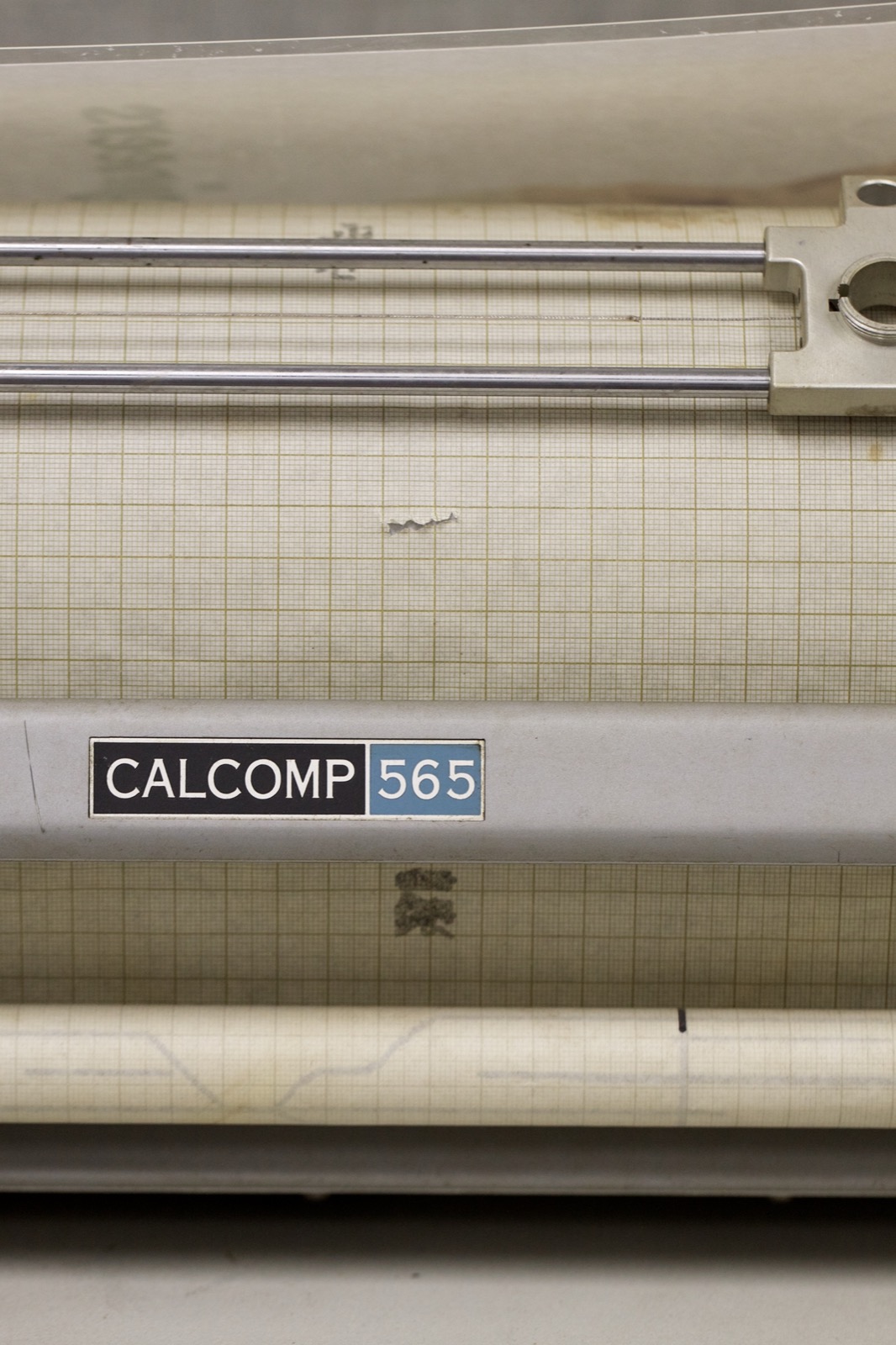
The CalComp 565 is a drum plotter made by California Computer Products (CalComp) and sold from the early 1960s.1 IBM sold the same machine as the IBM 1627 Model 1.2 Artists in the United States and Sweden drew on it, or on its IBM version, in the 1960s and 1970s.3, 4, 5
The company
Two engineers, Gene Seid and Robert Morton, built a prototype plotter in Los Angeles from 1953. With three others they incorporated California Computer Products in 1958 and set up in a garage in Downey, California. In the company's account it developed the world's first drum plotter in 1959. By 1961 the 565 was selling well enough for CalComp to go public.1
How it draws
The paper is a roll with holes along its edges, fed over a drum with pins. When the drum turns, the paper moves up or down under the pen. The pen sits on a carriage that travels left and right across the paper. Every signal from the computer moves the carriage, the paper or both by one step of 1/100 inch (0.254 mm), or raises or lowers the pen. For the 1627 Model 1, IBM gives a drawing width of 11 inches on paper 120 feet long and up to 18,000 steps a minute.6
Since paper and pen can move together, there are eight possible moves: along the two axes and along the four diagonals.2, 6 A line at any other angle has to be drawn as a staircase of these moves, and the computer must decide which move comes next, step by step. The University of Amsterdam's computer museum gives a different step, 0.1 mm at 250 steps a second, for its own 565.7
Bresenham's line
In 1962 Jack Bresenham at IBM wrote a program for an IBM 1401 that drove an IBM 1627, choosing the steps for a straight line without any multiplication or division.2 He published the method in 1965 as "Algorithm for Computer Control of a Digital Plotter". It is now known as Bresenham's line algorithm and is used to draw lines with pixels.8
Artists on the 565
At Ohio State University, Charles Csuri drew Sine Curve Man Three (1967) on a CalComp 565, with an IBM 7094 computer and punched cards.3
The Swedish designer Astrid Sampe worked with the IBM programmer Sten Kallin. The Art Institute of Chicago credits her textile Computer Colonne (1975) to Sampe "with computer programmer Sten Kallin and IBM Plotter 1627".4 Kallin also worked with the artist Sture Johannesson from 1970 to 1975. Their works were computed on an IBM 1130 without a screen, fed with punched cards, and drawn on a CalComp drum plotter on a 30 cm paper roll.5 Both stories are told in Computer art in Sweden and in the notes on Astrid Sampe and the IBM 1130.
Where to see one
The University of Amsterdam's computer museum has two 565s. One was used at the university's Van der Waals physics laboratory; the museum restored its wiring and has drawn the Newell Teapot on it.7
A pen told where to go one move at a time is still how plotters work: see HP-GL and JAEV's text on plotter art. Olof Broström's Unverified Air at JAEV is stored as files for a pen plotter, one drawing a day.9
Sources
- “CalComp Inc.”. Encyclopedia.com (company history)
Prototype by Gene Seid and Robert Morton from 1953; incorporated 1958, a garage in Downey; small military contracts; “In 1959 the company developed the world's first drum plotter”; “By 1961, however, sales of CalComp's Model 565 drum plotter were so promising that the company went public”. - “Bresenham line drawing and the IBM 1627”. IBM 1401 restoration project, Computer History Museum
“IBM 1627 Model 1 – Calcomp 565”; Model 2 = Calcomp 563. Bresenham's 1962 plotting program for the IBM 1401, eight direction codes from 0 to 315 degrees; “333 core locations”; “approximately 1.5 milliseconds” between steps. - Charles Csuri, Sine Curve Man Three, 1967. The Charles A. Csuri Project, Ohio State University
“Hardware Calcomp Drum Plotter Model 565, IBM 7094, Punch Cards”. - Astrid Sampe, Computer Colonne, 1975 (reproduced 1985). Art Institute of Chicago
“Designed by Astrid Sampe (Swedish, 1909–2002) with computer programmer Sten Kallin and IBM Plotter 1627”; cotton, screen printed. - “Sture Johannesson: In Memery”. Index – The Swedish Contemporary Art Foundation
Works “realized between 1970 and 1975 in collaboration with the Swedish IBM programmer Sten Kallin”, from cards “fed into a screen-less 1130 IBM machine”, “on a CalComp drum plotter 30cm-wide paper roll”. - “1627 Plotter”. IBM 1130 Functional Characteristics, transcribed at ibm1130.net
“The vertical plotting motion is achieved by rotation of the pin feed drum”; “The pen is mounted in a carriage that travels horizontally across the paper”; “a 1/100 inch incremental movement of the pen carriage … and / or paper”; Model 1: 11 inches by 120 feet, up to 18,000 steps/minute; pen up or down 100 ms; “a ball point pen, which lasts for about five or six hours of continuous plotting”. - “Calcomp 565 plotter”. Computer museum, University of Amsterdam
“a drum-type XY plotter driven by step motors”; steps of “0.1 mm” “at a rate of 250 steps per second”; “A solenoid permits the pen to be lifted or lowered.” Used at the Van der Waals laboratory; has drawn the Newell Teapot. - “Bresenham's algorithm”. Dictionary of Algorithms and Data Structures, NIST
“An efficient algorithm to render a line with pixels.” Reference: Jack E. Bresenham, “Algorithm for Computer Control of a Digital Plotter”, IBM Systems Journal 4(1):25–30, 1965. - Olof Broström, Unverified Air, 2026–2027. JAEV
“Every drawing is shown here as an image and stored as a file for a pen plotter, in black, red and blue ink”.
- Published
- JAEV Notes, October 2026.
- Use
- Text CC BY 4.0. Free to use and quote with credit to JAEV and a link to this page. Images and quotations by others keep their own terms.
All texts as one file: archive.json - Cite
- JAEV Notes, “CalComp 565 drum plotter”, jaev.gallery/notes/calcomp-565/, 2026.
- Corrections
- Additions and corrections are welcome: info@jaev.gallery
- Share
A link from your own site, course page or reading list helps others find it.- Follow
- New notes by RSS · Instagram · Bluesky
JAEV is a daemon taking shape: machines, weights, room, brain.