Truchet tiles
JAEV Notes · October 2026 · 2 min read
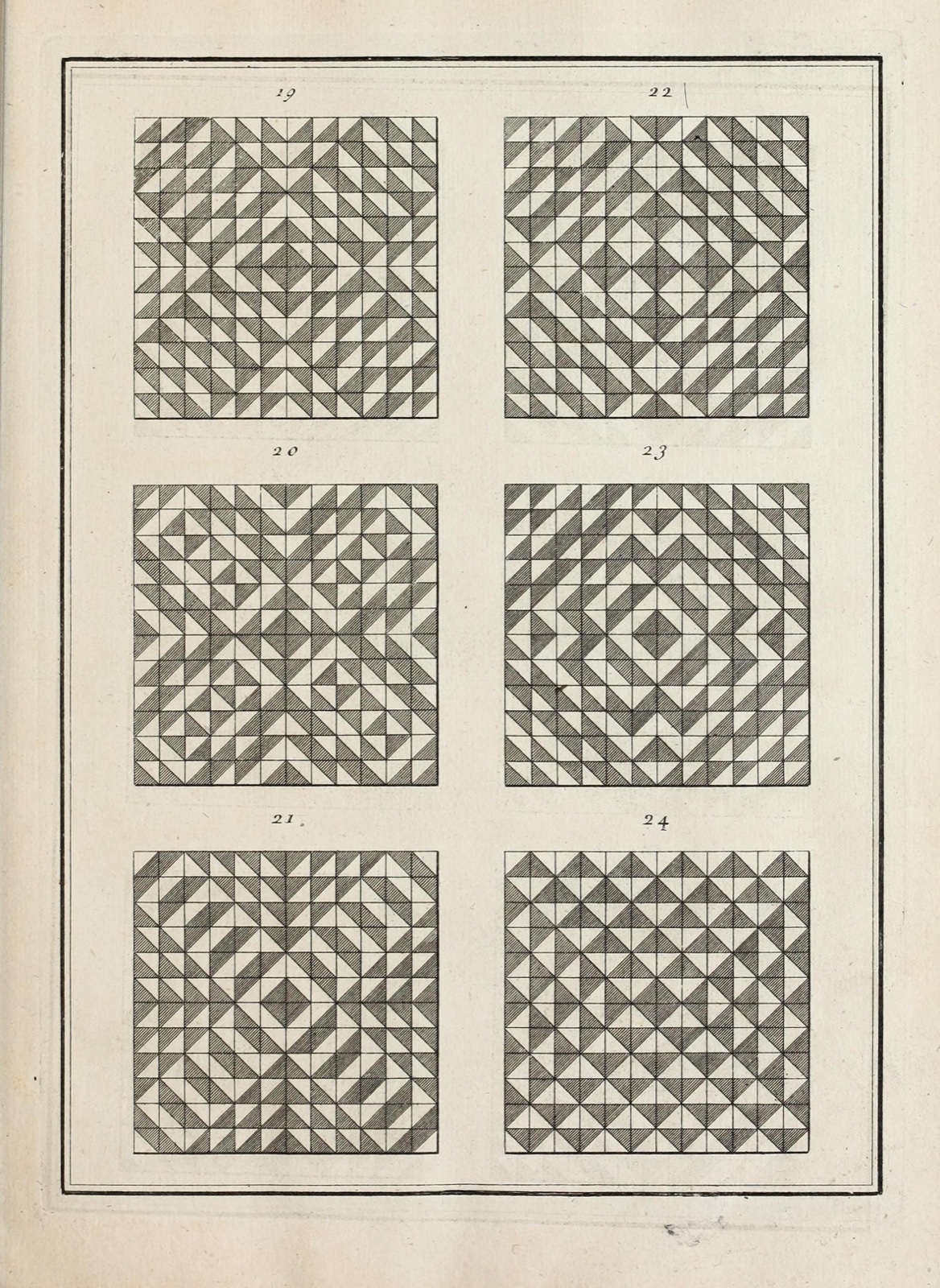
Truchet tiles are square tiles divided along one diagonal into two colours. Father Sébastien Truchet (1657–1729) described them in 1704 in a paper for the Académie Royale des Sciences in Paris, "Mémoire sur les combinaisons", and showed how a single tile, turned in different directions, makes a large number of patterns.1
The tile
Truchet wrote that at a château called La Motte S. Lyé, four leagues from Orléans, he had found "several square fayence tiles divided into two colors by a diagonal line", intended to tile a chapel and several other rooms.1 One half of each tile is dark, the other light. Because a square can be turned four ways, the dark triangle can lie in any of the four corners.
Counting the combinations
Truchet began with two tiles placed side by side. The first can take four orientations and so can the second, which can also be placed against any of the four sides of the first, giving 4 × 4 × 4 = 64 combinations.1
In 1722 Dominique Doüat published Méthode pour faire une infinité de desseins différens, with 72 tilings made from the same tile.1 In 1987 the historian of science Cyril Stanley Smith and Pauline Boucher returned to the memoir in the journal Leonardo, calling it "in essence a graphical treatment of combinatorics".1
Tiles at random
Truchet's and Doüat's patterns are all regular and symmetrical. Smith tried the opposite: he arranged the tiles at random orientations. He then removed the solid colour and kept only the diagonal line, which leaves two orientations instead of four. The result looks like the maze printed by the one-line Commodore 64 program 10 PRINT, published five years earlier.2
A later variant replaces the diagonal with two quarter-circle arcs, centred on opposite corners, each with a radius of half the tile's edge.3 It too has two orientations. Wherever two tiles meet, an arc continues into the next one, so a random grid of them forms unbroken curves, some of which close into loops.
The tile is a small example of a rule that makes many images: one element, a few permitted states, and a way of choosing between them. The choice can be a plan, as in Truchet's plates, or chance, as in Smith's grid and in Vera Molnár's collage Quatre éléments distribués au hasard (1959), which the authors of 10 PRINT place beside the maze.2 See also Generative art.
Sources
- Stéphane Vinatier and William Reginald Alcorn, “Mathematics as seen by an artist: Inspiring mathematical objects”. EMS Magazine 135 (2025), pp. 20–31
Truchet (1657–1729); “Mémoire sur les combinaisons”, Mémoires de mathématique et de physique tirés des registres de l'Académie Royale des Sciences, pp. 363–372, Paris (1704); tiles at La Motte S. Lyé, 4 leagues from Orléans, “divided into two colors by a diagonal line”; 64, 32 and 10 combinations; Doüat 1722, 72 tilings; Smith & Boucher quoted. - Nick Montfort, Patsy Baudoin, John Bell, Ian Bogost, Jeremy Douglass, Mark C. Marino, Michael Mateas, Casey Reas, Mark Sample and Noah Vawter, 10 PRINT CHR$(205.5+RND(1)); : GOTO 10. MIT Press, 2012. Chapter “Regularity”
Truchet gives “thirty different patterns” and “found too great a number to report them all”; Smith in 1987 arranged the tiles at random and removed the solid colouring, “The four possible orientations of any given tile are then reduced to two.” Molnar's 1959 collage Untitled (Quatre éléments distribués au hasard) as “similar to 10 PRINT”. - Eric W. Weisstein, “Truchet Tiling”. MathWorld, Wolfram Research
A modified tile of two circular arcs “of radius equal to half the tile edge length centered at opposed corners”.
- Published
- JAEV Notes, October 2026.
- Use
- Text CC BY 4.0. Free to use and quote with credit to JAEV and a link to this page. Images and quotations by others keep their own terms.
All texts as one file: archive.json - Cite
- JAEV Notes, “Truchet tiles”, jaev.gallery/notes/truchet-tiles/, 2026.
- Corrections
- Additions and corrections are welcome: info@jaev.gallery
- Share
A link from your own site, course page or reading list helps others find it.- Follow
- New notes by RSS · Instagram · Bluesky
JAEV is a daemon taking shape: machines, weights, room, brain.