Schotter (Georg Nees, 1968)
JAEV Notes · October 2026 · 2 min read
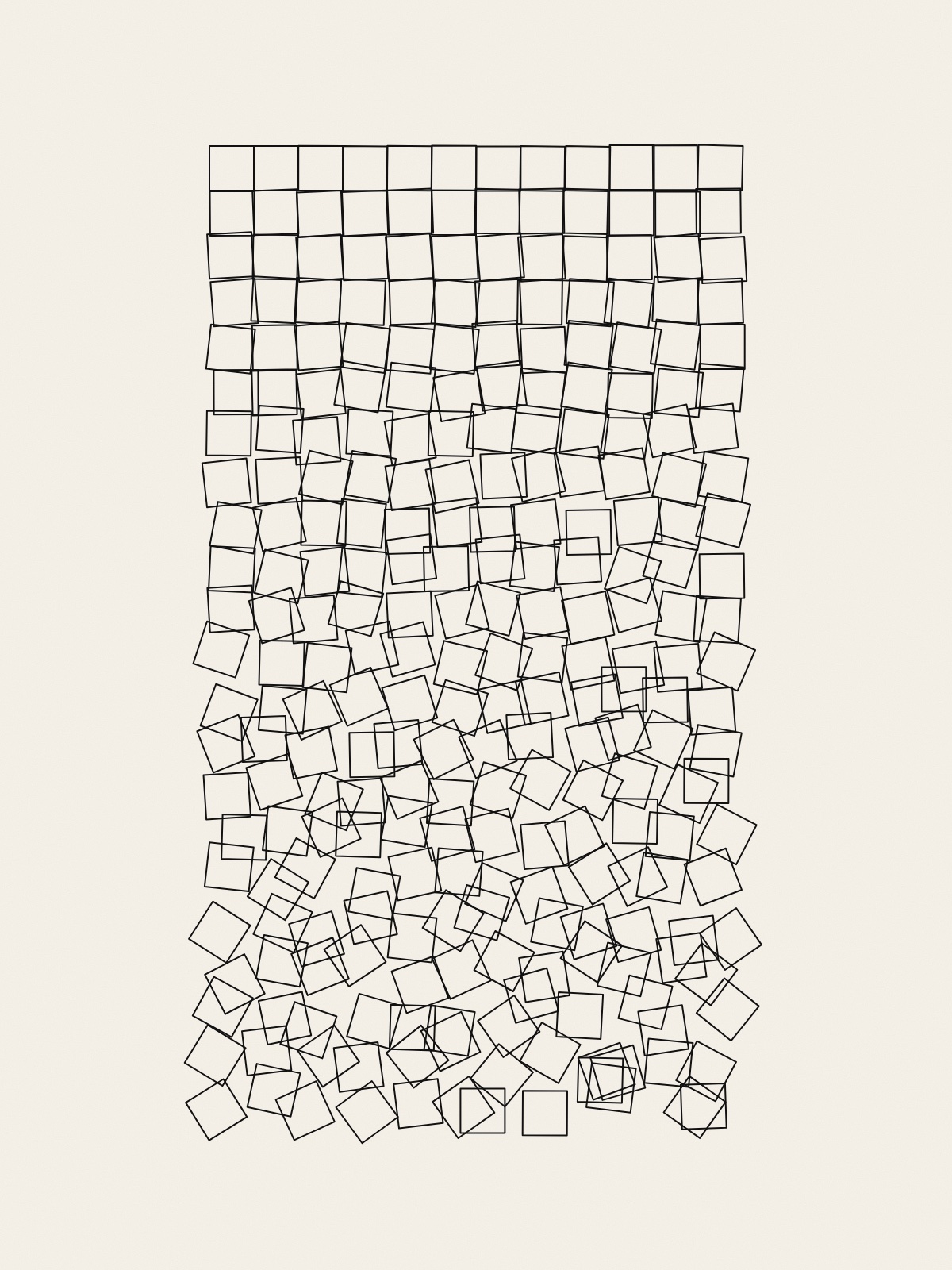
Schotter (German for gravel) is a plotter drawing by Georg Nees, made in 1968. It shows a grid of squares that stand in neat rows at the top and fall into disorder towards the bottom. The Victoria and Albert Museum in London holds a lithograph of it, printed 1968–70, 28 × 21.8 cm, and describes Nees's subject as "the relationship between order and disorder in picture composition".1
How it works
The program draws 264 squares, twelve across and twenty-two down, each with sides of 10 units on a grid with 10-unit spacing.2, 3 Every square gets three random numbers: a shift sideways, a shift up or down, and an angle. What makes the picture is that the allowed range of those numbers is not fixed. It depends on a counter, I, that goes up by one for every square drawn, from 0 to 263.2
- Shift. Each square may move up to 5 × I / 264 units from its place in the grid. For the first square that is 0; for the last it is almost 5, half a square.2
- Rotation. The angle is chosen between π/4 × (1 − I/264) and π/4 × (1 + I/264). A square drawn at π/4 from its corner stands straight; the last squares can turn by up to 45 degrees either way.2
So one number, the count of squares drawn so far, controls all the variation.2 That is why the picture can be read. The rule is visible in the image, and chance grows under it row by row.
The random numbers
Nees wrote his programs in ALGOL 60 at Siemens in Erlangen, and the drawings were made by a Zuse Graphomat Z64, a flatbed plotter that drew from a paper tape calculated beforehand.4 His dissertation, Generative Computergraphik (1969), describes a generator that multiplies the previous number by 5 and keeps only the remainder after dividing by 2³¹.3, 5 Schotter uses two such generators, one for the shifts and one for the angles, each started from its own number, the seed.3
Because the generator is exact arithmetic, the same seeds always give the same drawing. In 2024 the programmer Zellyn Hunter searched about a billion seeds against the printed sheet and found the pair that reproduces it: 1922110153 for the shifts and 1769133315 for the angles.3
Live sketch
Where to see it
The V&A's lithograph is listed in its online collection.1 Hunter's two articles, part 1 and part 2, show the ALGOL listing and a Python translation.
The same idea, a fixed rule whose output is decided by numbers from outside the artist's hand, runs through Difficulty, a drawing a day by Olof Broström at JAEV, where the number of lines and their angle come from the first block of a public proof-of-work ledger added after midnight UTC.
Sources
- Georg Nees, Schotter, 1968–1970. Lithograph on paper. Victoria and Albert Museum, London, E.217-2008
28 × 21.8 cm. Nees was “interested in the relationship between order and disorder in picture composition”. - Zellyn Hunter, “Schotter – Georg Nees – Part 1”, 2024
The ALGOL program: SERIE(10.0,10.0,22,12,QUAD); shift range 5*I/264; angle range π/4 · (1 ± I/264); Nees: the variation is controlled by the counter index I. - Zellyn Hunter, “Schotter – Georg Nees – Part 2”, 2024
The multiply-by-5 random generator from section 2.2.1 of Nees's dissertation; seeds 1922110153 (shift) and 1769133315 (rotation) reproduce the printed plot. - Frieder Nake, “The Semiotic Engine: Notes on the History of Algorithmic Images in Europe”. Art Journal, Spring 2009
Nees at Siemens, Erlangen; programs in ALGOL 60; the Zuse Graphomat Z64 drew from a paper tape calculated beforehand. - Georg Nees, Generative Computergraphik. Doctoral dissertation, 1969, with the 2006 reprint. Internet Archive
- Published
- JAEV Notes, October 2026.
- Use
- Text CC BY 4.0. Free to use and quote with credit to JAEV and a link to this page. Images and quotations by others keep their own terms.
All texts as one file: archive.json - Cite
- JAEV Notes, “Schotter (Georg Nees, 1968)”, jaev.gallery/notes/georg-nees-schotter/, 2026.
- Corrections
- Additions and corrections are welcome: info@jaev.gallery
- Share
A link from your own site, course page or reading list helps others find it.- Follow
- New notes by RSS · Instagram · Bluesky
JAEV is a daemon taking shape: machines, weights, room, brain.