Interruptions (Vera Molnár, 1968–69)
JAEV Notes · October 2026 · 2 min read
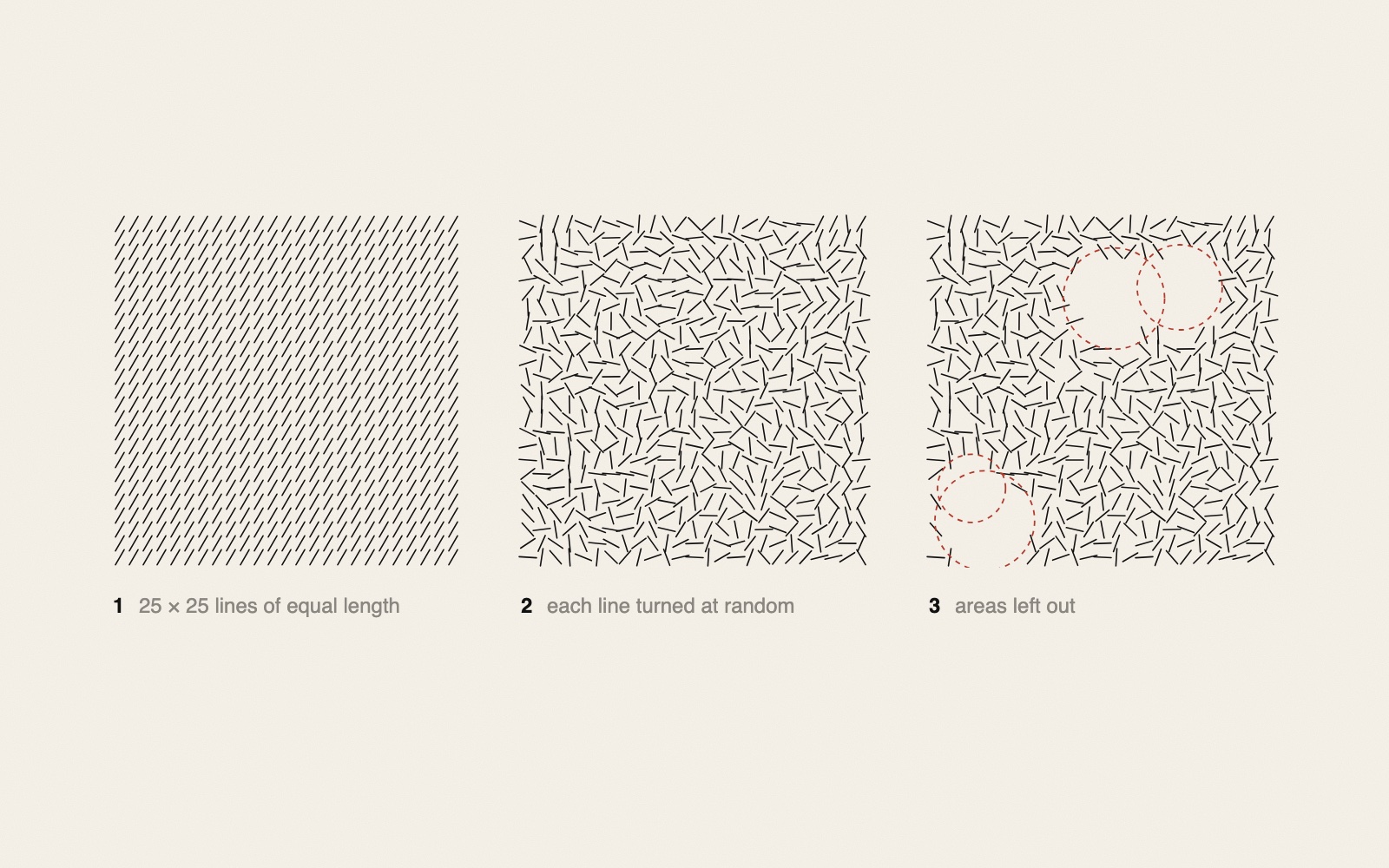
Interruptions is a series of plotter drawings that Vera Molnár made in Paris in 1968–69, among her first works made with a computer. Each sheet is a field of short straight lines turned in every direction, with patches where the lines are missing. The Victoria and Albert Museum holds one, dated 1969, 328 × 347 mm.1, 2
How it works
The rule has two steps.
- A grid of turned lines. Start with a square grid, 25 by 25, and put a straight line of the same length at each point. Turn every line by a random angle.3, 2 When the lines are about as long as the spacing, neighbours touch and cross, and the field reads as a texture rather than as separate marks.
- Interruptions. Choose areas at random and leave the lines there out. The museum descriptions call them "random interruptions" and "voids".3, 2
The first step makes an even, restless surface. The second breaks it, so the eye has somewhere to stop.
The V&A adds the point that makes it a series: with each new sheet she altered the algorithm slightly, building on the one before.1 The sheets are not repeats of one program with new random numbers. They are steps in a search.
None of the sources we used gives her exact rule for where the empty areas fall or how many there are, so the sketch below makes its own choice.
Live sketch
The machine and the wait
In 1968 Molnár taught herself the programming language FORTRAN; she also used BASIC.3, 2 She entered her programs on punch cards and, according to The New York Times, waited several days for each result to come back drawn by a plotter.4 The Toledo Museum of Art describes a sheet from 1968 as black ink on Benson plotter paper.3 With 625 places in the grid, a sheet like this holds several hundred separate lines, each drawn by the pen of a plotter such as the Benson.
The sources do not agree on where she worked. The Centre Pompidou says that in 1968 she gained access, in complete secrecy, to the computing centre at Orsay; the Digital Art Museum names the experimental psychology laboratory at the Sorbonne.5, 2 Dates differ in the same way: the V&A dates its sheet 1969, Toledo shows one dated 1968.1, 3
Working through the variants of a rule one sheet at a time is also how Automatic Colour Cubes by Olof Broström at JAEV proceeds: one cube a day until all 122 of Sol LeWitt's incomplete open cubes have been drawn.
Sources
- Vera Molnár, Interruptions, 1969. Plotter drawing. Victoria and Albert Museum, London
Paris, 1969; sheet 328 × 347 mm. Each new work in the series slightly altered the algorithm behind the one before. - “Vera Molnar”. DAM Digital Art Museum
Interruptions, 1968–69: straight lines of equal length, randomly rotated, and “random sections in which certain lines are erased, thus creating voids”; Fortran and Basic; the experimental psychology lab at the Sorbonne. - “Vera Molnar”. Infinite Images, Toledo Museum of Art
“Beginning with a 25-by-25 grid”, lines “randomly rotated”, “random interruptions” that erase sections; “Computer drawing in black ink on Benson plotter paper, 1968”; FORTRAN. - “Vera Molnár, Pioneer of Computer Art, Dies at 99”. The New York Times, December 2023, as reproduced by Galerie Thaddaeus Ropac
Punch cards; “she had to wait several days for the results, which were transferred to paper with a plotter printer”. - Stéphanie Pioda, “Vera Molnár, aux sources du code”. Centre Pompidou, Paris, 2023
In 1968 she gained access, “en totale clandestinité”, to the computing centre at Orsay.
- Published
- JAEV Notes, October 2026.
- Use
- Text CC BY 4.0. Free to use and quote with credit to JAEV and a link to this page. Images and quotations by others keep their own terms.
All texts as one file: archive.json - Cite
- JAEV Notes, “Interruptions (Vera Molnár, 1968–69)”, jaev.gallery/notes/vera-molnar-interruptions/, 2026.
- Corrections
- Additions and corrections are welcome: info@jaev.gallery
- Share
A link from your own site, course page or reading list helps others find it.- Follow
- New notes by RSS · Instagram · Bluesky
JAEV is a daemon taking shape: machines, weights, room, brain.