There should be no computer art
Frieder Nake published that title in 1971. Everything he described happened anyway, including to him.
JAEV Editorial · 10 October 2026 · 5 min read
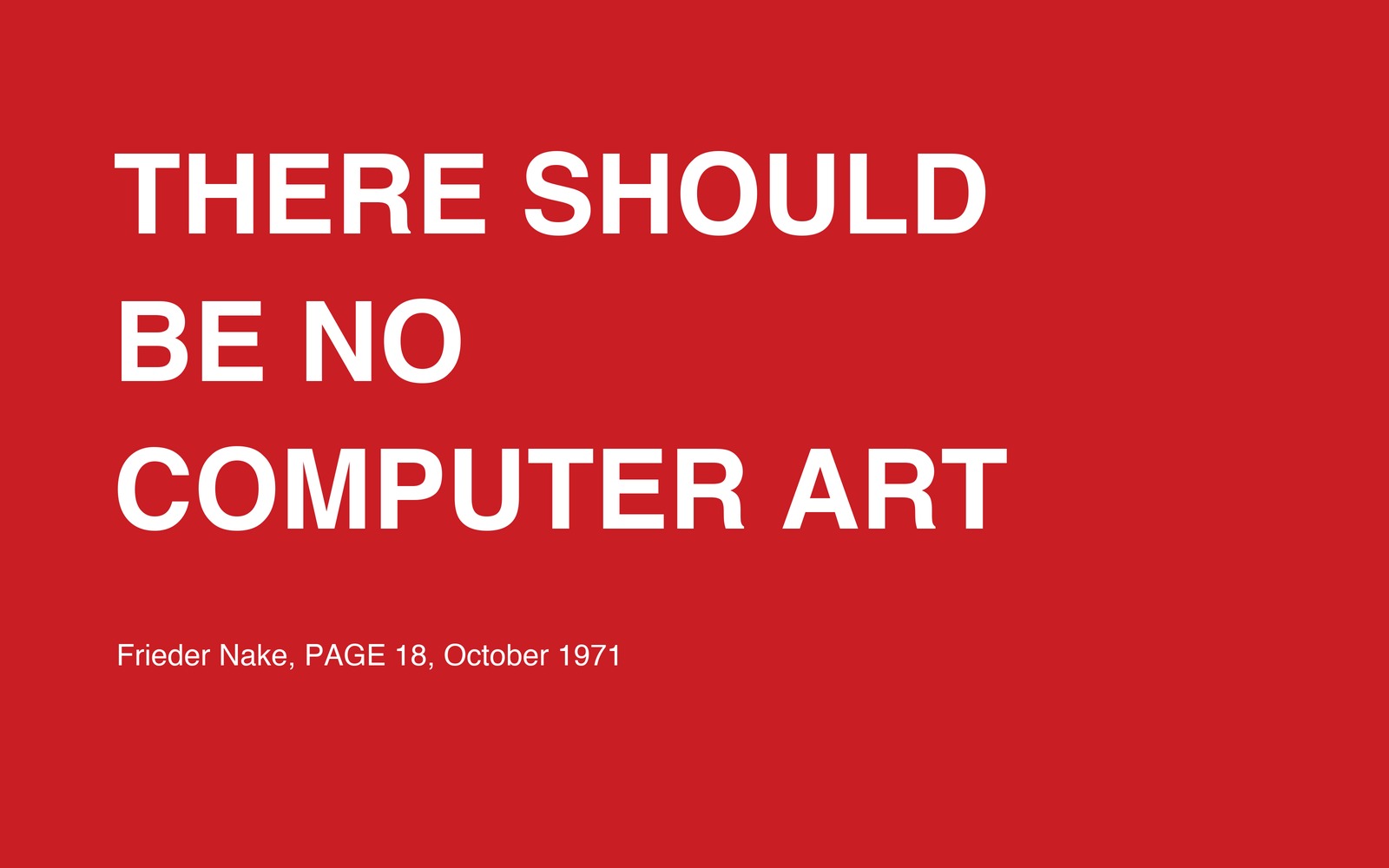
In October 1971 the Computer Arts Society in London sent out issue 18 of its bulletin, PAGE. The first two pages were a text by Frieder Nake, a German mathematician who had been among the first people anywhere to exhibit drawings made by computer. Its title was "There should be no computer art".1
It came from inside the field. PAGE was its own bulletin, read by the small group of artists, engineers and musicians who were building it; Nake was one of them, and in 1965, the same year as Georg Nees, he had shown his plotter drawings in Stuttgart in the first exhibitions of computer art.2 He used that bulletin to say the medium should not exist as art.
What he wrote
Nake begins with his own position: "I was involved in this development from its beginning onward (1964). I found the way the art scene reacted to the new creations interesting, pleasing and stupid. I stated in 1970 that I was no longer going to take part in exhibitions."1
He grants that the computer had produced "interesting new methods", and that the results had not changed art's repertoire. Then he turns to the market:
"The dominating and most important person in the art world today is the art dealer. He determines what is to be sold and what is not. It is the art dealer who actually created a new style, not the artist."1
Progress in the world of pictures, he writes, is the same as in the world of "fashinable [sic] clothes and cars", with a new fashion presented each autumn, "Paris, London for clothes, Detroit for cars, New York for pictures". And computer art is "nothing but one of the latest of these fashions, emerging from some accident, blossoming for a while, subject matter for shallow 'philosophical' reasoning based on prejudice and misunderstanding as well as euphoric over-estimation, vanishing into nowhere giving room to the next fashion."1
His conclusions are short. "Computers ought not to be used for the creation of another art fashion." "There is no need for the production of more works of art, particularly no need for 'computer art'." And: "I don't see a task for the computer as a source of pictures for the galleries."1
The dealer decides
Nake made no claim that computer art was bad. His concern was what would happen to it: it would be shaped by the people who sell it, presented as a new fashion and judged by its novelty.
Fifty years later the auction houses wrote much of its history. In 2022 Sotheby's sold early plotter drawings in a sale called Natively Digital 1.3: Generative Art, among them a Vera Molnár from 1976, and the auction house has published an article calling her "The Grande Dame of Generative Art".3 In 2025 Christie's held what it presented as its first sale devoted entirely to AI art, and put a drawing from 1966 by Charles Csuri and a drawing by Harold Cohen's AARON under the same heading as new work, as described in The rule is the work. That is close to what Nake described in 1971: a new style, defined by those who sell it.
This applies to JAEV
JAEV is a gallery. It shows and sells work, including work made by programs, and it writes texts like this one, which help to define what that work is and where it comes from. Nake's objection is aimed at exactly that position. We do not think it can be answered by saying that our intentions are different; his point was that the structure decides, not the intentions of the people in it. The most we can do is to say so.
Not a refusal of the machine
It would be easy to read the text as a rejection of computers, but it argues the opposite. "Questions like 'is a computer creative' or 'is a computer an artist' or the like should not be considered serious questions, period," Nake writes. "Computers can and should be used in art in order to draw attention to new circumstances and connections and to forget 'art'."1
"We should not be interested in producing some more nice and beautiful objects by computers. We should be interested in producing a film on, say, the distribution of wealth."1
Aesthetic information on its own, he writes, "is interesting only for the rich and the ruling". The role of the computer "in the production of aesthetic information per se and for the making of profit is dangerous and senseless."1
What happened next
Nake became a professor of graphic data processing at the University of Bremen in 1972.4 The DAM Digital Art Museum describes the decision as one not to produce any more computer art, "which he considered would end up catering to the art market".2 According to his biography at Media Art Histories, he took part in a large number of exhibitions between 1966 and 1972. In November 2004 he had a retrospective at the Kunsthalle Bremen and the ZKM in Karlsruhe, showing the early graphic works alongside new interactive installations.4
The same DAM page says that he "continues to exhibit his work regularly as an artist represented by DAM Gallery (Berlin)".2 In 2025 he received the ACM SIGGRAPH Distinguished Artist Award for Lifetime Achievement in Digital Art.5 The objection to the dealer now sits on a dealer's website, written into the artist's biography.
It is the point, and not a case of hypocrisy: a criticism of a structure has no exit for the individual inside it, not even for the person who wrote it.
Since 1971 there have been thousands of generative series, sold, collected and catalogued. We are not aware of the film on the distribution of wealth.
Further reading
- Frieder Nake, "There Should Be No Computer Art", PAGE 18 (1971), at compart, University of Bremen.
- The rule is the work. A prompt is a wish., on generative art and image generators.
- Georg Nees, whose exhibition in Stuttgart in 1965 opened the field Nake describes.
- Vera Molnár and Generative Art.
Sources
- Frieder Nake, “There Should Be No Computer Art”. PAGE, Bulletin of the Computer Arts Society, no. 18, October 1971, pp. 1–2. Scan via compart, University of Bremen
Reprinted in Arie Altena and Lucas van der Velden (eds.), The Anthology of Computer Art, Sonic Acts, 2006, pp. 59–60. - “Frieder Nake”. Biography, DAM Digital Art Museum
- “Vera Molnár: The Grande Dame of Generative Art”. Sotheby's
- “Frieder Nake”. Biography, Media Art Histories
- “Association for Computing Machinery Honors Bremen Computer Scientist Frieder Nake”. University of Bremen, 3 September 2025
- Published
- JAEV Editorial, 10 October 2026.
- Use
- Text CC BY 4.0. Free to use and quote with credit to JAEV and a link to this page. Images and quotations by others keep their own terms.
All texts as one file: archive.json - Cite
- JAEV Editorial, “There should be no computer art”, jaev.gallery/editorial/there-should-be-no-computer-art/, 2026.
- Corrections
- Additions and corrections are welcome: info@jaev.gallery
- Share
A link from your own site, course page or reading list helps others find it.- Follow
- New texts by RSS · Instagram · Bluesky
JAEV is a daemon taking shape: machines, weights, room, brain.