Circle packing
JAEV Notes · October 2026 · 2 min read
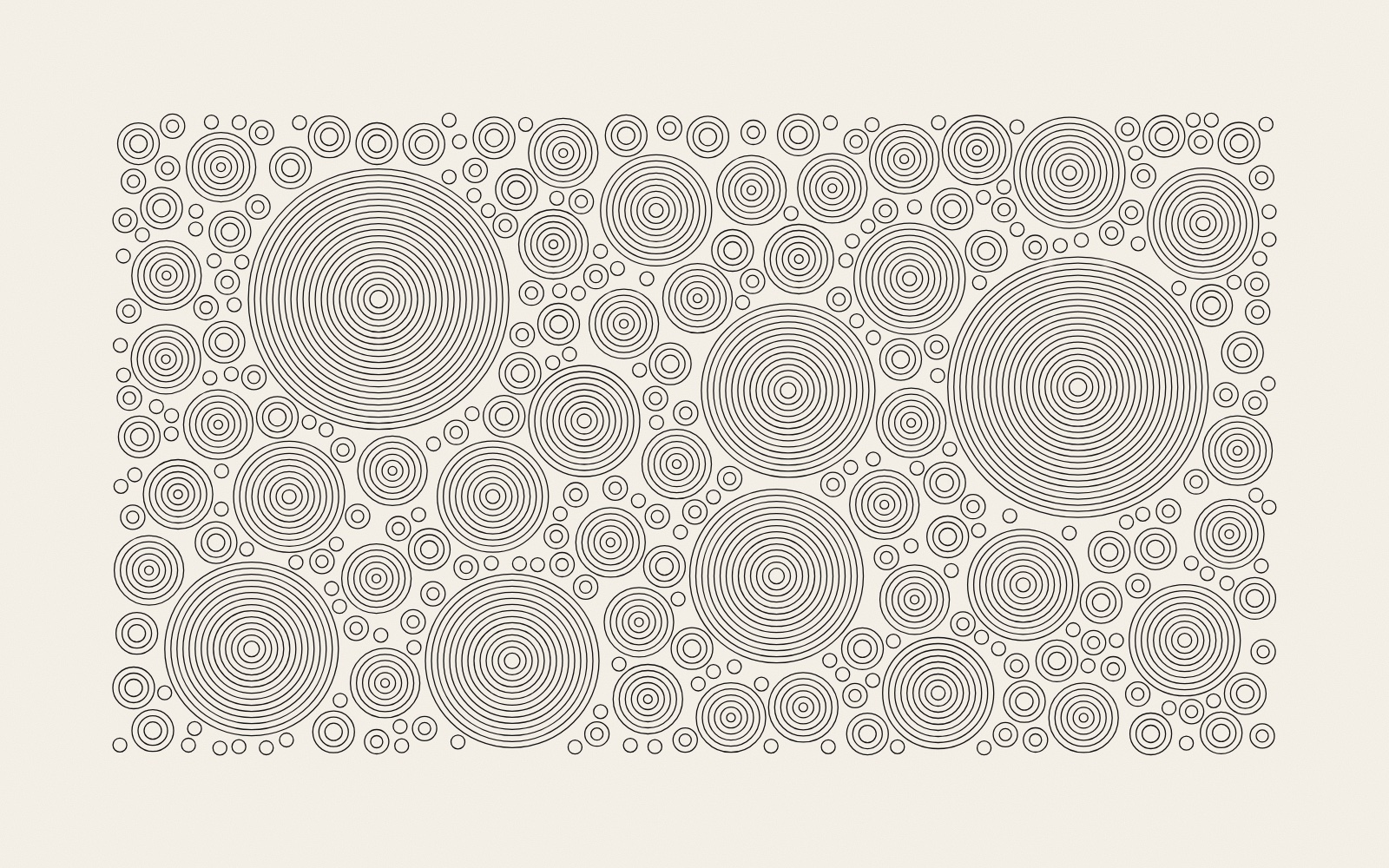
Circle packing is the arrangement of circles in an area so that none of them overlap. In mathematics it is a question about how tightly circles can fit; in generative art it is a way of filling a sheet with shapes that are spread out evenly without lying on a grid.1
The densest packing
If all the circles are the same size, the tightest arrangement is hexagonal: every circle touches six others, as in a honeycomb. The circles then cover π/(2√3), about 90.69 per cent, of the plane. Joseph-Louis Lagrange proved in 1773 that this is the densest packing among regular, lattice arrangements; Axel Thue published a proof in 1890 that it is the densest of all, and László Fejes Tóth gave the first rigorous proof in 1942.1
Circles in the gaps
With circles of different sizes, the gaps can be filled again and again. The classic case is the Apollonian gasket. Start with three circles that touch each other. In every gap between three touching circles, place a new circle that touches all three, and repeat for ever.2
The finished gasket is a fractal: the circles never cover the whole area, and what is left has a dimension of about 1.31.2
The random method
A simpler way is trial and error, with no geometry of tangent circles. The artist Tyler Hobbs describes his method in "A Randomized Approach to Circle Packing" (2016):3
- Choose the sizes of circle you want, and roughly how many of each.
- Start with the largest. Pick a random position and check whether the circle fits: it overlaps another circle if the distance between their centres is not larger than the two radii added together.
- If it fits, keep it; if not, try another position. Hobbs gives up on a size after 2,000 failed attempts in a row, a balance, he writes, between speed and how dense the result becomes.
- Move on to the next size, ending with the smallest.
Because the large circles are placed first, the small ones end up in the gaps between them.
As a tool
A packing is also a way of choosing points. The centres of the circles are spread evenly but irregularly, which is what Poisson disc sampling also aims for. Hobbs lists circle packing as one way of choosing where curves start in a flow field: "things are pretty evenly spaced out".4 On a plotter, each circle can be filled with lines, as with the concentric rings in the drawing at the top of this page; see line hatching and Plotter Art.
Sources
- “Circle packing”. Wikipedia
Arrangement of circles on a surface so that none overlap and none can be enlarged without creating an overlap; hexagonal packing, each circle touching six others, density π/(2√3) ≈ 0.9069; Lagrange 1773 (densest lattice packing), Thue 1890, Fejes Tóth 1942 (first rigorous proof). - “Apollonian gasket”. Wikipedia
Three mutually tangent circles, new circles each tangent to three others; named after Apollonius of Perga; Descartes' theorem (1/r₁ + 1/r₂ + 1/r₃ + 1/r₄)² = 2(1/r₁² + 1/r₂² + 1/r₃² + 1/r₄²); Hausdorff dimension about 1.3057. - Tyler Hobbs, “A Randomized Approach to Circle Packing”, 2 May 2016
“a brute-force approach that tries to place a circle in thousands of random locations until a fit is found”; sizes and rough counts chosen first; “begins with the largest circles and ends with the smallest”; collision when the distance between centres is not larger than the sum of the radii; stops after “2000 failed attempts in a row”; also applied to triangles in Up There (2016). - Tyler Hobbs, “Flow Fields”, 3 February 2020
Starting points for curves: “Use circle packing”; “The circle packing approach has a nice balance: things are pretty evenly spaced out”.
- Published
- JAEV Notes, October 2026.
- Use
- Text CC BY 4.0. Free to use and quote with credit to JAEV and a link to this page. Images and quotations by others keep their own terms.
All texts as one file: archive.json - Cite
- JAEV Notes, “Circle packing”, jaev.gallery/notes/circle-packing/, 2026.
- Corrections
- Additions and corrections are welcome: info@jaev.gallery
- Share
A link from your own site, course page or reading list helps others find it.- Follow
- New notes by RSS · Instagram · Bluesky
JAEV is a daemon taking shape: machines, weights, room, brain.