Computer Technique Group (Tokyo, 1966–1969)
JAEV Notes · October 2026 · 2 min read
The Computer Technique Group (CTG) was a collective in Tokyo that made computer graphics and films from December 1966 until it disbanded in November 1969. It was founded by Masao Komura, Haruki Tsuchiya, Kunio Yamanaka and Junichiro Kakizaki, and six more members joined later.1, 2 Its best-known work is Running Cola is Africa.
Designers and engineers at IBM
The group worked with IBM Japan, at the IBM Scientific Data Centre in Tokyo, where it had a large computer and a plotter.1, 2 According to the Science Museum Group, its office was at once a design studio, selling graphics to galleries, and a "think tank with expertise in computer analysis".2 Their works are credited by task: who had the idea, who prepared the data and who wrote the program. For Running Cola is Africa that was Komura, a product designer (idea), Makoto Ohtake (data) and Koji Fujino, a systems engineer (program).2, 3
Metamorphoses
CTG took familiar images, such as a running man, a woman's profile or John F. Kennedy, and changed them with geometric transformations calculated by the computer.2, 4 Running Cola is Africa (1967–68) is number 3 in its Metamorphoses series. In the words of ZKM in Karlsruhe, "A computer algorithm converts a running man into a bottle of cola", and the bottle then becomes the outline of Africa. The program was written in Fortran IV for an IBM 7090 and drawn on a CalComp 563 plotter; the print is a lithograph made from the plotter drawing.3
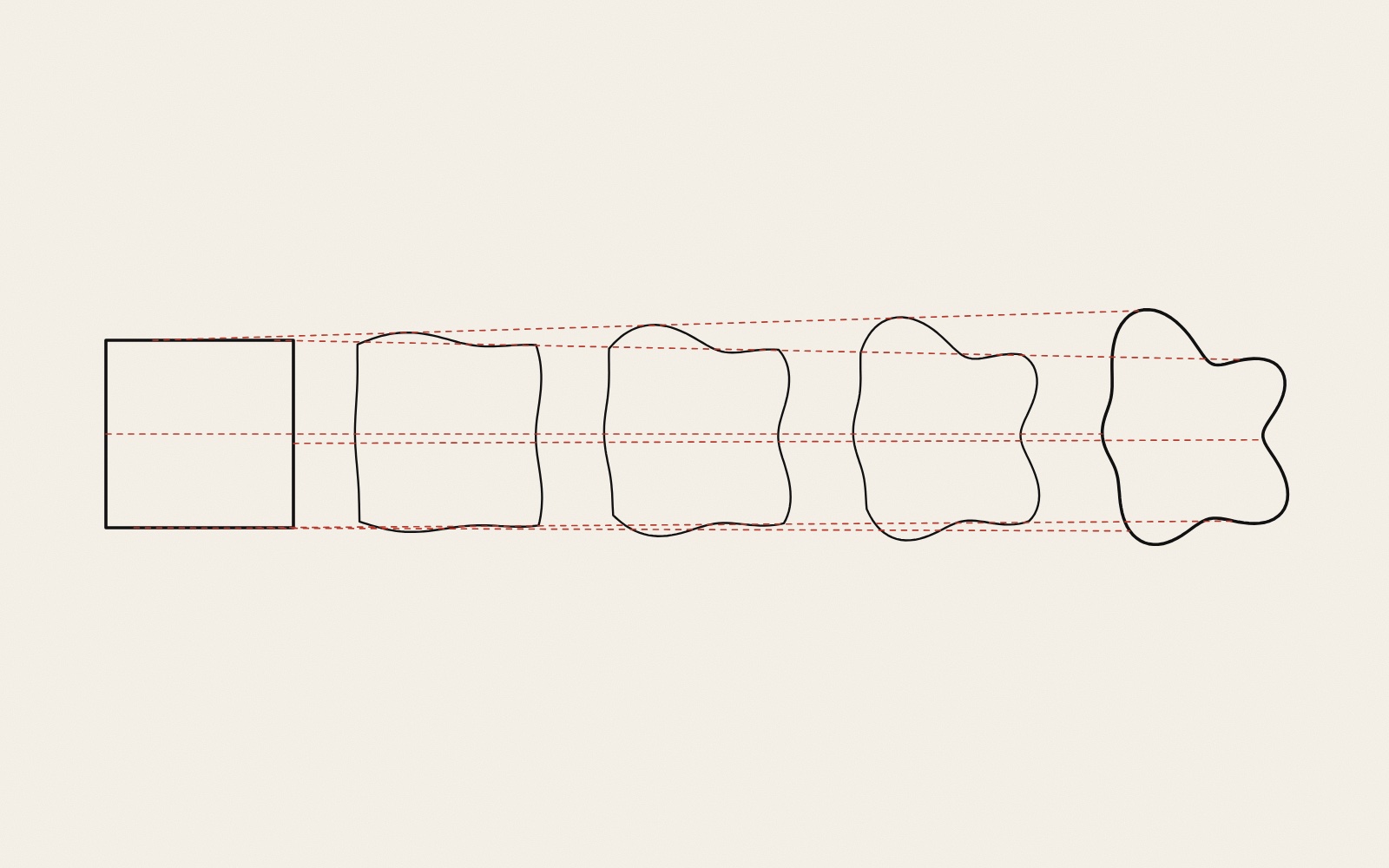
The diagram above shows the simplest way to compute such a change. Both outlines are described by the same number of points. For each step in between, every point moves the same fraction of the way, in a straight line, from its place in the first outline to its place in the second. The sources we read do not give CTG's exact formula, so the diagram shows the principle rather than their program.
London, 1968
In 1968 CTG was shown in Cybernetic Serendipity at the Institute of Contemporary Arts in London, and the catalogue had a section on the "Computer Technique Group from Japan".1, 5 The group's lithographs were published in London by Motif Editions; ZKM holds Running Cola is Africa.2, 3 In 2005 the NTT InterCommunication Center in Tokyo showed CTG in Possible Futures: Japanese postwar art and technology.4
Sources
- “CTG (Computer Technique Group)”. Electronic Arts Intermix, artist overview
Founded in December 1966 by Masao Komura, Haruki Tsuchiya, Kunio Yamanaka and Junichiro Kakizaki, later joined by six more; worked with IBM Japan, using a large computer and a plotter; took part in Cybernetic Serendipity, ICA London, 1968; disbanded in November 1969. - “Computer Technique Group”. Science Museum Group Collection, people record
Founded December 1966; members worked at the “IBM-Scientific-Data-Centre in Tokyo”; the office was a design studio and a “think tank with expertise in computer analysis”; geometric transformations of objective motifs; Pop Art. Return to Square: idea Masao Komura, program Kunio Yamanaka; Running Cola is Africa: idea Komura, data Makoto Ohtake, program Koji Fujino. - Computer Technique Group, Running Cola is Africa, 1967. ZKM | Center for Art and Media Karlsruhe
No. 3 of CTG's Metamorphoses series; “A computer algorithm converts a running man into a bottle of cola”, which then becomes a map of Africa; IBM 7090, Fortran IV; Calcomp 563 plotter; lithograph after a plotter drawing, 50.5 × 75 cm, Motif Editions; credits Masao Komura (idea), Makoto Ohtake (data), Koji Fujino (programme). - “CTG (Computer Technique Group)”. NTT InterCommunication Center [ICC], archive
Works 1967–68: Return to a Square, CTG Computer Movie #1, Kennedy in a Dog, Shot Kennedy No. 2, Kennedy in the Net, APM No. 1, March of Polygons, Running Cola is Africa!, Computer is a Good Illustrator (Random Walk Kennedy); exhibition Possible Futures: Japanese postwar art and technology, 21 October – 25 December 2005. - “Cybernetic Serendipity: The Computer and the Arts”, Studio International special issue, ed. Jasia Reichardt, 1968. Contents
Contents include “Computer Technique Group from Japan” and “An interview with Charles Csuri by Arthur Efland”.
- Published
- JAEV Notes, October 2026.
- Use
- Text CC BY 4.0. Free to use and quote with credit to JAEV and a link to this page. Images and quotations by others keep their own terms.
All texts as one file: archive.json - Cite
- JAEV Notes, “Computer Technique Group (Tokyo, 1966–1969)”, jaev.gallery/notes/computer-technique-group/, 2026.
- Corrections
- Additions and corrections are welcome: info@jaev.gallery
- Share
A link from your own site, course page or reading list helps others find it.- Follow
- New notes by RSS · Instagram · Bluesky
JAEV is a daemon taking shape: machines, weights, room, brain.