Hiroshi Kawano (1925–2012)
JAEV Notes · October 2026 · 3 min read
Hiroshi Kawano (1925–2012) was a Japanese philosopher of aesthetics who wrote his first computer programs in 1963 and made his first computer-generated designs in 1964. They are counted as the first computer graphics made in Japan with a digital computer.1, 2 He described his computer art as scientific research rather than artistic activity.3
A philosopher at the computer centre
Kawano was born to Japanese parents in Fushun, China, on 14 April 1925, and studied philosophy and aesthetics at the University of Tokyo from 1948 to 1951. By 1961 at the latest he had read the Aesthetica of the German philosopher Max Bense and the information theory of Claude Shannon.1, 3
In the autumn of 1963 he taught himself to program, in assembler, for the OKITAC 5090A computer, and in the spring of 1964 he was given time on one at the Computer Center of the University of Tokyo.1, 3
Markov chains
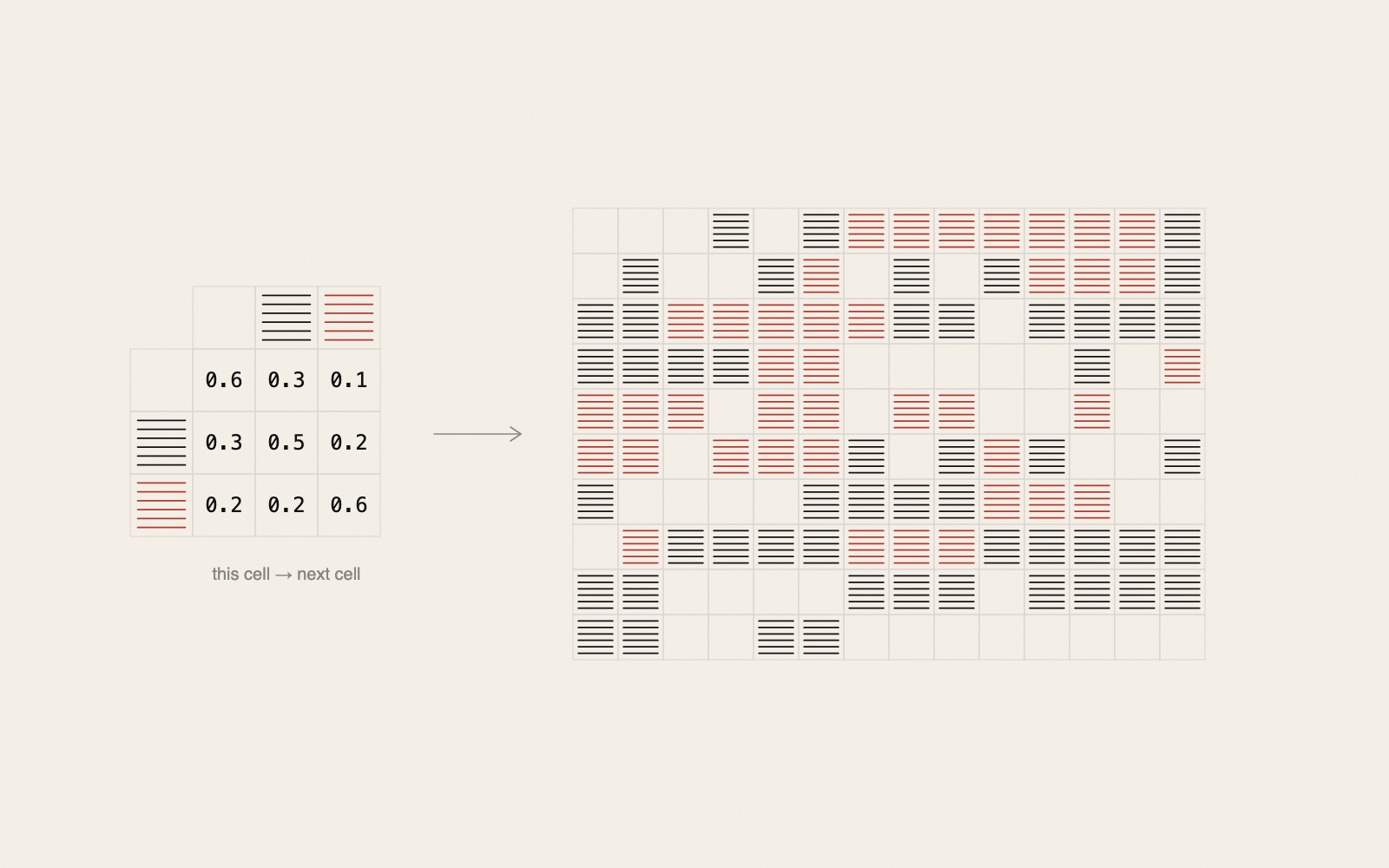
Kawano's early designs are based on Markov chains. A Markov chain is a rule for producing a sequence by chance, one in which the probability of the next step depends only on the present one. In a picture, the colour of the square just placed decides how likely each colour is to come next. The probabilities sit in a table, the transition matrix, which has one row for each present colour and one column for each possible next colour, as in the diagram at the top of this page.
For most of his early works, according to the ZKM, Kawano first analysed a series of images statistically, counting how often and in what position each colour appeared.4 Random numbers decide each step of a chain; the table decides which steps are likely. How a computer makes such random numbers is explained in the linear congruential generator.
Printout and paint
The University of Tokyo's computer centre had only line printers, which print letters and numbers, not pictures. Kawano's printouts held the colour data, not the colours, and the design was then painted by hand, by Kawano and sometimes by his students.3 The finished works in the ZKM are gouache on paper.4 JAEV's Plotter Art lists him among the early computer artists who did not use a pen plotter.
In the series Artificial Mondrian, for example KD 28 of 1969, a transition matrix decided the length of the lines and where they cross, and the colours were assigned at random. Kawano named the series out of admiration for Piet Mondrian, "without claiming any close visual resemblance".4 Compare A. Michael Noll's Computer Composition with Lines.
Exhibitions and the archive
Kawano took part in the first Japanese computer art contest exhibition in 1968, and in Tendencies 4 in Zagreb in 1968–69.1 At his first solo exhibition, at Plaza DIC in Tokyo in October 1970, he credited himself with "planning, programming and text" and the computer with "design and works".3
In 2010 Kawano gave his archive to the ZKM in Karlsruhe, which showed a retrospective, Hiroshi Kawano. Der Philosoph am Computer, from September 2011 to January 2012. He died on 18 December 2012.5, 2
Sources
- Margit Rosen, “Hiroshi Kawano: Biography”. ZKM | Center for Art and Media Karlsruhe
Born 14 April 1925 in Fushun, China, to Japanese parents; philosophy and aesthetics, University of Tokyo, 1948–51; Bense's Aesthetica by 1961 at the latest; lecturer, Tokyo Metropolitan College of Air-Technology, 1961–72; professor 1972–88; autumn 1963 teaches himself programming for the OKITAC 5090A; spring 1964 access to an OKITAC 5090A at the Computer Center of the University of Tokyo, first computer-generated images; September 1964 article in the Japanese IBM Review; 1968 first Japanese computer art contest exhibition and the information exhibition of the tendencies 4 colloquy; 1969 tendencies 4, Zagreb; 1970 solo show, Plaza DIC, Tokyo; archive to ZKM 2010. - “川野洋” (Hiroshi Kawano). Wikipedia (Japanese)
14 April 1925 – 18 December 2012; in 1964 made the first computer graphics in Japan with a digital computer. - Simone Gristwood, “Hiroshi Kawano (1925–2012): Japan's Pioneer of Computer Arts”. Leonardo 52:1 (2019), 75–80
Bense's Aesthetica and Shannon's information theory; assembler on the OKITAC 5090A, Fortran from 1966; designs programmed 1963, executed 1964, “based on Markov chains and were printed using line printers”; “The output prints for Kawano's work contained color data … and Kawano would sometimes enlist his students to help color”; Plaza DIC 5–14 October 1970, HITAC 5020, FORTRAN IV, Kawano credited for “planning, programming and text” and the computer for “design and works”; 1970 letter from the US Department of the Army; his reply that his computer art was not artistic activity but scientific research; 1971 paper “Computer Art as Artificial Intelligence”, Zagreb. - Hiroshi Kawano, KD 28, from the series Artificial Mondrian, 1969. ZKM | Center for Art and Media Karlsruhe (work record, text by Clara Runge)
Markov chains; for most early works Kawano first analysed a series of images statistically, how often and in what position a colour appeared; a transition probability matrix for the length of the lines and the occurrence of intersections; colours assigned randomly; named for his admiration of Mondrian “without claiming any close visual resemblance”; gouache on paper; HITAC 5020, FORTRAN IV. - “Hiroshi Kawano. Der Philosoph am Computer”. ZKM | Center for Art and Media Karlsruhe, 24 September 2011 – 29 January 2012
Curated by Margit Rosen; draws on the Hiroshi Kawano Archive at the ZKM since 2010; Max Bense part of the reason for the donation.
- Published
- JAEV Notes, October 2026.
- Use
- Text CC BY 4.0. Free to use and quote with credit to JAEV and a link to this page. Images and quotations by others keep their own terms.
All texts as one file: archive.json - Cite
- JAEV Notes, “Hiroshi Kawano (1925–2012)”, jaev.gallery/notes/hiroshi-kawano/, 2026.
- Corrections
- Additions and corrections are welcome: info@jaev.gallery
- Share
A link from your own site, course page or reading list helps others find it.- Follow
- New notes by RSS · Instagram · Bluesky
JAEV is a daemon taking shape: machines, weights, room, brain.