Zuse Graphomat Z64 (1961–1964)
JAEV Notes · October 2026 · 2 min read
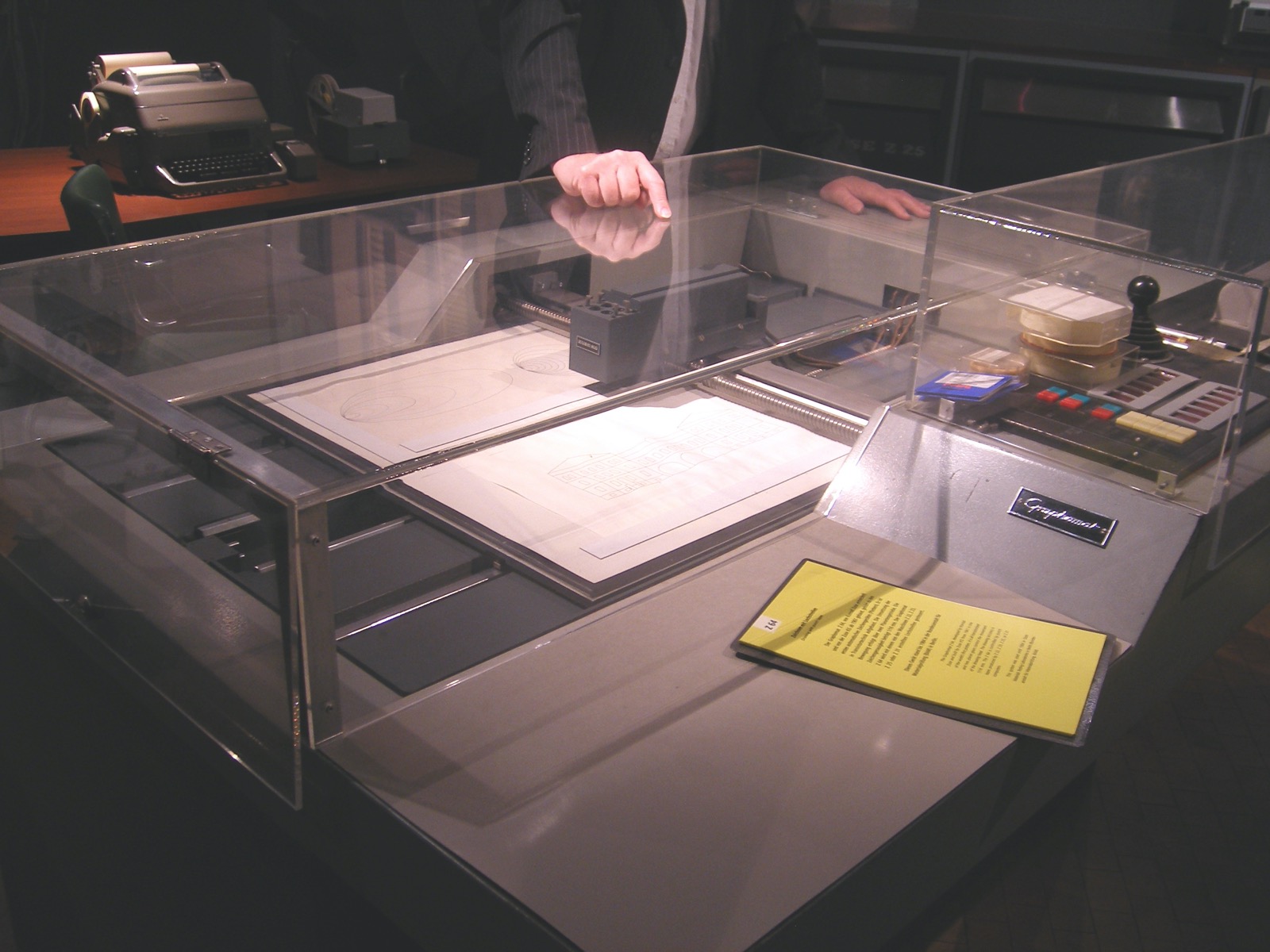
The Graphomat Z64 is a pen plotter built by the computer pioneer Konrad Zuse's company from 1961 to 1964. Ninety-eight were made.1 Graphomats drew some of the first computer graphics shown as art, by Frieder Nake in Stuttgart and Georg Nees at Siemens.2, 3
The machine
The Z64 is a flatbed plotter: the paper lies still and the pen moves over it in both directions. An item in the Deutsches Museum archive calls it an "elektronisch gesteuerter Zeichentisch", an electronically controlled drawing table.4, 5 According to the ZCOM Zuse-Computer-Museum in Hoyerswerda, the machine could draw in four colours and write lettering on its own. The museum presents it as the realisation of an idea Zuse had in 1945: that computers should also be able to draw.1
The plotter did not have to stand next to the computer. A program punched the drawing into paper tape, which was carried to the plotter and read there. The pen moved in steps of 1/16 mm at up to 22.5 mm a second, and a straight line one metre long took about 45 seconds.6
Nake's tape
The computing centre of the Technische Hochschule Stuttgart ordered a Z64 and got unit number 9, Nake recalled; it came without software, and he was told to write it. The centre's computer was not a Zuse machine, so he wrote his programs without being able to test them, punched them on tape and took them to Zuse's headquarters. There the plotter started, then stopped after five minutes, again and again. Nake picked up the punched-out scraps of paper from the floor, glued them into chosen holes in his tape, and the drawing ran.2 His programs ran on the centre's Standard Elektrik Lorenz ER56 and were drawn on the Z64, among them Hommage à Paul Klee 13/9/65 Nr. 2.7
Nees at Siemens
Nees was a software engineer at Siemens, and according to the Victoria and Albert Museum he was instrumental in the company buying a Graphomat. He showed his drawings at the Technische Hochschule Stuttgart in February 1965, the exhibition described in the note on Generative Computergrafik.3 ZKM in Karlsruhe holds his Achsenparalleler Irrweg (1964), written in ALGOL for a Siemens 2002 computer and drawn in ink on the Z64.8 His best-known plotter work is Schotter.
Mohr in Darmstadt
In early 1970 Manfred Mohr, then in Paris, got access through a friend to a Zuse flatbed plotter and an IBM 7040 at the university in Darmstadt. There he drew his program P-21, his first drawings by a mechanical pen plotter, and called it "a milestone". He does not name the model. A few months later he was drawing on a Benson plotter in Paris.5
Where to see one
The ZCOM Zuse-Computer-Museum in Hoyerswerda holds a Z64 with its control cabinet. Both were used in a drawing and design office in Hamburg.1, 9 JAEV's editorial Plotter art places the Z64 among the other plotters artists have used since.
Sources
- Z 64 Graphomat (HZu.000005.0). ZCOM Zuse-Computer-Museum, Hoyerswerda, via museum-digital:sachsen
In German: “Der Graphomat wurde von 1961 bis 1964 mit Transistortechnik gebaut”; two “hochgenau arbeitende Planetengetriebe”; four colours; lettering “vollautomatisch”; input “über Lochstreifen oder direkt vom Rechner”; 98 built, sold for 79,000 to 128,000 DM; 170 × 230 × 200 cm; Zuse's vision of 1945 that computers should be able to draw. - Frieder Nake and Wolf Lieser, “60 Years of Algorithmic Art”. Digital Art Museum (DAM)
“the Graphomat Z64, the last creation of Konrad Zuse”; “We received unit number 9”; programs written “blindly on punched tape”; the machine stopped after five minutes; paper scraps glued into the tape; “For each drawing, I noted how much time it took to be drawn.” - Georg Nees, Schotter, 1968–1970. Victoria and Albert Museum, London (catalogue text)
Nees, a software engineer at Siemens, “was instrumental in their purchasing a ‘Zuse Graphomat’, a drawing machine operated by computer-generated punched tape”; shown at the Technische Hochschule Stuttgart in February 1965. - “Zuse Z64 Graphomat. Elektronisch gesteuerter Zeichentisch” (NL 207/4077). Deutsches Museum, Munich, archive
Title of the archive item: an electronically controlled drawing table. - Manfred Mohr, “50 Year Celebration: Time Line”
Early spring 1970: “a Zuse high-resolution flatbed ink pen plotter and a IBM 7040 computer at the University of Darmstadt”; “I plotted P-21. It was a milestone.” - “Project Zuse”. Computer Museum, Department of Computer Science, University of Stuttgart
“not controlled directly online by the computer, but via punched strips”, 5-channel, later 8-channel; “The increment is 1/16mm”; “the maximum speed is 22.5 mm/sec”; engraving needles and cutting gravers; given to Furtwangen in the 1970s; original tapes survive. - Frieder Nake, Hommage à Paul Klee 13/9/65 Nr. 2, 1965. ZKM | Center for Art and Media Karlsruhe
“computer: Standard Elektrik Lorenz ER56”, “output device: Zuse Graphomat Z64”; screenprint after a plotter drawing, 50.1 × 50.1 cm. - Georg Nees, Achsenparalleler Irrweg, 1964. ZKM | Center for Art and Media Karlsruhe
“Siemens digital computer 2002”, ALGOL, “ZUSE Graphomat Z 64”, ink on paper, 29.7 × 42 cm. - Z 64 Steuerschrank (control cabinet). ZCOM Zuse-Computer-Museum, Hoyerswerda, via museum-digital:sachsen
The Graphomat and its control cabinet were used in a drawing and design office in Hamburg.
- Published
- JAEV Notes, October 2026.
- Use
- Text CC BY 4.0. Free to use and quote with credit to JAEV and a link to this page. Images and quotations by others keep their own terms.
All texts as one file: archive.json - Cite
- JAEV Notes, “Zuse Graphomat Z64 (1961–1964)”, jaev.gallery/notes/zuse-graphomat-z64/, 2026.
- Corrections
- Additions and corrections are welcome: info@jaev.gallery
- Share
A link from your own site, course page or reading list helps others find it.- Follow
- New notes by RSS · Instagram · Bluesky
JAEV is a daemon taking shape: machines, weights, room, brain.