AARON's rules (Harold Cohen, 1970s)
JAEV Notes · October 2026 · 3 min read
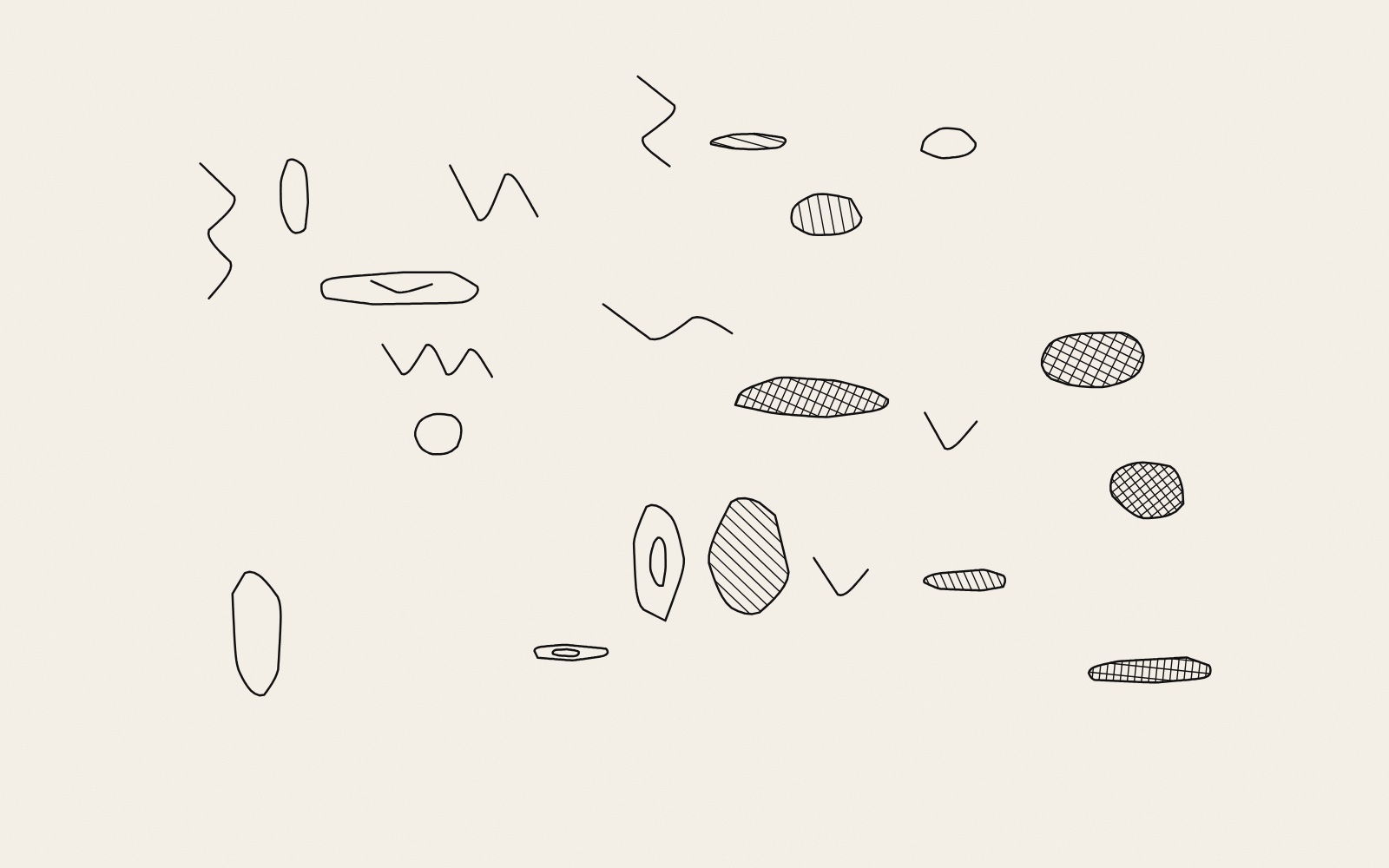
AARON was a drawing program written by the painter Harold Cohen (1928–2016), who conceived it in the late 1960s at the University of California, San Diego, and named it in the early 1970s.1 It drew by following rules of the form if these conditions hold, then do this. Cohen printed several of them in "What is an Image?", a paper written in December 1978 and given in Tokyo in 1979.2, 3 This note describes those rules as he did and runs a small reconstruction.
A system of rules
In 1978 the program had "about three hundred productions", or rules. The left part of each rule tested "combinations of up to five or six conditions"; the right part carried out actions, one of which could pass control to another level of the program.2
The levels were ARTWORK, which decided how to start and when the drawing was finished; MAPPING, which found and allocated space; PLANNING, which developed each figure; and LINES, SECTORS and CURVES, which turned a planned line into movements of the pen. In Cohen's words, "no single part knows what the drawing should turn out to be like."2
The rules for a figure
Each figure was built in up to three "developments". The first decided, "on the basis of frequency considerations", whether the figure would be closed, open, or left uncommitted for the moment. One rule Cohen printed:2
If (this is a first development
   and the last figure was open
   and at least n figures have been done
   and at least q of them were open
   and at least t units of space are now available)
Then
   This figure will be closed
After a closed first development, a second could divide the figure, shade it, add a closed form to it, or draw a closed or an open form inside it. If the second development was a series of parallel lines inside, a third could add another series "perpendicular to first" or "alongside the first".2 Words such as "boulder" and "penumbra" in his rules were Cohen's own descriptions; the program did not attach such descriptions to the things it drew.2
The shapes themselves came from repetition protocols. One "requires the line to move a given distance (more-or-less) and then change direction, continuing this cycle a given number of times"; closed forms were made by a similar "go, turn, repeat" cycle. Over all of this, avoidance protocols prohibited the program "from ignoring the existence of one figure in drawing another one".2
Chance inside limits
Cohen defined randomness as "the impossibility of predicting the outcome of a choice on the basis of previously-made choices". His rules took the form if (a and b and … n) then p% of the time do x, q% of the time do y. For the proportions of a closed loop, for example: 50 per cent of the time between 1:4 and 1:6, 12 per cent between 3:4 and 7:8.2
The program kept track of the drawing in a coarse matrix of 90 by 160 cells, recording which figure occupied each cell. Before starting, it "roughens" the surface, declaring some parts unusable for new figures, "in order to maximize the rate of change of density across the image".2
Cohen tested the program in public. At documenta 6 in Kassel and at the Stedelijk Museum in Amsterdam it drew continuously, on a display terminal and with a small drawing robot on the floor.2 Its later machines are described in Plotter art. The rules compare with the one-sentence instructions of Sol LeWitt: LeWitt's were written for a person, Cohen's for a program that decides each step from what is already on the paper.
Sources
- “Harold Cohen: AARON”, 3 February – 19 May 2024. Whitney Museum of American Art, New York
Cohen (1928–2016) “conceived the software in the late 1960s at the University of California, San Diego” and “named it AARON in the early 1970s”. - Harold Cohen, “What is an Image?”. Invited paper, 6th International Joint Conference on Artificial Intelligence, Tokyo, 1979
“about three hundred productions”; “combinations of up to five or six conditions”; written in C under UNIX (note 5); ARTWORK, MAPPING, PLANNING, LINES, SECTORS, CURVES; the rules for first, second and third developments; repetition and avoidance protocols; frequencies and meta-rules; the 90 x 160 matrix and the “roughened” surface; documenta 6 and the Stedelijk Museum. The text dates itself to December 1978. - Harold Cohen, Bibliography. aaronshome.com
“What is an Image?” Invited paper, proceedings of the 6th International Joint Conference on Artificial Intelligence, Tokyo. 1979.
- Published
- JAEV Notes, October 2026.
- Use
- Text CC BY 4.0. Free to use and quote with credit to JAEV and a link to this page. Images and quotations by others keep their own terms.
All texts as one file: archive.json - Cite
- JAEV Notes, “AARON's rules (Harold Cohen, 1970s)”, jaev.gallery/notes/aaron-rules/, 2026.
- Corrections
- Additions and corrections are welcome: info@jaev.gallery
- Share
A link from your own site, course page or reading list helps others find it.- Follow
- New notes by RSS · Instagram · Bluesky
JAEV is a daemon taking shape: machines, weights, room, brain.