Sol LeWitt's instructions as algorithms (Wall Drawing 86)
JAEV Notes · October 2026 · 2 min read
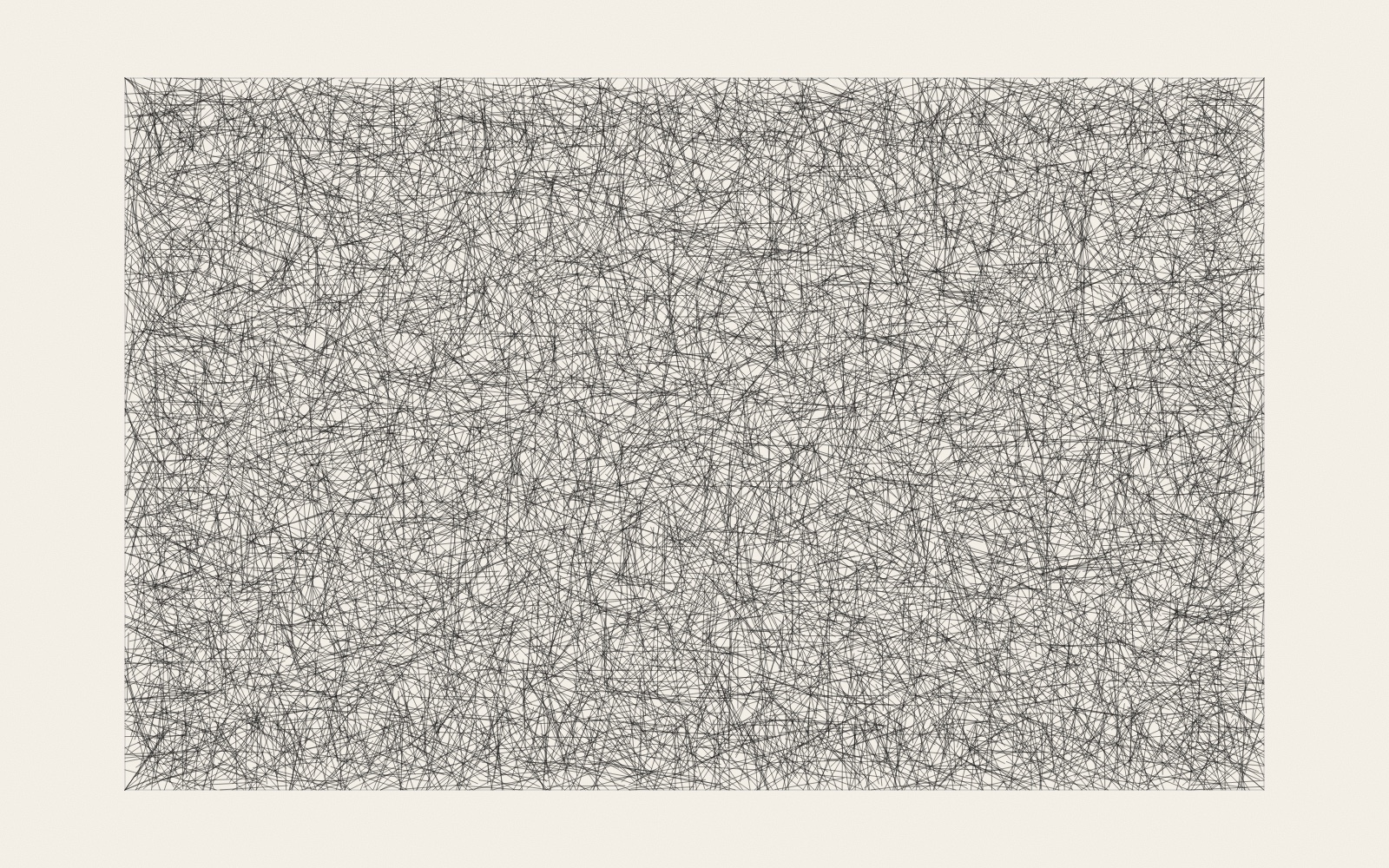
Sol LeWitt's wall drawings exist as written instructions that other people carry out on a wall. Read as a procedure, an instruction is close to an algorithm: a description precise enough that someone other than the author can produce the work by following it. This note takes one instruction, Wall Drawing 86 (1971), turns it into code, and lists the decisions the code has to make.
The instruction
The Massachusetts Museum of Contemporary Art (MASS MoCA), where the drawing is installed, gives the full instruction for Wall Drawing 86, dated June 1971:1
Ten thousand lines about 10 inches (25 cm) long, covering the wall evenly.
It is drawn in black pencil. The museum adds that "other aspects of the lines (their orientation, how often they intersect each other, etc.) are decided by the draftsman", and that "the even distribution is conditioned by the dimensions of the wall."1
Why it is close to an algorithm
LeWitt described the principle in "Paragraphs on Conceptual Art" in 1967: "The idea becomes a machine that makes the art."2 He installed his first wall drawing himself. From 1969 he asked friends, curators and collectors to install them from his instructions, and later he employed a team of technicians.3
Wall Drawing 86 has a single step, repeated ten thousand times: draw a line. What it does not define is "about", "evenly" and the direction of each line. A person settles these by judgement, line by line, while drawing. A program has to settle them before it starts.
What the code decides
The sketch below makes four decisions. Each is JAEV's, not LeWitt's:
- The wall. 4 by 2.5 metres. The instruction fits any wall; code needs numbers.
- "About 25 cm". Every line is between 22.5 and 27.5 cm long.
- "Evenly". The wall is divided into a grid of 125 by 80 cells, which makes exactly 10,000, and the centre of one line is placed at random inside each cell.
- Direction. Any angle, all equally likely.
Each of the four choices replaces a decision that a drafter makes on the wall. Casey Reas began his project {Software} Structures for the Whitney Museum of American Art the same way, "by implementing three of Lewitt's drawings in software and then making modifications".4 The program can draw the work again at any time, but each drawing varies only as far as the code allows.
LeWitt also used instructions to produce complete series rather than open executions. Variations of Incomplete Open Cubes (1974) "proposes all of the 122 variations in which a cube can be incomplete".5 Olof Broström's Automatic Colour Cubes at JAEV takes those 122 variations as its rule, one cube a day.
Sources
- “Wall Drawing 86”, Sol LeWitt, June 1971. MASS MoCA, North Adams
Instruction: “Ten thousand lines about 10 inches (25 cm) long, covering the wall evenly.” Black pencil; first installation The Bykert Gallery, New York; first drawn by R. Holcomb, Kazuko Miyamoto. “Other aspects of the lines (their orientation, how often they intersect each other, etc.) are decided by the draftsman.” “The even distribution is conditioned by the dimensions of the wall.” Building 7. - Sol LeWitt, “Paragraphs on Conceptual Art”, Artforum, June 1967
“The idea becomes a machine that makes the art.” “The plan would design the work.” - Anna Lovatt, “Ideas in Transmission: LeWitt’s Wall Drawings and the Question of Medium”, Tate Papers no. 14, Tate, London, 2010
First wall drawing installed by LeWitt himself (1968); from 1969 friends, curators and collectors installed them; later a team of technicians. - “Casey Reas: {Software} Structures”. Whitney Museum of American Art, New York
“I began to answer the question by implementing three of Lewitt's drawings in software and then making modifications.” - “Sol LeWitt: Cubic Forms”. Paula Cooper Gallery, New York
Variations of Incomplete Open Cubes (1974) “proposes all of the 122 variations in which a cube can be incomplete”.
- Published
- JAEV Notes, October 2026.
- Use
- Text CC BY 4.0. Free to use and quote with credit to JAEV and a link to this page. Images and quotations by others keep their own terms.
All texts as one file: archive.json - Cite
- JAEV Notes, “Sol LeWitt's instructions as algorithms (Wall Drawing 86)”, jaev.gallery/notes/sol-lewitt-instructions-as-algorithms/, 2026.
- Corrections
- Additions and corrections are welcome: info@jaev.gallery
- Share
A link from your own site, course page or reading list helps others find it.- Follow
- New notes by RSS · Instagram · Bluesky
JAEV is a daemon taking shape: machines, weights, room, brain.