The Benson plotter (Paris, 1970–1983)
JAEV Notes · October 2026 · 2 min read
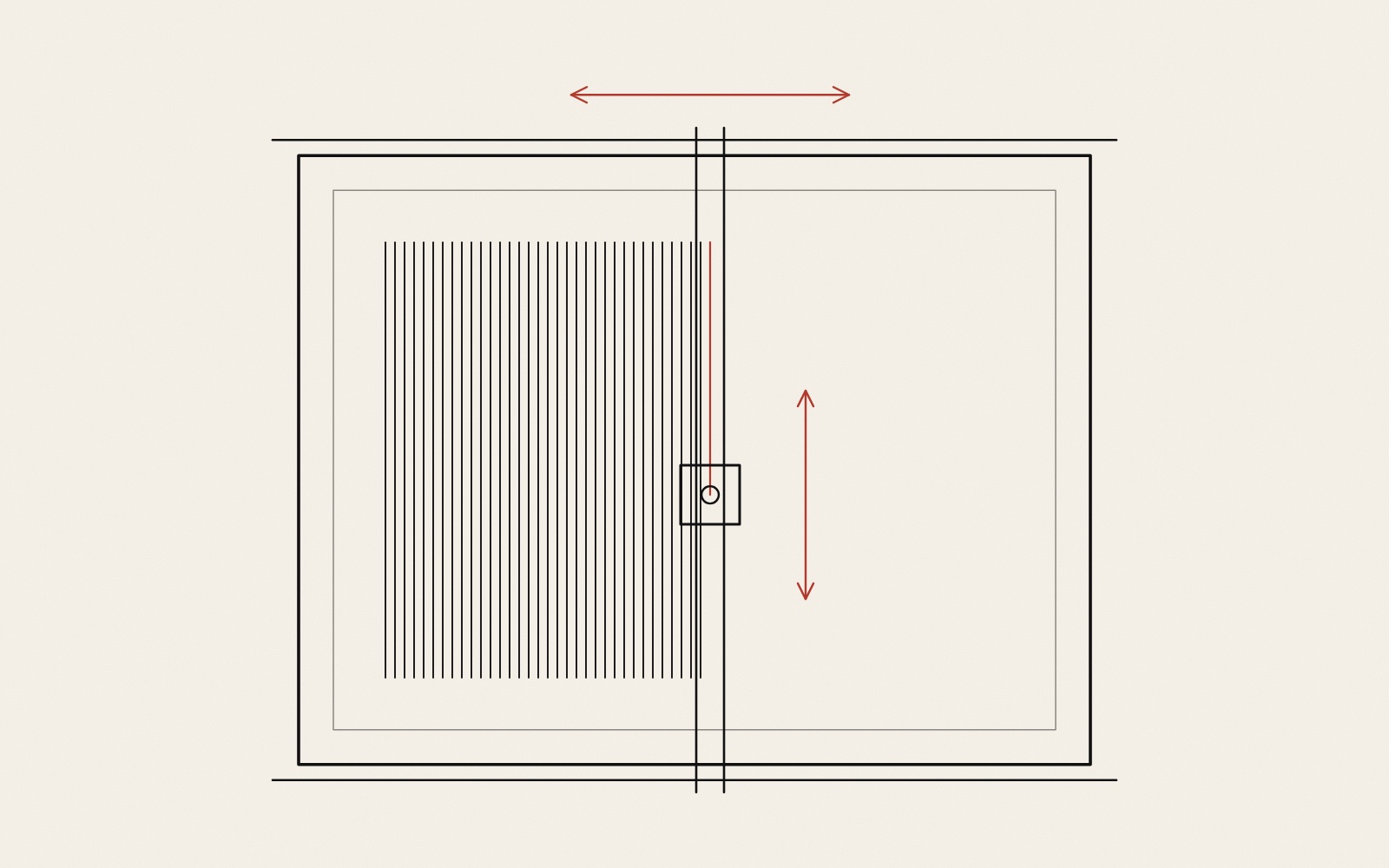
Benson was a French maker of pen plotters. In the late 1970s, according to the HP Computer Museum, CalComp and Xynetics dominated the American market while "a French company, Benson, held sway in Europe".1 In art history the name belongs to one machine: the Benson 1284 flatbed plotter at the French weather service in Paris, on which Manfred Mohr made his drawings from 1970 to 1983.2
Nearly everything known about that machine comes from Mohr's own pages.
How Mohr got there
Mohr, an artist living in Paris, wrote his first computer program in October 1969. He had seen the weather service's plotter in a TV news report and asked to use it together with its CDC 6400 computer. On 17 June 1970 he received written permission to work in the computing centre at nights and weekends. He worked there until 1983, when he moved to New York.3 In his words he was there "almost nightly".2 His first pen-plotter drawings had been made a few months earlier on a Zuse plotter in Darmstadt.3
The machine
A flatbed plotter holds the paper still while the pen moves over it in both directions. Mohr describes the Benson as follows:3
- Size: a drawing area of roughly 1 × 1.30 metres, large for the time.
- Step: 0.1 mm, or 0.2 mm in a fast mode, so the lines came out smooth.
- Paper: held down by static electricity. He drew on drawing paper, tracing paper, thin canvas and a treated metal plate.
From program to drawing
Mohr wrote his programs in Fortran IV. His photographs from the weather service show the steps: punching the program on cards and feeding them in, running it from the console of the CDC 6400, preparing magnetic tape and mounting it on a tape drive, setting up the tape to transfer the data to the plotter, watching the plotter work and changing its pens.2 The first program he plotted there was P-21, the band-structures.3
The plotter in the museum
For Mohr's exhibition Computer Graphics – Une Esthétique Programmée at ARC, Musée d'Art Moderne de la Ville de Paris, which opened on 11 May 1971, Benson-France installed a plotter of the same type in the gallery, with a magnetic tape drive. At the opening and every afternoon during the show, Mohr demonstrated how the machine drew his work.4
Benson paper
Benson's name also appears on Vera Molnár's (Des)ordres (1974): nine drawings on one strip of "Benson plotter paper", 4.96 metres long and 35.9 cm wide, sold at Phillips in London in 2022.5 The catalogue does not say which machine drew it.
How the Benson compares with other machines of its time is set out in JAEV's text on plotter art and in the notes on the CalComp 565 and HP-GL.
Sources
- HP 7580A Drafting Plotter. HP Computer Museum
“In the late 1970s two firms, Calcomp and XYnetics dominated the US market, while a French company, Benson, held sway in Europe.” - Manfred Mohr, “Working at Météorologie Nationale, Paris in 1970”
“a Benson 1284 flatbed plotter and a CDC 6400 computer”; “almost nightly from 1970 to 1983”; Fortran IV; photo captions: punched cards, “preparing magnetic data tape”, “setting up magnetic tape for data transfer to plotter”, “changing plotter pens”; TF1 broadcast 6 November 1973. - Manfred Mohr, “50 Year Celebration: Time Line”
Seen in a TV news show; permission on 17 June 1970 to work “nights and weekends”; until 1983; “In the range of: 1 meter by 1.30 meters”; “.1 mm step (fast mode .2 mm step)”; drawing paper, tracing paper, thin canvas, a treated metal plate; “The paper was held down with electrostatics.” P-21 the first algorithm plotted there; the 1971 show, curator Pierre Gaudibert. - Manfred Mohr, “Computer Graphics – Une Esthétique Programmée”, ARC, Musée d'Art Moderne de la Ville de Paris, 1971
“BENSON-France SA, generously installed a plotter (drawing machine) as well as a magnetic tape drive”; demonstrations “at the opening and each afternoon during the show”; opening 11 May 1971; “the same type of machines” as at the Météorologie Nationale. - Vera Molnár, (Des)ordres, 1974. Phillips, Ex-Machina: A History of Generative Art, London, July 2022, lot 22
“computer-generated graphic ink on Benson plotter paper”; 496 × 35.9 cm; inscribed “9 DESSINS SUR 1 ROULEAU”; unique.
- Published
- JAEV Notes, October 2026.
- Use
- Text CC BY 4.0. Free to use and quote with credit to JAEV and a link to this page. Images and quotations by others keep their own terms.
All texts as one file: archive.json - Cite
- JAEV Notes, “The Benson plotter (Paris, 1970–1983)”, jaev.gallery/notes/benson-plotter/, 2026.
- Corrections
- Additions and corrections are welcome: info@jaev.gallery
- Share
A link from your own site, course page or reading list helps others find it.- Follow
- New notes by RSS · Instagram · Bluesky
JAEV is a daemon taking shape: machines, weights, room, brain.