Datasaab and Swedish computer art (D2, D21, D22)
JAEV Notes · October 2026 · 3 min read
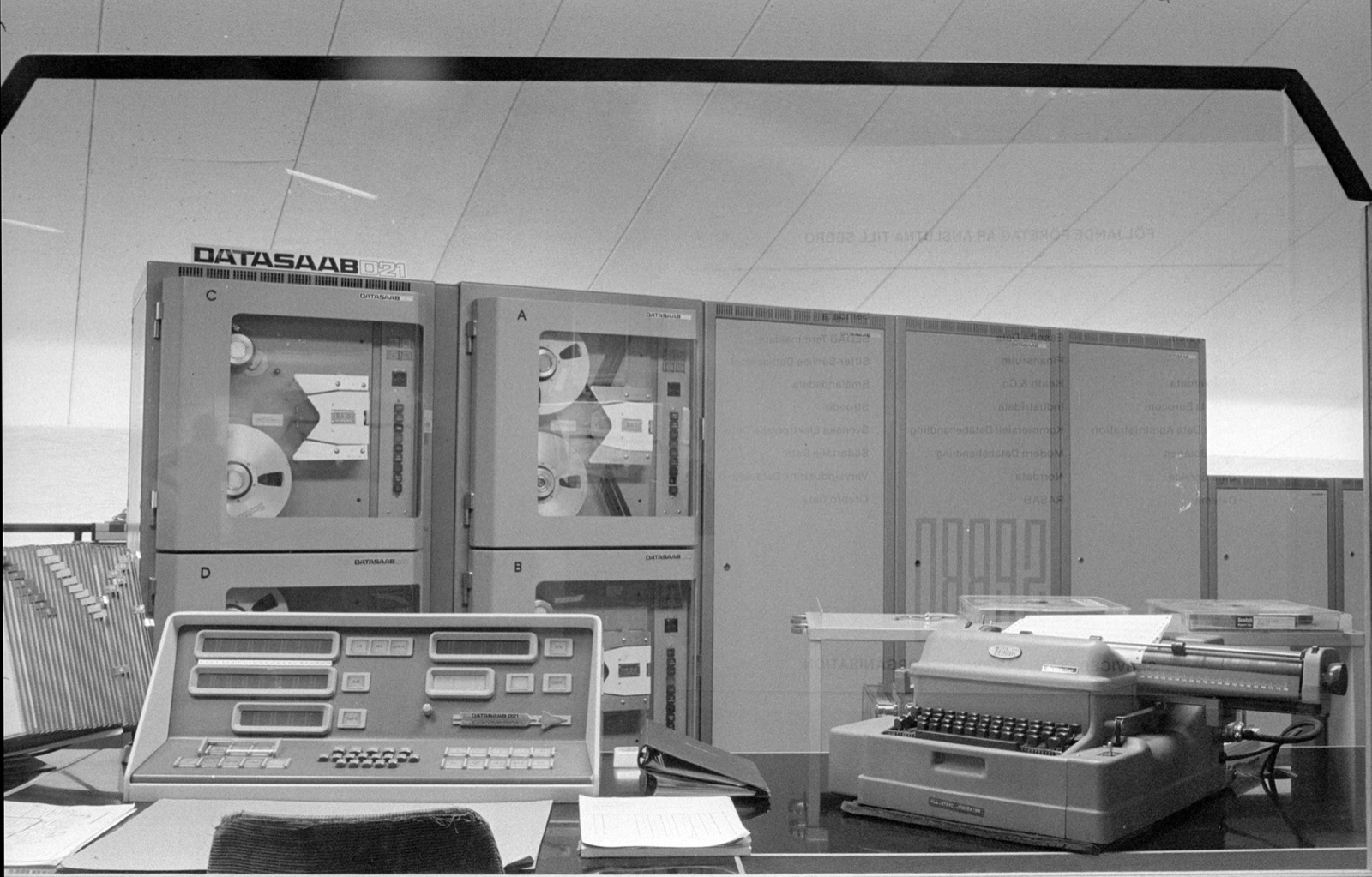
Datasaab was the computer branch of the Swedish aircraft maker Saab in Linköping. It built the transistorised D2 in 1960 and its first mainframe, the D21, in 1962; 32 D21s were sold to companies and government agencies.1 In the published sources, Swedish artists used Datasaab machines in the 1960s only through one engineer, Göran Sundqvist, and one customer's computers in Stockholm. This note covers what is documented.
The D2: a demonstration
At SAAB around 1960–61, Sundqvist was asked to impress visiting air force officers. On the D2, a prototype for an aircraft computer, he drew the path of a cannonball on an oscilloscope, with dials for the gun, and went on for years making pictures with it that he photographed off the screen.2 More in Computer Art in Sweden.
SEVED: a power company's D21
In spring 1962 a D21 was delivered to the power company Skandinaviska Elverk in Stockholm, and Sundqvist came with it as its technician: "I was part of the purchase." It was called SEVED, for Skandinaviska Elverks Elektroniska Datamaskin. Its real job, Morthenson says, was to regulate the gates of hydroelectric dams by the demand for power.2, 3
The D21 could make sound. A loudspeaker was connected to a register, so that switching it 440 times a second gave the note A. Sundqvist programmed the musical dice game attributed to Mozart, with a random generator in place of the dice.2 Composers from the music society Fylkingen came to him:
- Jan W. Morthenson, Neutron Star (1967): short pulses from a random generator, written in assembler on the D21.2, 3 See Jan W. Morthenson.
- Morthenson, Supersonics (1969) for West German television: figures that Morthenson drew, built up on a Tektronix 611 storage oscilloscope driven by the D21, filmed from an outside-broadcast bus parked outside the office.2
- Lars-Gunnar Bodin, the 1968 Lund picture: cells with random numbers of elements, printed on the line printer and painted by hand. Sundqvist remembers that the printed text said it was made possible "through the courtesy of Datasaab".2 See Lars-Gunnar Bodin.
The D22 and the pictures of 1970
From 1969 the company, now Kraftdata, had a D22. Between 7 and 8 in the morning, during maintenance, Sundqvist could use the processor with a Tektronix 611, and photographed what he drew.2 In August 1970 Computers and Automation printed three of the pictures, Fossil II, Spirals and Fire Bird, "taken from a Tektronix 611 display terminal connected to a SAAB D22 computer", made "from a simple program to produce a circle".4 It ended in 1972, when terminals came in and the computer had to run around the clock.2
What is not documented
Anna Orrghen's survey of where Swedish artists met computers names SAAB among eight places.5 We found no artist who worked with Datasaab directly, and no work made on its computers after 1972. Sundqvist's later plotter work for Bodin was on a Swedish microcomputer from Luxor, an ABC 80, with an XY plotter; he was unsure whether that was before 1980.2 The other route to a computer, through IBM, is in The IBM 1130 and Swedish computer art.
Sources
- DataSaab D21 (TEKS0041633). Tekniska museet, Stockholm, on DigitaltMuseum
In Swedish. The fully transistorised D2 in 1960; “Först ut i raden av flera stordatorer var D21 som var klar 1962”; 32 built, sold to companies and authorities; this D21 donated to the museum in 1974 and shown in running condition. Photo CC BY. - Göran Sundqvist, interviewed by Anna Orrghen, 31 August 2007. Från matematikmaskin till IT, Tekniska museet, Stockholm
In Swedish. D2 cannonball and photographs of the screen; D21 delivered in spring 1962, “jag ingick i köpet”; 24-bit words; SEVED; SMHI at night; 440 clicks a second; Mozart's dice game, “slumpvisan”; Neutron Star in assembler; Lundsten's free time on a D21 at a wholesaler in Liljeholmen; Lund 1968 printed “på radskrivaren”, credited “genom tillmötesgåendet av Datasaab”; Supersonics on a D21 with a Tektronix 611 lent by Erik Ferner AB, filmed from an OB bus on Kammakargatan; D22 from 1969, the hour from 7 to 8, until 1972; ABC 80 and an XY plotter for Bodin, date uncertain. - Jan W Morthenson, interviewed by Anna Orrghen, 17 August 2007. Från matematikmaskin till IT, Tekniska museet, Stockholm
“Datasaabs stora D21 dator som tillhörde Skandinaviska Elverk och vars egentliga funktion var att reglera dammluckor …”; Sundqvist “den förste som kunde erbjuda tillgång till dator”. - Göran Sundqvist, “Fossil II”, “Spirals”, “Fire Bird”. Eighth Annual Computer Art Contest, Computers and Automation, August 1970, p. 20
“The three drawings on this page are taken from a Tektronix 611 display terminal connected to a SAAB D22 computer. The pictures are made from a simple program to produce a circle, with different and varying parameters for radius, center coordinates, and angles.” Contributor list: Sundqvist, Kraftdata AB, Stockholm. - Anna Orrghen, Från matematikmaskin till IT. Fokusgrupp: Media. Slutrapport. Tekniska museet, Stockholm, 2008
Places where artists met computers: Lund University's computing centre, IBM, SAAB, SVT/SR, Fylkingen, EMS, Digitalteatern, SIGRAD. Neutron Star (1967) on a SAAB D21 from Skandinaviska Elverk; Supersonics (1969) with computer animation by Sundqvist.
- Published
- JAEV Notes, October 2026.
- Use
- Text CC BY 4.0. Free to use and quote with credit to JAEV and a link to this page. Images and quotations by others keep their own terms.
All texts as one file: archive.json - Cite
- JAEV Notes, “Datasaab and Swedish computer art (D2, D21, D22)”, jaev.gallery/notes/datasaab-and-swedish-computer-art/, 2026.
- Corrections
- Additions and corrections are welcome: info@jaev.gallery
- Share
A link from your own site, course page or reading list helps others find it.- Follow
- New notes by RSS · Instagram · Bluesky
JAEV is a daemon taking shape: machines, weights, room, brain.