Lars-Gunnar Bodin (1935–2021)
JAEV Notes · October 2026 · 3 min read
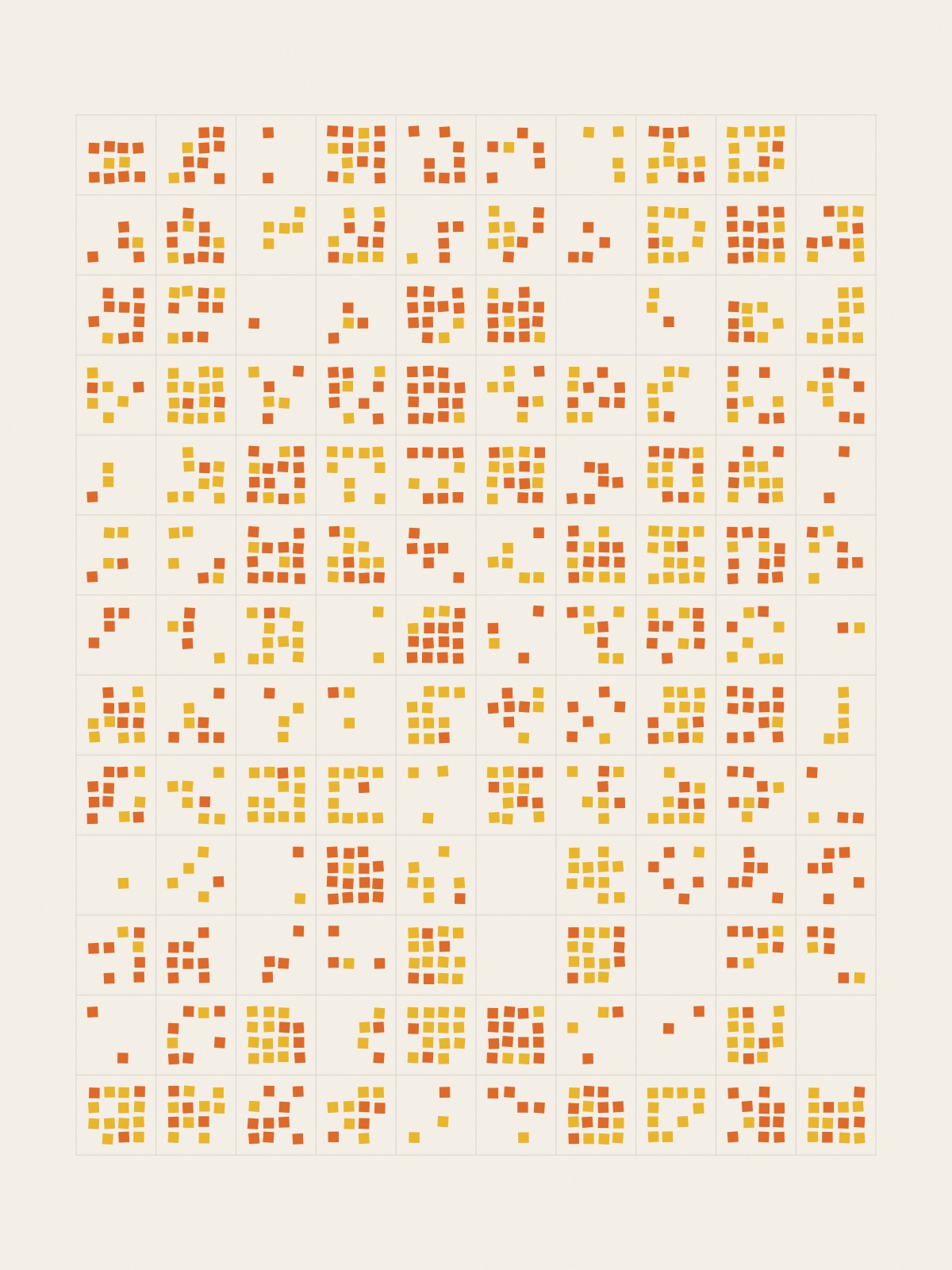
Lars-Gunnar Bodin (1935–2021) was a Swedish composer and intermedia artist, and one of the first artists in Sweden to plan a picture with a computer. He was born in Stockholm and died in Gnesta.1 He called himself a komponist, not a tonsättare: someone who composes in any material, sound, text or picture, by placing things according to rules.2
Before the computer
Bodin started going to concerts at Fylkingen, the Stockholm society for new music, in 1954, and studied composition privately until 1960.2 His debut exhibition, at Sturegalleriet in Stockholm in December 1960, showed "serial structures in picture and music"; in 1962 he showed "stochastic structures" at Galleri Petra.3 Serial music works with fixed series and rules for changing them; stochastic methods add chance within set limits. Both were in his pictures before any computer was.
Lund, 1968: the computer decides where
The engineer Göran Sundqvist gave Bodin access to a computer. For En festival kring konst och teknologi (A festival around art and technology) in Lund in 1968, the programme lists Bodin's "serial and stochastic structures", made with Sundqvist.4
The picture was made of 120 or 130 small cells. He gave rules for each kind of cell and said how many elements of each colour, yellow or orange, there should be. The computer placed them and returned a printout of letters and coordinates. Bodin then painted the picture by hand, cell by cell.2, 4 The large Lund picture was later destroyed by water in storage.2 The method, and a reconstruction by JAEV, are described in Computer Art in Sweden.
Computer time was the obstacle. Bodin remembers that renting it would have cost about 1,200 kronor an hour; Sundqvist did the work on the side, at night.2
Sound, text and the studio
With the poet Bengt Emil Johnson, Bodin coined the Swedish term text-ljud-komposition (text-sound composition), and from 1967 the two ran festivals of it in Stockholm.1, 5 He chaired Fylkingen from 1969 to 1972.1 His largest work, Clouds (1976), used five film projectors, ten slide projectors, three dancers, three singers and eight-channel sound; its prologue, about ten minutes long, is made with frequency-modulated digital sound, which he produced at Dartmouth College because no Swedish computer available to him could do it.2 He ran the Elektronmusikstudion (EMS) in Stockholm, first unofficially from 1977 and as director from 1979.2, 5
Plotter pictures, 1979
At the end of the 1970s Bodin and Sundqvist made pictures on a plotter that held one technical pen at a time, so they could choose the colour of each line. They were shown in L'Artiste et l'Ordinateur, curated by Torsten Ridell, which opened in Paris and toured; silkscreen versions were issued in two boxes. According to Bodin, he and Sundqvist were the only Swedes in it.2 His CV lists the tour as Paris, Caen, Lille and Seclin in 1979, Lund and Norrköping in 1980, and Wege der Computerkunst in Kiel in 1981. It also states that Moderna Museet holds two of his works.3
Lund comes back in Olof Broström's Automatic Colour Cubes at JAEV, which starts from another computer picture made there in the 1970s, told in The colour cubes.
Sources
- “Lars-Gunnar Bodin”. Wikipedia (Swedish)
Born 15 July 1935 in Stockholm, died 10 May 2021 in Gnesta; coined “text-ljud-komposition” with Bengt Emil Johnson; chairman of Fylkingen 1969–1972. - Lars-Gunnar Bodin, interviewed by Anna Orrghen, 5 September 2007. Från matematikmaskin till IT, Tekniska museet, Stockholm
Original wording: “Man tänkte som en dator alltså.” — “…annars skulle vi få betala, ja 1 200 kronor i timmen och så där.” — “Jag gav ett antal regler för hur de här skulle vara och det görs i små, små, vad skall man säga, delbilder, som sedan kopplades ihop till en större bild.” - Lars-Gunnar Bodin, Curriculum Vitae – bild, 2009
Debut “Moment 2”, Sturegalleriet, December 1960, serial structures in picture and music; 1962 Galleri Petra, stochastic structures; 1968 Lund, computer-generated picture; 1979 L’artiste et l’ordinateur, Paris, Caen, Lille, Seclin; 1980 Lund, Norrköping; 1981 Wege der Computerkunst, Kiel; two works in Moderna Museet. - Göran Sundqvist, interviewed by Anna Orrghen, 31 August 2007. Från matematikmaskin till IT, Tekniska museet, Stockholm
On the 1968 Lund programme: Bodin's “serial and stochastic structures”, made with Sundqvist, printed on the line printer and copied by hand. - “Lars-Gunnar Bodin”. Wikipedia (English)
Director of EMS from 1979; with Bengt Emil Johnson directed the Stockholm festivals of text-sound composition from 1967.
- Published
- JAEV Notes, October 2026.
- Use
- Text CC BY 4.0. Free to use and quote with credit to JAEV and a link to this page. Images and quotations by others keep their own terms.
All texts as one file: archive.json - Cite
- JAEV Notes, “Lars-Gunnar Bodin (1935–2021)”, jaev.gallery/notes/lars-gunnar-bodin/, 2026.
- Corrections
- Additions and corrections are welcome: info@jaev.gallery
- Share
A link from your own site, course page or reading list helps others find it.- Follow
- New notes by RSS · Instagram · Bluesky
JAEV is a daemon taking shape: machines, weights, room, brain.