EMS, Elektronmusikstudion (Stockholm, 1964)
JAEV Notes · October 2026 · 3 min read
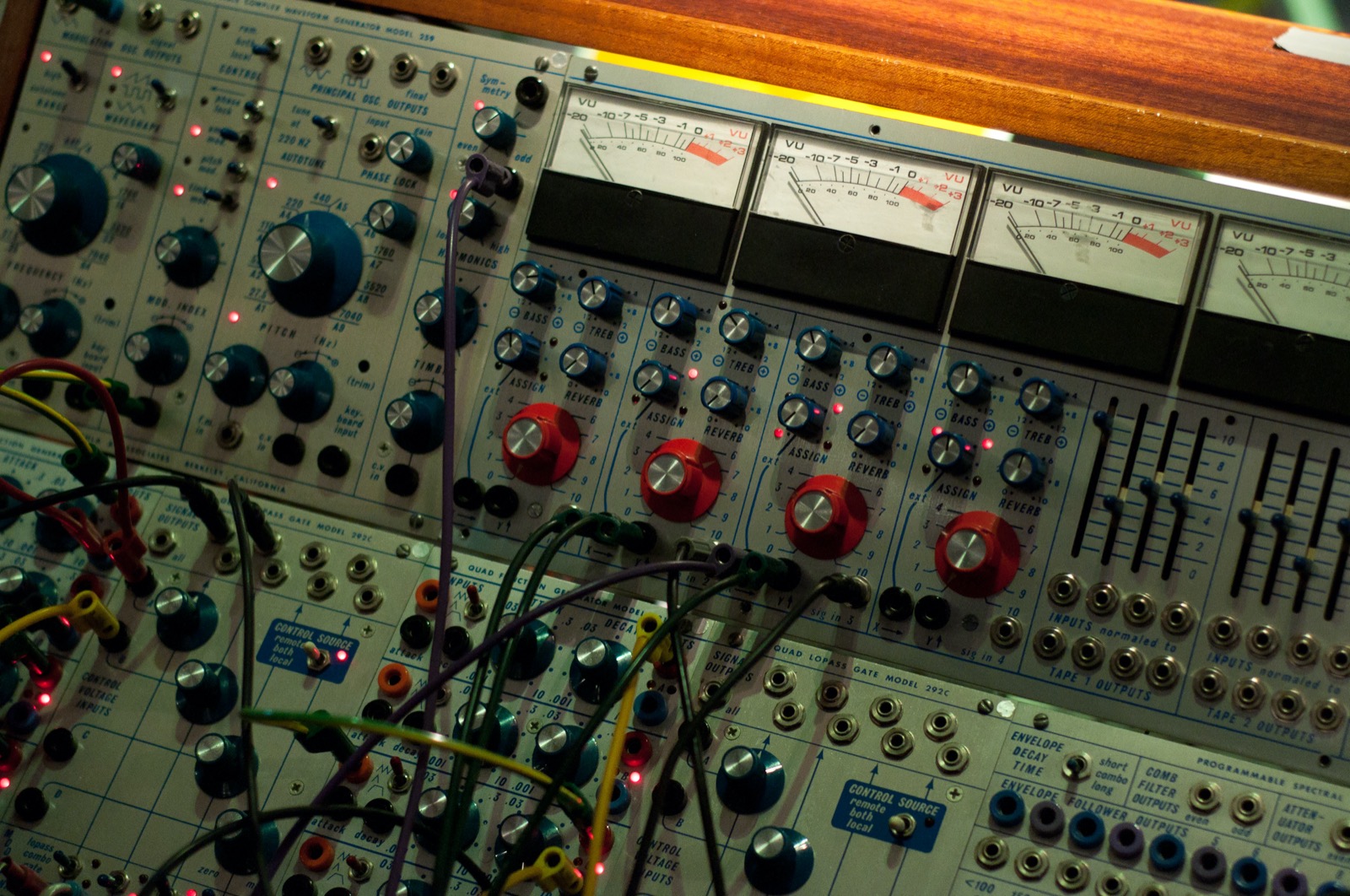
EMS (Elektronmusikstudion, the Electronic Music Studio) is Sweden's centre for electroacoustic music and sound art, in Stockholm. It was set up at the national broadcaster Sveriges Radio in 1964, pushed by the radio's head of music, the composer Karl-Birger Blomdahl, and its first director was Knut Wiggen.1, 2
A tape studio first
Wiggen, who also chaired the music society Fylkingen, had built a small studio at the Workers' Educational Association (ABF) in 1961. EMS opened with a conventional studio for composing on analogue tape, a workspace while the real project was built.3 It was in Sveriges Radio's old radio-theatre rooms on Kungsgatan, and the tape studio was called Klangverkstaden, "the sound workshop".4
The hybrid studio
The real project was a studio of analogue sound equipment under the control of a computer. Most of it was ready in 1966. The composer played it from a control console about nine metres long, on which every parameter of the equipment was laid out, and switched values on and off by touching the surface with a copper brush.3, 5 EMS tested a computer at Stockholm University in 1968 and then bought its own, a PDP-15; it arrived in 1970.3, 1
The computer was too slow to calculate control signals while the music played, so they were stored on digital magnetic tape and played back from it. Composers typed their pieces on teleprinters that punched paper tape, in the language EMS-1, written by a team at Uppsala University and finished in spring 1972. James Beauchamp's comparison of synthesis systems in 1973 called EMS "probably the most powerful system in the world to be placed for the exclusive use of composers on a 24 hour basis".3 Jan W. Morthenson found it "very cumbersome for making a single sound", because it was a hybrid studio.6
Composers against the plan
Composers meanwhile made pieces with what there was. Morthenson brought the sounds for Neutron Star (1967), computed on a power company's Datasaab D21, to EMS and made the piece there.6, 5 According to Lars-Gunnar Bodin, Wiggen told some of them to stop composing until his system was ready.4 By the early 1970s EMS had lost its place as Sveriges Radio's major development project. A new board, with several composers on it, wanted less research and more help with composers' immediate needs, and the text-sound composers wanted the money to go to the tape studio. Wiggen resigned in 1975.3
After Wiggen
Bodin tells what followed. A state inquiry of 1977 proposed closing EMS and moving its equipment, the computer included, to the Royal College of Music. Bodin ran the studio unofficially from 1977 and applied for the post in 1979, when the ministry let EMS go on.4 EMS left Kungsgatan in 1985, by Bodin's account, for purpose-built rooms on Söder Mälarstrand.4, 7 It is there today, at number 61, as part of the state agency Statens musikverk. Its seven studios are open around the clock all year, to several hundred Swedish and visiting composers and sound artists a year.2
How the computers Swedish composers used in the 1960s were borrowed, mostly from industry, is told in Datasaab and Swedish computer art and Computer Art in Sweden.
Sources
- Jøran Rudi, “Elektronmusikstudion”. Store norske leksikon
In Norwegian. “EMS ble opprettet hos Sveriges Radio i 1964, etter påtrykk av musikksjef Karl-Birger Blomdahl.” Studio director Knut Wiggen; the PDP-15 installed in 1970. - Om Elektronmusikstudion EMS; Hitta hit; Utrustning i våra studior. Elektronmusikstudion EMS, Stockholm
“Sedan 1964 …”; several hundred composers and sound artists a year; studios open “dygnet runt, året om”; Söder Mälarstrand 61; seven studios, among them Buchla 200 and Serge modular systems; part of Statens musikverk. - Jøran Rudi, “Unpacking the Musical and Technical Innovation of Knut Wiggen”. Organised Sound 23 (2), 2018, pp. 195–207
First studio at ABF in 1961; EMS opened in 1964 “only with a conventional studio for analogue tape composition”; most sound apparatus finished in 1966; tests in 1968 with a computer at the University of Stockholm; PDP 15/40 arrived 1970; EMS-1 by Klaus Appel's team in Uppsala, finished spring 1972; 24 oscillators, a noise generator, four reverbs, two third-octave filter banks, three ring modulators, two envelope generators; console about 9 metres long, operated with a copper brush; Beauchamp (1973): “probably the most powerful system in the world to be placed for the exclusive use of composers on a 24 hour basis”; Wiggen resigned in 1975. - Lars-Gunnar Bodin, interviewed by Anna Orrghen, 5 September 2007. Från matematikmaskin till IT, Tekniska museet, Stockholm
In Swedish. The studio in the old Radioteatern rooms on Kungsgatan, “ända fram till -85 då vi flyttade från Kungsgatan”; the tape studio was called Klangverkstaden; Wiggen told composers to stop composing until his system was ready; Wiggen left in 1975; John Appleton from the USA was director for six months; the 1977 elektronmusikutredningen proposed closing EMS and moving the equipment, “inklusive datorn”, to Musikhögskolan; Bodin “inofficiellt som chef under två år”, “sökte jobbet 1979 när vi hade fått klartecken från utbildningsdepartementet”. - Göran Sundqvist, interviewed by Anna Orrghen, 31 August 2007. Från matematikmaskin till IT, Tekniska museet, Stockholm
“Man körde med en pensel med koppartrådar …”; Morthenson took the Neutron Star material “till EMS för att bearbeta”. - Jan W Morthenson, interviewed by Anna Orrghen, 17 August 2007. Från matematikmaskin till IT, Tekniska museet, Stockholm
“Det var väldigt omständligt för att göra en enda klang. Och det hade att göra med att det var en hybridstudio …” On Neutron Star: “Datasaabs stora D21 dator som tillhörde Skandinaviska Elverk”. - Elektronmusikstudion – konst, teknik och politik. Scenkonstmuseet, Stockholm
The move in the 1980s to purpose-built premises on Söder Mälarstrand; EMS's first computer among the objects shown.
- Published
- JAEV Notes, October 2026.
- Use
- Text CC BY 4.0. Free to use and quote with credit to JAEV and a link to this page. Images and quotations by others keep their own terms.
All texts as one file: archive.json - Cite
- JAEV Notes, “EMS, Elektronmusikstudion (Stockholm, 1964)”, jaev.gallery/notes/ems-elektronmusikstudion/, 2026.
- Corrections
- Additions and corrections are welcome: info@jaev.gallery
- Share
A link from your own site, course page or reading list helps others find it.- Follow
- New notes by RSS · Instagram · Bluesky
JAEV is a daemon taking shape: machines, weights, room, brain.