The IBM 1130 and Swedish computer art
JAEV Notes · October 2026 · 2 min read
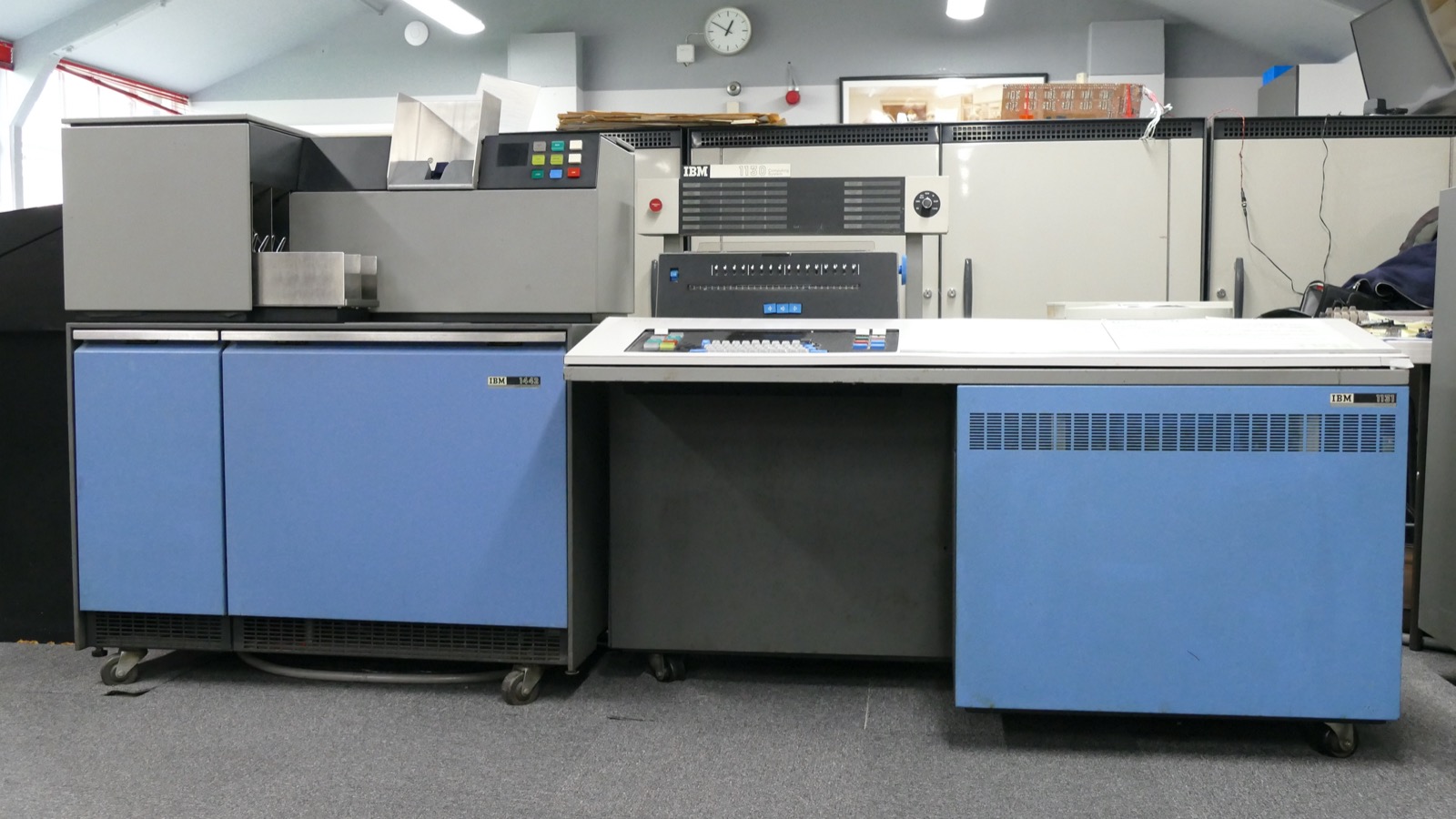
The IBM 1130 was a small scientific computer that IBM introduced in February 1965 for schools and engineering firms.1 In Sweden one spare 1130, with a drum plotter, became the machine on which the IBM programmer Sten Kallin made pictures with the textile designer Astrid Sampe and the artist Sture Johannesson in the late 1960s and early 1970s.2, 3
The machine
The 1130 was a 16-bit computer. A drum plotter, the IBM 1627, could be attached.1 The 1627 Model 1 was a CalComp 565 sold under IBM's name.4 For a programmer, Kallin explains, the pen could take one step in one of eight directions, along the axes or diagonally, "and nothing else".2
A computer in a cupboard
One of the 1130s at IBM's head office was left over and placed in the training department in Solna, where it stood in a small room driving the printers. In the daytime it was busy. In the evenings and at weekends Kallin could use it with a plotter he heard was "left over somewhere". He wrote practice programs for it in FORTRAN.2
Astrid Sampe. Asked for a picture for a Red Cross auction, Sampe called IBM and was put through to Kallin. He wrote a program that drew the cross many times, smaller and turned each time, with a menu where she typed the number of turns, the angle and the reduction. The pen sat loosely in its holder, so the diagonal lines came out slightly uneven, which Kallin liked. The weaving firm Almedahls printed the cross as curtain fabric;2 the Art Institute of Chicago credits Computer Colonne (1975) to "Astrid Sampe with computer programmer Sten Kallin and IBM Plotter 1627".5
Sture Johannesson. Johannesson had an "alphabet" of three signs, a keyhole, a heart and the two laid over each other, and asked IBM for help to vary it. With Kallin at the 1130 he made INTRA, curves repeated and shifted until moiré appeared; IBM printed some as Christmas greetings to its staff three years running.2, 3 Orrghen dates INTRA 1969–1974; the 2013 exhibition at Index in Stockholm dated their printouts 1970–1975, made on a CalComp drum plotter with a 30 cm paper roll, fed by punched cards into an 1130 without a screen.3, 6
Other machines Swedish artists borrowed
The 1130 was one borrowed machine among several. Göran Sundqvist programmed Jan W. Morthenson's Neutron Star (1967) on a SAAB D21 belonging to the power company Skandinaviska Elverk.3 Beck & Jung worked with IBM in Malmö and got their image alphabet out on a line printer.7 At Lund University the colour plotter was fed by the computing centre's UNIVAC 1108.8 Machines of their own came later: Sture and Ann-Charlotte Johannesson got their first Apple in 1978–79, the start of Digitalteatern in Malmö.9 The full story is in Computer Art in Sweden, and the machines in Plotter Art, which ends with Olof Broström's Unverified Air, drawn for a pen plotter today.
Sources
- “IBM 1130”. Wikipedia
“February 11, 1965 – IBM introduces the 1130”; 16-bit; marketed to “education and engineering”; about $1,000 a month to rent; production estimated at 10,000; IBM 1627 Calcomp plotter optional. - Sten Kallin, interviewed by Anna Orrghen, 10 September 2007. Från matematikmaskin till IT, Tekniska museet, Stockholm
In Swedish. APL on the 1130; the spare 1130 in Solna driving printers in “en skrubb”; evenings and weekends; “en överbliven plotter någonstans, en trumplotter”; eight directions; FORTRAN; Sampe's Red Cross and menu; Almedahls; Johannesson's keyhole, heart and crown; IBM's Christmas prints three years running; INTRA. - Anna Orrghen, Från matematikmaskin till IT. Fokusgrupp: Media. Slutrapport. Tekniska museet, Stockholm, 2008
Kallin at Swedish IBM 1963–1991; “INTRA (1969–1974): Ett mångårigt experimenterande med olika former tillverkade med en IBM 1130 och en penplotter.” Neutron Star (1967) on a SAAB D21 from Skandinaviska Elverk, programmed by Göran Sundqvist. - “Bresenham line drawing and the IBM 1627”. IBM 1401 restoration project
“IBM 1627 Model 1 — Calcomp 565”; “Plotting area: 11 inches by 120 feet”; “1/100 inch incremental-step size, up to 18,000 steps/minute”. - Astrid Sampe with computer programmer Sten Kallin and IBM Plotter 1627, Computer Colonne, 1975. The Art Institute of Chicago, gift of Astrid Sampe
- “Sture Johannesson: In Memery”, 16 March–25 May 2013. Index – The Swedish Contemporary Art Foundation, Stockholm
“early graphic printouts realized between 1970 and 1975” with Sten Kallin; “All works were produced by cards fed into a screen-less 1130 IBM machine”, “on a CalComp drum plotter 30cm-wide paper roll”; Leaves (1971), Computer Paragraph (1971), Yin-Yang (1975). - Elisabeth Fagerstedt, “Beck & Jung: datakonstens pionjärer”, Uppsala konstmuseum 2009, published 2012
“De samarbetade med IBM i Malmö för att överföra bildalfabetet i digital form”, printed “med en enkel radskrivare”. - Mikael Jern, interviewed by Anna Orrghen, 4 October 2007. Från matematikmaskin till IT, Tekniska museet, Stockholm
“På datacentralen hade vi då en UNIVAC 1108 som vi körde på.” - Sture Johannesson and Ann-Charlotte Johannesson, interviewed by Anna Orrghen, 2 October 2007. Från matematikmaskin till IT, Tekniska museet, Stockholm
Digitalteatern on Apple computers; a Servogor plotter.
- Published
- JAEV Notes, October 2026.
- Use
- Text CC BY 4.0. Free to use and quote with credit to JAEV and a link to this page. Images and quotations by others keep their own terms.
All texts as one file: archive.json - Cite
- JAEV Notes, “The IBM 1130 and Swedish computer art”, jaev.gallery/notes/ibm-1130-swedish-computer-art/, 2026.
- Corrections
- Additions and corrections are welcome: info@jaev.gallery
- Share
A link from your own site, course page or reading list helps others find it.- Follow
- New notes by RSS · Instagram · Bluesky
JAEV is a daemon taking shape: machines, weights, room, brain.