MusicBox (Knut Wiggen, EMS Stockholm, 1971–75)
JAEV Notes · October 2026 · 3 min read
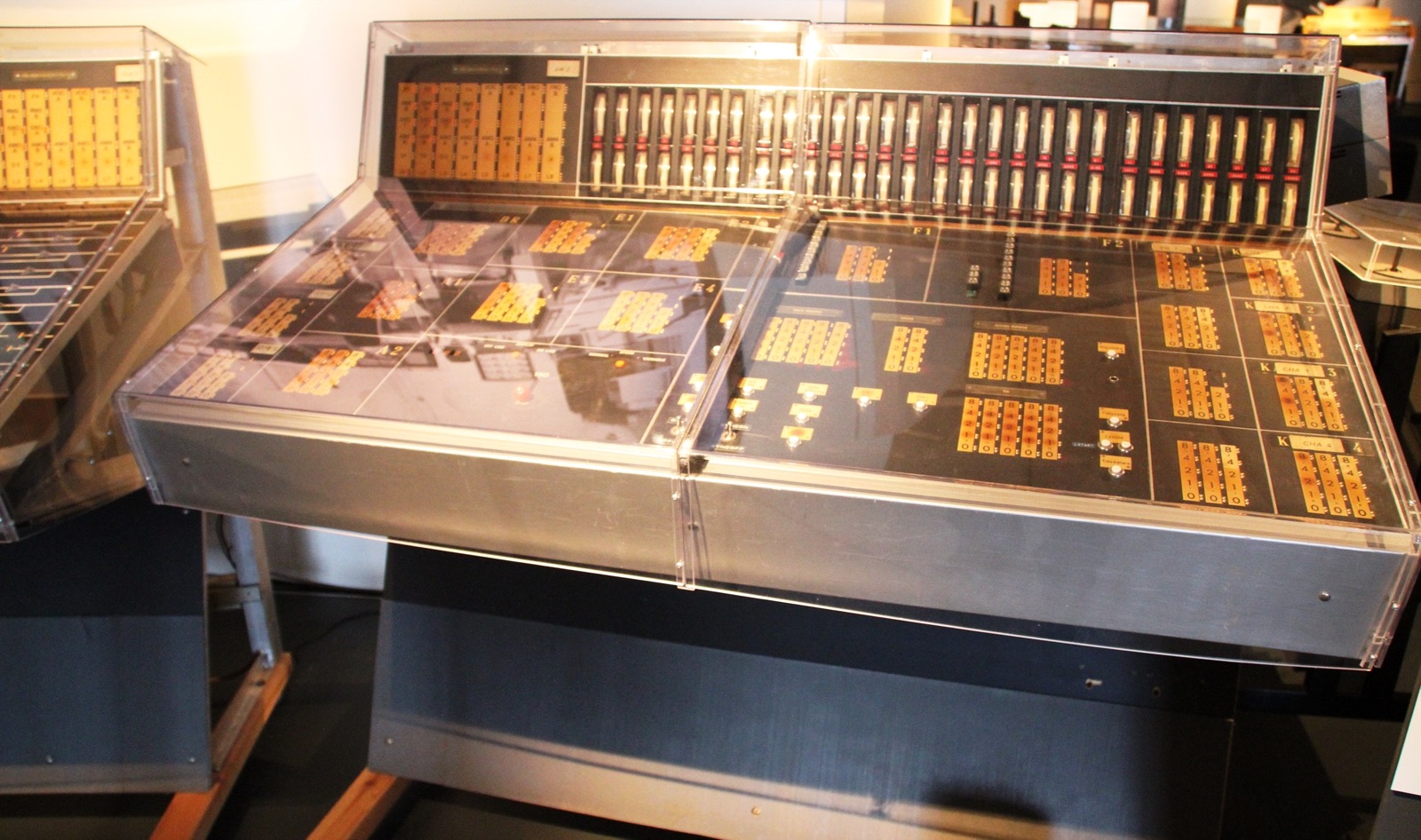
MusicBox was a composition program written for the Elektronmusikstudion (EMS) in Stockholm under its director, the Norwegian-born composer Knut Wiggen. The first version was finished in 1971. In MusicBox a piece of music was not a list of notes but a network of boxes, each holding a mathematical function, that passed numbers on to each other.1
The studio
Wiggen (1927–2016) led the Stockholm concert society Fylkingen from 1959 and built up EMS from 1964.2 EMS was a hybrid studio: analogue oscillators, filters and reverbs controlled by a computer, a PDP-15 bought in 1970.1, 3, 4
Composing meant typing numbers. With the studio's language EMS-1, each event was described line by line, on a teleprinter that punched paper tape.1 The composer Lars-Gunnar Bodin remembers another program on the same machine where one forgotten semicolon spoiled a whole session.5 Jan W Morthenson called the work "very cumbersome for making a single sound".3
How MusicBox worked
As Rudi points out, typing numbers for pitch and duration is not much different from writing notes. Wiggen wanted the composer to work with rules and structure instead. In MusicBox each box took a number in, applied its function and sent the result to the next box. Small boxes could be wrapped into larger ones and reused, so that complex events came out without any pitch being written down. MusicBox was written in Fortran. The programmer David Fahrland wrote the first version; Kaj Beskow added sound moving between four loudspeakers, and Zaid Holmin better macros.1
Rudi describes the score of Sommarmorgon (1972), the first study. A Gauss box sends out an irregular stream of numbers between 35 and 14,000, bell-shaped, so that low numbers are rare. If boxes sort the stream into three ranges: below 200, 200 to 1,600, and 1,600 to 14,000. In each range Choice boxes pick a duration and a waveform from fixed lists by weighted chance, and the number itself becomes the frequency. The rare low numbers get the long durations, so in the piece a dark tone is also a long tone. Half of them have a waveform other than a sine; the high range plays only short sine tones. Two realisations exist, made with different random seeds: different, and recognisably the same piece.1
Five studies, then nothing
Wiggen made five studies with MusicBox: Sommarmorgon, Etyd and Resa (1972), Massa (1974) and EMS för sig själv (1975).1 They were composed for four channels.4 Resa was played at MIT in 1976, at the first international conference on computer music.1
The program was never given to other composers. A new board wanted EMS to serve composers' immediate needs, and Wiggen resigned in 1975.1, 2 He took the code with him, partly because EMS did not want it and partly so that it would not be used for "elevator music".1 Rudi compares the idea to Max and Pd, where music is also made by connecting boxes.1 The five pieces were issued on an LP in 2018, in new stereo mixes.4
In JAEV's exhibition Content, numbers from a hash of the day's text choose among fixed options in a similar way; see SHA-256 as a random source.
Sources
- Jøran Rudi, “Unpacking the Musical and Technical Innovation of Knut Wiggen”. Organised Sound 23 (2), 2018, pp. 195–207
DOI 10.1017/S1355771818000079. “A composition in MusicBox was a network of interconnected boxes that described the control signals for the electronic equipment at EMS. Each box contained a mathematical function that would operate on the input and provide output, whereby the output message would be the input for the next box in the network flow.” - Jøran Rudi, “Knut Wiggen”. Store norske leksikon
In Norwegian. Born 13 June 1927 in Buvika, died 10 September 2016 in Fredrikstad; led Fylkingen from 1959; began building EMS in 1964; left in 1975. - Jan W Morthenson, interviewed by Anna Orrghen, 17 August 2007. Från matematikmaskin till IT, Tekniska museet, Stockholm
Original wording: “1970 köptes en Digital PDP-15 och byttes 1980 mot en Digital VAX.” — “…man var tvungen på den här tiden att bygga särskilda programmeringsspråk, till exempel IMPAC och MUSICBOX.” — “Det var väldigt omständligt för att göra en enda klang.” - Knut Wiggen, Electronic Works 1972–1975. LP, O. Gudmundsen Minde (OGM005), 2018, sleeve notes by Jøran Rudi
The pieces were composed for quadraphonic playback; the LP has new stereo mixes. Listen: https://ogudmundsenminde.bandcamp.com/album/electronic-works-1972-1975 - Lars-Gunnar Bodin, interviewed by Anna Orrghen, 5 September 2007. Från matematikmaskin till IT, Tekniska museet, Stockholm
On the PDP-15 at EMS; a composition program brought from Yale by Wayne Flawson (name as transcribed): parameters typed on a teleprinter onto punched tape; “glömde man ett semikolon, ja då var hela sessionen felaktig”.
- Published
- JAEV Notes, October 2026.
- Use
- Text CC BY 4.0. Free to use and quote with credit to JAEV and a link to this page. Images and quotations by others keep their own terms.
All texts as one file: archive.json - Cite
- JAEV Notes, “MusicBox (Knut Wiggen, EMS Stockholm, 1971–75)”, jaev.gallery/notes/knut-wiggen-musicbox/, 2026.
- Corrections
- Additions and corrections are welcome: info@jaev.gallery
- Share
A link from your own site, course page or reading list helps others find it.- Follow
- New notes by RSS · Instagram · Bluesky
JAEV is a daemon taking shape: machines, weights, room, brain.