The Hertz ink-jet colour plotter (Lund, 1970s)
JAEV Notes · October 2026 · 3 min read
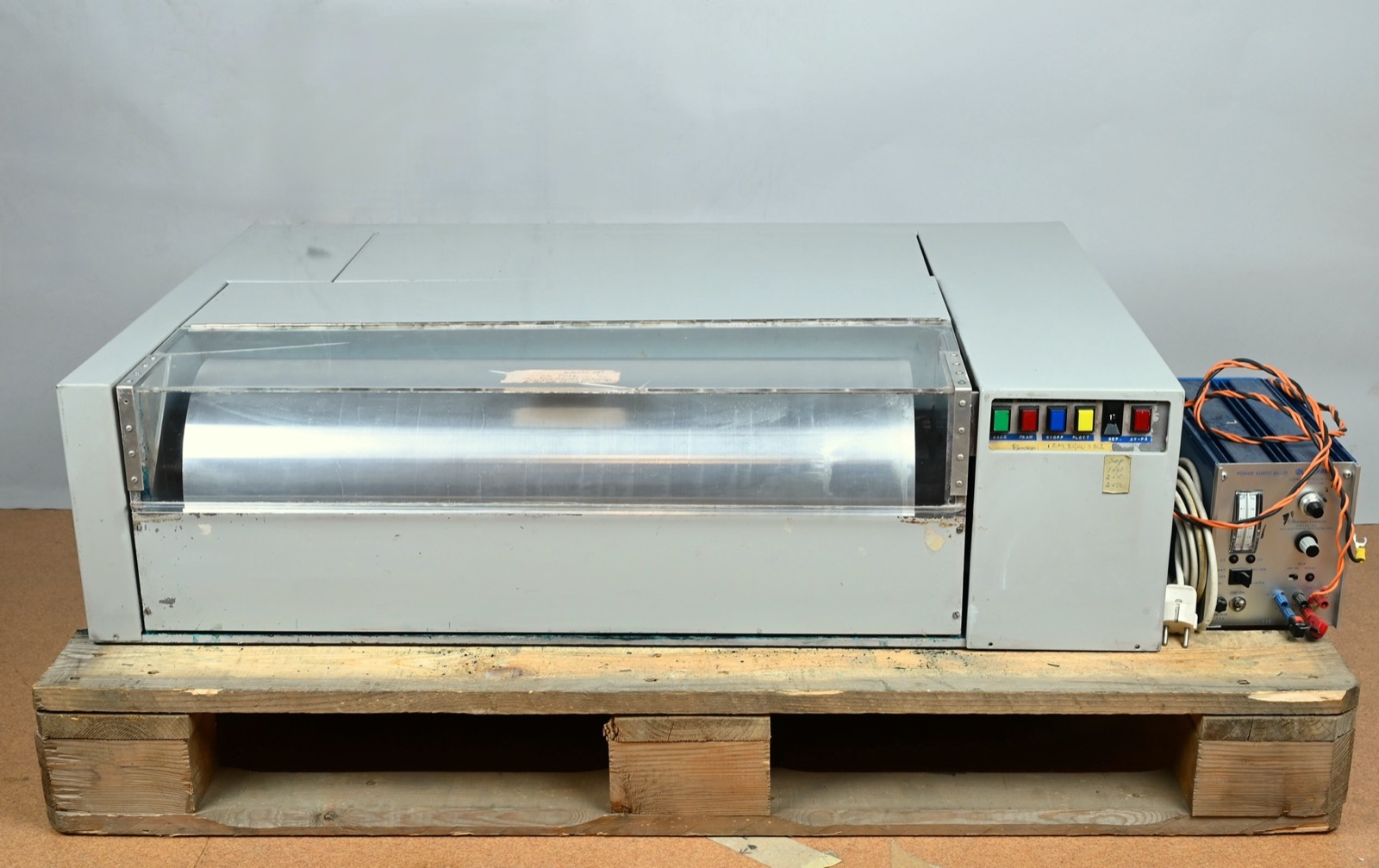
The Hertz colour plotter was an ink-jet printer for computer images, built at Lund University by the physicist Hellmuth Hertz and his laboratory in the early 1970s. It printed pictures as dots of three inks on paper wrapped round a drum, and its programmer counts it among the first colour plotters in the world.1, 2
Who built it
Hellmuth Hertz (1920–1990) became professor of electrical measurement technology at Lund in 1963. He is also known for the first echocardiographs, made with the physician Inge Edler.3 According to Tekniska museet, he patented the ink-jet principle in 1965, and the patent was assigned to an American consulting firm that sold licences to printer makers.4 The plotter itself was run by his technician Boris Smeds.2
How it works
A nozzle shoots a continuous stream of ink droplets, in the programmer Mikael Jern's description about a million a second. An electric signal either lets the stream go straight on to the paper or stops it. Switching the stream on and off places dots. The plotter had three nozzles, for cyan, yellow and magenta; where all three fall on the same spot, the dot is black. The paper was fixed to a rotating drum, and the picture was printed line by line, like a scanner.2
The plotter was not connected to a computer. A picture was calculated on the computing centre's UNIVAC 1108, written to magnetic tape, and the tape was carried to the plotter in the building next door. For an A4 sheet the computer had to hold about 2,000 × 1,200 dots for each of the three colours, on machines with 64–128 KB of memory, so much of the software dealt with keeping only part of the picture in memory at a time.2 That software is described in the note on COLOR.
The sources differ on dates and resolution
Larsson and Stenlund's history of Swedish computer graphics says a working prototype was ready by 1970 and gives a resolution of 125 dots per inch.1 Jern, interviewed in 2007, places the plotter in 1973 and says they worked at 150 dots per inch.2
What came of it
Hertz went on to build two more A4 plotters and, from 1974, a first A1 plotter. Users abroad posted their tapes to Lund, by Jern's count twenty to forty a day. Contracts with Applicon, a CAD company in the Boston area, were signed in 1976, and the first plotters were sold around 1977 for about 100,000 dollars; Larsson and Stenlund give 1977 for the sale.2, 1 At SIGGRAPH 1979 Applicon showed its Color Plotter: an off-line ink-jet plotter with a tape unit, printing up to 22 × 34 inches at 125 points per inch.5 In 1984 two former Applicon employees who had worked with Hertz founded Iris Graphics, whose ink-jet printers were later used for fine-art prints.6
The plotter's best-known images are colour cubes, which the artists Beck & Jung turned into prints; the story is told in The colour cubes. Olof Broström's Automatic Colour Cubes at JAEV takes up those cubes again.
Where to see one
Tekniska museet in Stockholm holds a prototype ink-jet printer with three jets, made at Lund University in 1976 and used by the Geological Survey of Sweden in Uppsala until 1992.4
Sources
- Thomas Larsson and Ulf Stenlund, “Vignettes of Sweden's Computer Graphics History”. IEEE Annals of the History of Computing, 2008
“professor Helmut Hertz developed a color graphics printer, achieving a working prototype by 1970”; “color raster graphics at a 125-dpi resolution”; “Hertz and Jern sold both the color printer and the software to the US company Applicon in 1977.” - Mikael Jern, interviewed by Anna Orrghen, 4 October 2007. Från matematikmaskin till IT, Tekniska museet, Stockholm
In Swedish. A million droplets a second; the copying machine with two drums; 1973; 150 dots per inch, about 2,000 × 1,200 dots × three colours on A4; 64–128 KB of memory; UNIVAC 1108 and magnetic tape; Boris Smeds; Facit; Applicon contracts 1976, first sales about 1977 at about $100,000. Abstract: “During 1970-1976 Jern worked with professor Hellmuth Hertz”. - “Carl Hellmuth Hertz”. Wikipedia
Born 15 October 1920 in Berlin, died 29 April 1990 in Lund; professor of electrical measurement technology in Lund from 1963; the first echocardiographs with Inge Edler. - “Bläckstråleskrivare, prototyp” (TEKS0043360). Tekniska museet, Stockholm, via DigitaltMuseum
Three ink jets; principle by Hertz at the Department of Electrical Measurement, patented 1965, patent assigned to an American consulting firm that sold licences; made by Lund University 1976; used by SGU, Uppsala, 1976–1992. - “Applicon, Inc.”, exhibitor, SIGGRAPH 1979. ACM SIGGRAPH History Archives
“The Applicon Color Plotter is a unique system for making full color plots from digital data.” Off-line ink-jet plotter with magnetic tape unit, FORTRAN subroutines, up to 22 × 34 inches, 125 points per inch. - “Iris printer”. Wikipedia
Founded in 1984 by two former Applicon employees “who had worked with Professor Helmuth Hertz of Lund University in Sweden, from whom Applicon had licensed the continuous-flow inkjet technology”.
- Published
- JAEV Notes, October 2026.
- Use
- Text CC BY 4.0. Free to use and quote with credit to JAEV and a link to this page. Images and quotations by others keep their own terms.
All texts as one file: archive.json - Cite
- JAEV Notes, “The Hertz ink-jet colour plotter (Lund, 1970s)”, jaev.gallery/notes/hertz-ink-jet-colour-plotter/, 2026.
- Corrections
- Additions and corrections are welcome: info@jaev.gallery
- Share
A link from your own site, course page or reading list helps others find it.- Follow
- New notes by RSS · Instagram · Bluesky
JAEV is a daemon taking shape: machines, weights, room, brain.