Tendencies 4: Computers and Visual Research (Zagreb, 1968–69)
JAEV Notes · October 2026 · 3 min read
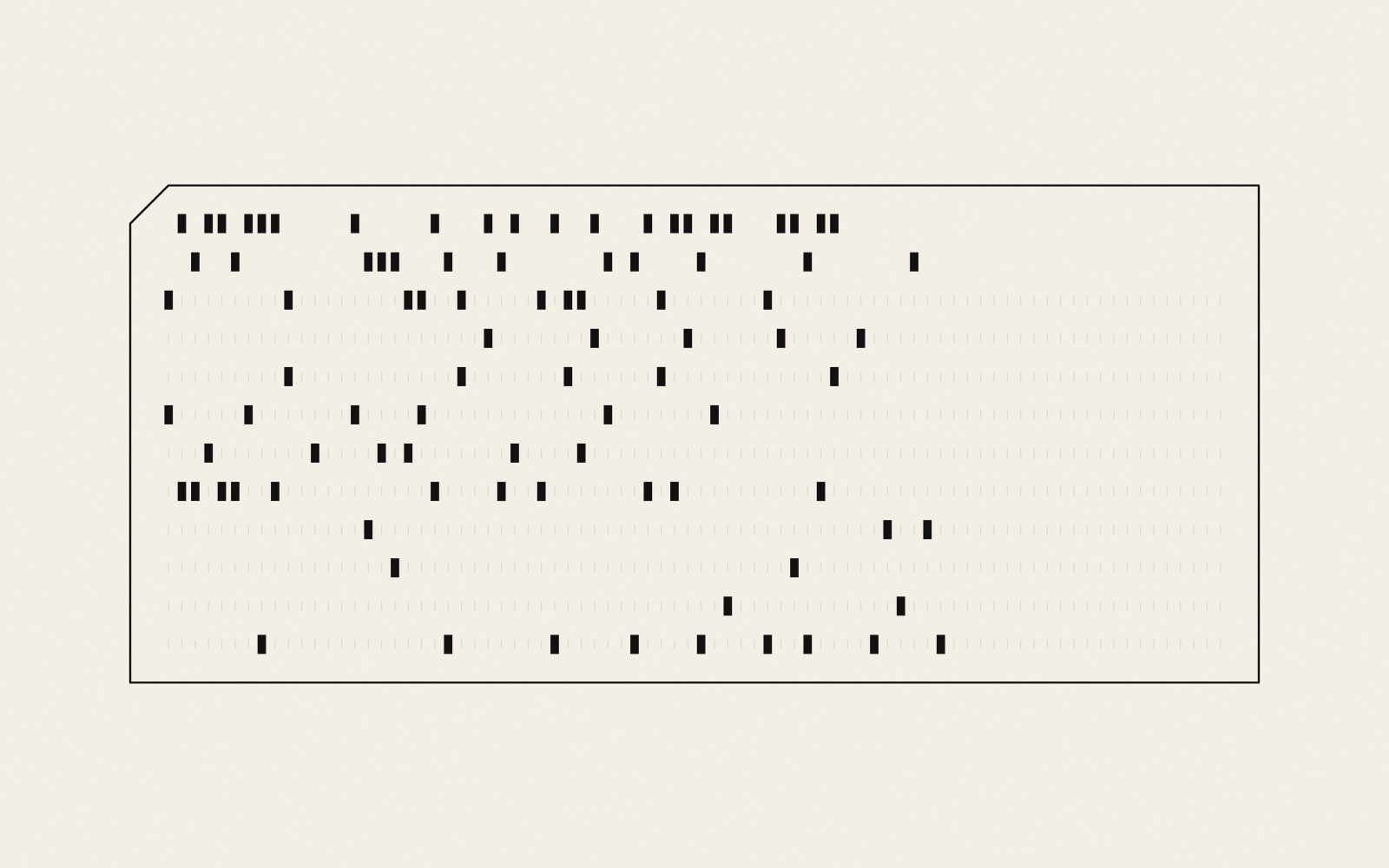
Within the framework of Tendencies 4 (Tendencije 4), a series of exhibitions and symposia entitled Computers and Visual Research took place in Zagreb in 1968 and 1969. It brought computer art into the New Tendencies movement. Its histories set it beside London's Cybernetic Serendipity, which opened one day before the Zagreb colloquy in August 1968.1, 2, 3
New Tendencies
New Tendencies began in 1961 in Zagreb, with an exhibition of concrete and constructive art organised by the city's Gallery of Contemporary Art, now the Museum of Contemporary Art. The artists called their work visual research: experiments with perception, light and movement, meant as research rather than as goods for the art market.1, 2 By the mid-1960s Op art had absorbed much of it. The movement was in crisis in 1967, so the organisers postponed that year's exhibition by a year and dropped "New" from its name.2, 3
The colloquy, August 1968
The new direction was the computer. On 3 and 4 August 1968 Zagreb held an international colloquy, Computers and Visual Research. It opened one day after Cybernetic Serendipity opened at the Institute of Contemporary Arts in London.3, 4, 5 The critic Boris Kelemen had put "visual research" into the title, and the organising committee included Frieder Nake in Stuttgart, Leslie Mezei in Canada and Abraham Moles in France. Speakers ranged from artists to engineers from Zagreb's research institutes. According to Christoph Klütsch's account of the papers, Nake said that Cybernetic Serendipity had mainly addressed the play instinct, and that Tendencies 4 might address social consciousness.4
Nake later put the difference this way: London was art as an event, Zagreb was art as research.3
bit international
In 1968 the gallery also started a journal, bit international, on information theory, exact aesthetics, design and media. Most of its first issue was taken up by Max Bense and Moles writing on information aesthetics, the theory that tried to measure art by order and complexity. Nine issues appeared; the sources disagree on whether the last came out in 1972 or 1973.1, 2, 4
The exhibition, 1969
The exhibition ran from 5 May to 30 August 1969.4, 5 According to Darko Fritz, it showed 189 computer-generated works by 33 artists or groups from 12 countries. A jury of Umberto Eco, Karl Gerstner, Vera Horvat-Pintarić, Kelemen and Martin Krampen gave prizes for computer and visual research to Vladimir Bonačić, Marc Adrian and the group Compos 68.2
Bonačić, a scientist at the Ruđer Bošković Institute in Zagreb, showed seventeen works. As part of the exhibition he also put a large computer-controlled light object on the façade of the NaMa department store on Kvaternik Square.2
Radoslav Putar, one of the curators of New Tendencies, summed up the change in the catalogue: the New Tendencies artists "have all dreamt of machines—and now the machines have arrived", but from an unexpected direction, "accompanied by people who were neither painters nor sculptors".2
Afterwards
The programme continued until 1973, when Tendencies 5 showed computer work beside the earlier visual research and conceptual art.1, 2 In 2007 the Neue Galerie Graz reconstructed the story in the exhibition bit international, curated by Darko Fritz in collaboration with the Museum of Contemporary Art in Zagreb; an expanded version was shown at the ZKM in Karlsruhe in 2008–09.1, 6 Nees's exhibition in Stuttgart, three years before Zagreb, is in Generative Computergrafik.
Sources
- “bit international. [Nove] tendencije. Computer und visuelle Forschung. Zagreb 1961–1973”. Exhibition page, ZKM Karlsruhe, 2008–09
New Tendencies began in 1961 in Zagreb with an exhibition of concrete and constructive art and called itself “visual research”; in summer 1968 the programme “Computer and Visual Research” started with Tendencije 4 and ran until 1973; bit international, nine issues. Curators Margit Rosen, Darko Fritz, Peter Weibel. - Darko Fritz, “Vladimir Bonačić: Computer-Generated Works Made within Zagreb’s New Tendencies Network (1961–1973)”. Leonardo 41, no. 2, 2008, pp. 175–183
Five New Tendencies exhibitions 1961–1973; “Tendencies dropped ‘New’ from its title”; Tendencies 4 “presented 189 computer-generated works in total by 33 artists or artist groups from 12 countries”; jury Umberto Eco, Karl Gerstner, Vera Horvat-Pintarić, Boris Kelemen, Martin Krampen; prizes to Bonačić, Marc Adrian and Compos 68; Putar's catalogue preface. - Frieder Nake, “The Semiotic Engine: Notes on the History of Algorithmic Images in Europe”. Art Journal, Spring 2009
Cybernetic Serendipity opened at the ICA, London, on 2 August 1968; Computers and Visual Research opened in Zagreb “with a symposium on August 3–4, 1968”; “art as an event” versus “art as research”; the 1967 show postponed by one year and renamed Tendencies. - Christoph Klütsch, “The Summer 1968 in London and Zagreb: Starting or End Point for Computer Art?”. Creativity & Cognition, 2005
Colloquy 3–4 August 1968; exhibition 5 May – 30 August 1969; Boris Kelemen brought “visual research” into the title; organising committee members Frieder Nake, Leslie Mezei, Abraham A. Moles; Nake's remark on Cybernetic Serendipity and social consciousness. - “Timeline: Events”. DAM Digital Art Museum, Berlin
3–4 August 1968, colloquy “Computers and Visual Research”, Zagreb; 5 May – 30 August 1969, exhibition “Computers and Visual Research”, Zagreb. - “bit international – [Nove] tendencije. Computer und visuelle Forschung. Zagreb 1961–1973”. Exhibition page, Neue Galerie Graz, Universalmuseum Joanneum, 2007
28 April – 26 August 2007 (extended from 17 June); curated by Darko Fritz; coordination Peter Peer; scholarly advice Margit Rosen and Peter Weibel; in collaboration with the Museum of Contemporary Art, Zagreb.
- Published
- JAEV Notes, October 2026.
- Use
- Text CC BY 4.0. Free to use and quote with credit to JAEV and a link to this page. Images and quotations by others keep their own terms.
All texts as one file: archive.json - Cite
- JAEV Notes, “Tendencies 4: Computers and Visual Research (Zagreb, 1968–69)”, jaev.gallery/notes/tendencies-4-zagreb/, 2026.
- Corrections
- Additions and corrections are welcome: info@jaev.gallery
- Share
A link from your own site, course page or reading list helps others find it.- Follow
- New notes by RSS · Instagram · Bluesky
JAEV is a daemon taking shape: machines, weights, room, brain.